



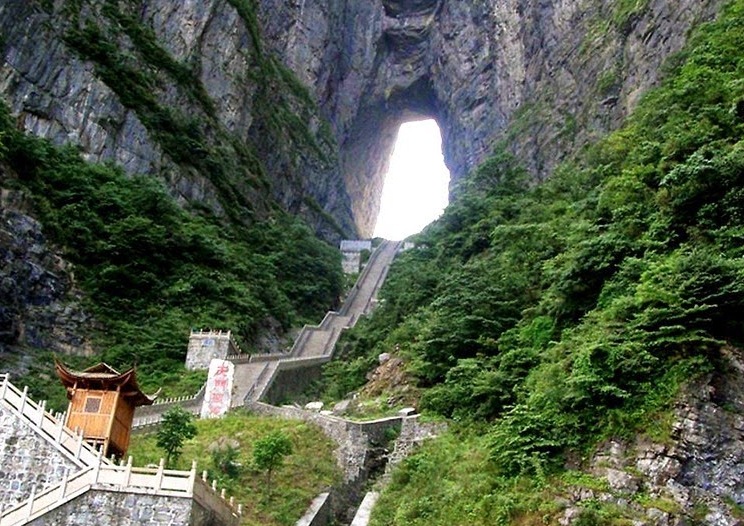
Rising majestically from the verdant landscapes of Zhangjiajie, Тяньмэнь Шань (Tianmen Mountain) is a place where the natural and the mystical converge. The mountain is not only renowned for its striking beauty but also for the лесвіца 999 (999 Steps) that leads visitors through an ethereal gateway known as the Брама ў рай (Heaven's Gate). This massive natural archway, carved by millennia of erosion, soars to an awe-inspiring height of 131.5 meters.

The history of Тяньмэнь Шань is steeped in legend and spirituality. As one of the sacred peaks in Chinese culture, it has been venerated for centuries. The mountain's spiritual significance is intertwined with ancient Daoist practices, with hermits and monks seeking enlightenment in its secluded caves and forests. The legend of Heaven's Gate dates back to 263 AD, when a natural cave collapse formed the archway that now draws pilgrims and tourists alike. This extraordinary event was seen as a divine omen, marking the mountain as a bridge between earth and sky.
Architecturally, Тяньмэнь Шань is a marvel. The 999 steps that lead to Heaven's Gate are meticulously carved into the mountain's limestone face, representing the number of steps to ascend to heaven in Chinese numerology. These steps are not merely functional but serve as a spiritual journey, challenging visitors to reflect on their own path. Beyond the staircase, the mountain hosts one of the world's longest cableways, stretching over 7,455 meters, offering panoramic vistas of the surrounding karst landscapes.

Culturally, the area around Тяньмэнь Шань is rich with traditions. The local Tujia and Miao ethnic groups add vibrant cultural tapestries to this breathtaking locale. The annual Tujia New Year Festival, celebrated with traditional dances and music, is a vivid display of the region's heritage. Visitors might also witness the mesmerizing art of Miao embroidery, with intricate patterns that tell stories passed down through generations.
No exploration of Тяньмэнь Шань would be complete without indulging in its local gastronomy. The cuisine here is a reflection of the mountain's bounty and the cultural melting pot of Zhangjiajie. Dishes like sour fish soup, a spicy and tangy delight, are staples, while the Miao people are known for their unique smoked bacon and spicy pickles. Local teas, often infused with regional herbs, provide a soothing end to a day of adventure.
For those seeking lesser-known curiosities, Тяньмэнь Шань does not disappoint. The mountain is home to the Guigu Plank Road, a sky-high walkway clinging to the cliff face that offers breathtaking views for the brave-hearted. Not far from the main tourist paths lies the Tianmen Cave, a quieter spot less frequented but equally impressive, offering a serene escape from the crowds. Notably, the mountain has also hosted daring events, such as wing suit flying competitions, cementing its status as a place of both natural and human wonder.
Visitors planning a trip to Тяньмэнь Шань should consider the best times to visit. Spring (April to May) and autumn (September to October) offer mild weather and clearer skies, ideal for exploring. Early morning visits can help avoid the crowds, especially on weekends and holidays. It's advisable to wear comfortable shoes for the climb and bring layers as the weather can change rapidly at higher altitudes.
In the end, Тяньмэнь Шань is more than just a mountain; it's a journey through history, culture, and the natural world. Whether you're ascending the 999 steps, savoring local delicacies, or simply absorbing the serene beauty, this place offers an experience that's as profound as it is unforgettable.
