
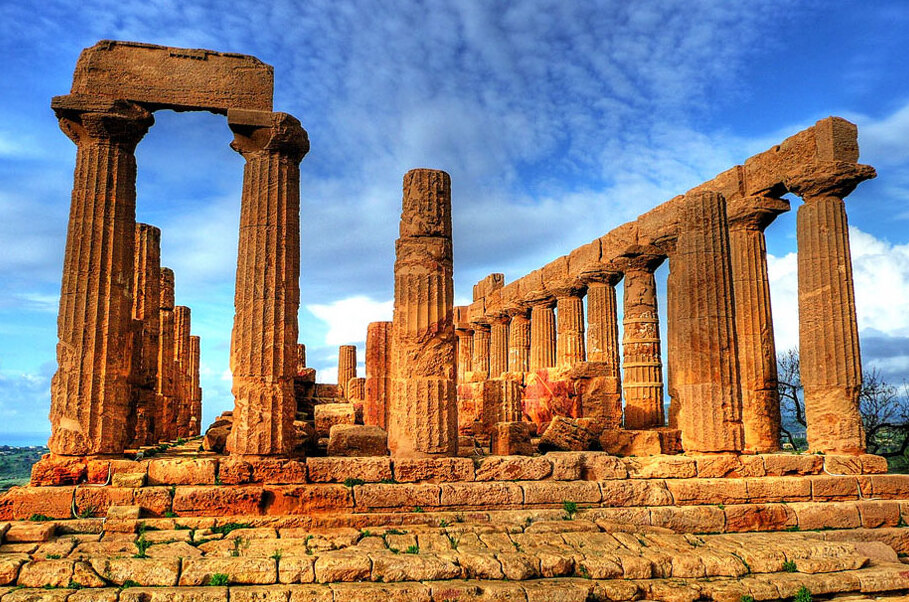

Perched majestically atop a hill in Agrigento, the Temple of Juno offers more than just a stunning view; it is a portal into the rich tapestry of ancient Sicilian history. Founded in 460 B.C., this temple honors Juno, the Roman equivalent of the Greek goddess Hera, who was revered as the protector of marriage and women. Its strategic location at the highest point of the Valley of the Temples signifies its importance in the ancient world, both spiritually and politically.
The temple's architectural style is a prime example of the Doric order, characterized by sturdy columns and minimal ornamentation. The Temple of Juno has a peripteral structure, featuring 13 columns in length and 6 columns in width, a design that embodies the austere beauty typical of ancient Greek temples. Although much of the temple has succumbed to the ravages of time, the remaining columns stand as a testament to the artistry and engineering prowess of the ancient Greeks. The temple once housed a statue of Juno, intricately crafted and revered, though it now exists only in historical accounts.
Rituals conducted at the Temple of Juno were deeply ingrained in local culture. Among the most fascinating was the ritual of the lamb, a ceremony tied to marriage. In this ritual, a lamb was bathed in cold water, and its reaction determined the fate of prospective marriages. If the lamb trembled, it was interpreted as an omen of matrimonial discord, leading to the cancellation of the union. This unique practice highlights the intertwining of religion, superstition, and daily life in ancient Agrigento.
Beyond the temple, the local culture thrives with traditions that echo its ancient past. Festivals celebrating the Goddess Hera are still observed, drawing on the rich heritage of reverence for femininity and family bonds. The Sagra del Mandorlo in Fiore, usually held in February, celebrates the blossoming of almond trees and features a blend of traditional music, dance, and *cucina siciliana*. This lively event reinforces the community's connection to its roots while showcasing the beauty of the island's springtime.
In terms of gastronomy, Agrigento is a veritable feast for the senses. The region is renowned for its cuscus, a dish of North African origin that has been adapted into Sicilian cuisine, often served with seafood or vegetables. Local wines, particularly Nero d’Avola, pair beautifully with the traditional fare. Don’t miss the opportunity to savor cannoli, a sweet pastry filled with ricotta, which has become synonymous with Sicilian desserts.
For those seeking to delve deeper into Agrigento’s history and culture, there are lesser-known curiosities that often escape the notice of the casual visitor. One intriguing fact is that the original name of Agrigento was Akragas, founded by Greek colonists in the 6th century B.C. The city was once one of the most powerful in the Mediterranean, home to a population that celebrated its wealth and cultural achievements. Additionally, the temple was believed to be a site of refuge during times of conflict, symbolizing the enduring importance of Juno as a protective figure.
When planning a visit, the best time to explore the Temple of Juno is during the spring or fall. The milder weather enhances the experience of wandering through the expansive archaeological park, allowing visitors to fully appreciate the grandeur of the temple against the backdrop of blooming wildflowers or autumn leaves. Early morning visits can offer a quieter atmosphere, perfect for soaking in the history and significance of the site.
As you stroll through the ruins, be sure to look for the remnants of the altar on the eastern side of the temple, once used for sacrifices to Juno. The experience is not only visually stunning but also steeped in a palpable sense of history and spirituality.
To enhance your journey and discover even more about Agrigento, consider using the Secret World app to craft a personalized itinerary that captures the essence of this ancient city.


