
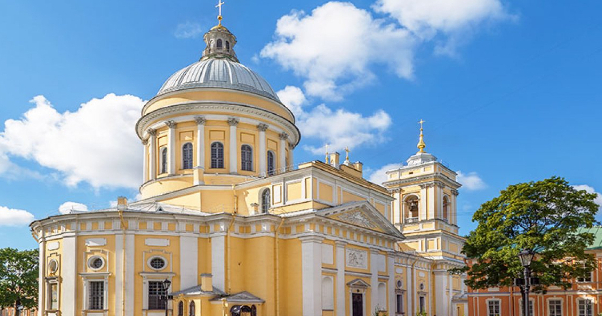

Nestled along the banks of the Neva River in the historic city of Saint Petersburg, the Alexander Nevsky Monastery stands as a monument to Russia's spiritual and cultural legacy. Founded in 1710 by Peter the Great, this revered site was established to honor the legendary prince and warrior, Alexander Nevsky, who shielded the Russian lands from Swedish invasion. The monastery was strategically built where Peter believed Nevsky had secured a decisive victory at the Battle of the Neva in 1240, though historical records suggest the battle occurred further downstream.
The architectural ensemble of the monastery is a testament to the evolution of Russian ecclesiastical design. The centerpiece is the Holy Trinity Cathedral, completed in 1790 by the Italian architect Ivan Starov. Its neoclassical style is marked by a harmonious blend of grandeur and simplicity, featuring a majestic facade adorned with Corinthian columns and a striking blue dome. The cathedral's interior houses remarkable iconostases and frescoes that reflect centuries of artistic devotion.
Scattered across the monastery grounds are several churches, each showcasing unique architectural styles ranging from baroque to neoclassical. The Church of the Annunciation, with its distinct baroque elements, is particularly noteworthy. Inside, visitors can find delicate iconography and intricate woodwork that highlight the rich traditions of Russian sacred art.
Beyond its architectural splendor, the Alexander Nevsky Monastery is a cornerstone of Russian cultural life. It serves as a gathering place for the faithful during significant religious festivals such as Orthodox Easter and Nevsky's feast day on September 12th. The monastery's bells echo across the city, calling worshippers to celebrate these moments with prayers and vibrant liturgies.
While the monastery itself is a spiritual haven, the surrounding area offers a taste of local gastronomy that reflects the hearty and comforting flavors of Russian cuisine. Visitors can indulge in traditional dishes like pirozhki (stuffed pastries), borscht (beet soup), and pelmeni (dumplings) at nearby eateries. For a truly local experience, sampling kvass, a fermented rye bread beverage, is a must.
One of the monastery's lesser-known treasures lies in its cemeteries, particularly the Tikhvin Cemetery and Lazarus Cemetery, where Russia's illustrious figures such as Pyotr Ilyich Tchaikovsky and Fyodor Dostoevsky rest in eternal peace. These cemeteries not only serve as places of reflection but also as open-air museums chronicling Russian history through the lives of its cultural giants.
Amidst the well-trodden paths, there are hidden details that many visitors overlook. The monastery's library holds an extensive collection of ancient manuscripts and texts, offering a glimpse into the intellectual pursuits that flourished here. Additionally, the lesser-known Nikolskoe Cemetery is home to the graves of lesser-known but equally significant Russian academics and artists.
For those planning a visit, the best time to experience the Alexander Nevsky Monastery is during the late spring and early summer months, when Saint Petersburg sheds its winter coat. The long daylight of the White Nights illuminates the city, casting a magical glow over the monastery's golden spires and enhancing the serene beauty of its gardens.
Visitors are encouraged to attend a service to witness the profound spiritual atmosphere. When exploring the grounds, taking a guided tour can enrich the experience, offering insights into the history and significance of each corner of this sacred site. It's also advisable to wear respectful attire, as the monastery remains an active place of worship.
In the heart of Saint Petersburg, the Alexander Nevsky Monastery stands not just as a religious landmark, but as a living testament to Russia's rich tapestry of history, art, and culture. Whether you're drawn by faith, history, or the allure of Russian art, a visit to this iconic site promises a journey through the soul of a nation.


