
← Back

Basilica of St. Euphemia

Via Aurelio Saffi, 13, 06049 Spoleto PG, Italia ★★★★☆ 127 views
Sonia Malone
Spoleto
🏆 AI Trip Planner 2026

Get the free app

Discover the best of Spoleto with Secret World — the AI trip planner with 1M+ destinations. Get personalized itineraries, hidden gems and local tips. Free on iOS & Android.

🧠 AI Itineraries 🎒 Trip Toolkit 🎮 KnowWhere Game 🎧 Audio Guides 📹 Videos
Download on the App Store Get it on Google Play
Scan to download Scan to download

Religious places · Spoleto

Basilica of St. Euphemia - Spoleto | Secret World Trip Planner

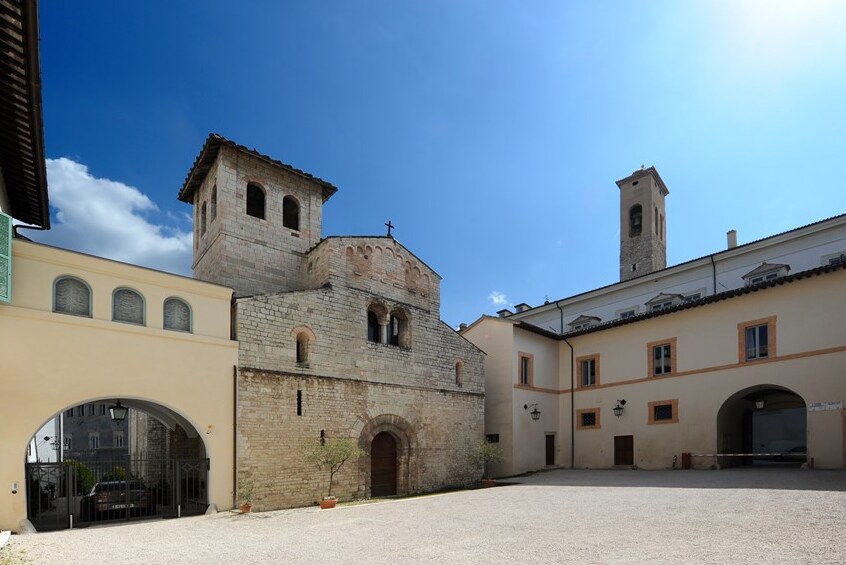
The Basilica of S. Eufemia rises inside the Archiepiscopal Palace, whose area was occupied by the residence of the Lombard Dukes, as documents of the VIII and IX centuries remind us. The first news about the monastery of S. Eufemia and the annexed church dates back to the X century, when the abbess of the Monastery of S. Eufemia asked the Benedictine monk Giovanni Cassinese to write the life of S. Giovanni Archbishop of Spoleto. Towards the middle of the twelfth century the complex was used as a Bishop's Palace, probably following the extension of the cathedral that involved the use of the area occupied by the ancient residence of the Bishops. Towards the end of the fourteenth century was commissioned to a modest painter to portray the complex of the Bishop's Palace, he has left us, in the premises of the ancient chancellery, a snapshot of the complex and St. Euphemia before they began the major construction work on the structures of the building. Towards the middle of the 15th century, the diocese of Spoleto was ruled by the Patriarch of Alexandria, the Venetian Marco Condulmer, and around that time the church seems to have changed its ancient title of St. Euphemia or St. John Archbishop to that of St. Lucy, and the triptych for the high altar was made, now preserved in the Diocesan Museum. At the end of the 15th century is attributable the painting of the semi-catin of the main apse which presents the Eternal among the cherubs. The interior, despite the smallness of its spaces, is striking for the rightness of its rhythms and proportions: the columns and pillars, often obtained with elements from classical and early medieval buildings, punctuate the three naves; the presence of women's galleries has been related to the tradition according to which St. Euphemia occupied the area of the ancient royal and ducal residence where, like the palatine chapel of Aachen, there were women's galleries. The Basilica of Sant'Eufemia can be accessed through the Diocesan Museum, set up in the representation wing of the Archbishop's Palace. Recently it has risen to a new and incongruous celebrity also as the church of Don Matteo, in the well-known Rai 1 TV series.

Basilica of St. Euphemia - Spoleto | Secret World Trip Planner
🗺 AI Trip Planner

Plan your visit to Spoleto

Suggested itinerary near Basilica of St. Euphemia

MAJ+
500.000+ travelers worldwide
  1. 🌅
    Morning
    Basilica of St. Euphemia
    📍 Spoleto
  2. ☀️
    Afternoon
    In Via Visiale, between Via del Municipio and Via Saffi, stands the Casa Romana, located on the left side of the street.
    📍 0.1 km · Spoleto
  3. 🌆
    Evening
    Menotti House
    📍 0.1 km · Spoleto

Buy Unique Travel Experiences

Powered by Viator

See more on Viator.com

Explore nearby · Spoleto

Frequently Asked Questions

The Basilica of Sant'Eufemia can be accessed through the Diocesan Museum, which serves as the main entrance to this historic site. This arrangement allows visitors to explore both the museum's collections and the basilica within the Archiepiscopal Palace complex.
The basilica's site was originally occupied by the residence of the Lombard Dukes in the VIII-IX centuries, and the first documented records of the monastery and church date back to the X century. By the middle of the twelfth century, it had evolved into the Bishop's Palace, reflecting the shifting religious and political importance of Spoleto throughout medieval times.
The basilica features a notable triptych for the high altar from the mid-15th century (now in the Diocesan Museum), and a striking semi-dome painting of the Eternal among the cherubs in the main apse from the end of the 15th century. The late 14th-century painter's work also documents what the complex looked like before major renovations.
Despite its small interior spaces, the basilica impresses visitors with its perfectly proportioned rhythms, featuring three naves separated by columns and pillars that were often repurposed from classical and early medieval buildings. The presence of women's galleries relates to its historical use as a royal and ducal chapel, similar to the Palatine Chapel of Aachen.
The church changed its original dedication from St. Euphemia or St. John Archbishop to St. Lucy around the middle of the 15th century, during the tenure of Patriarch Marco Condulmer, a Venetian who ruled the Spoleto diocese. This change in title coincided with the creation of the triptych now preserved in the Diocesan Museum.
