
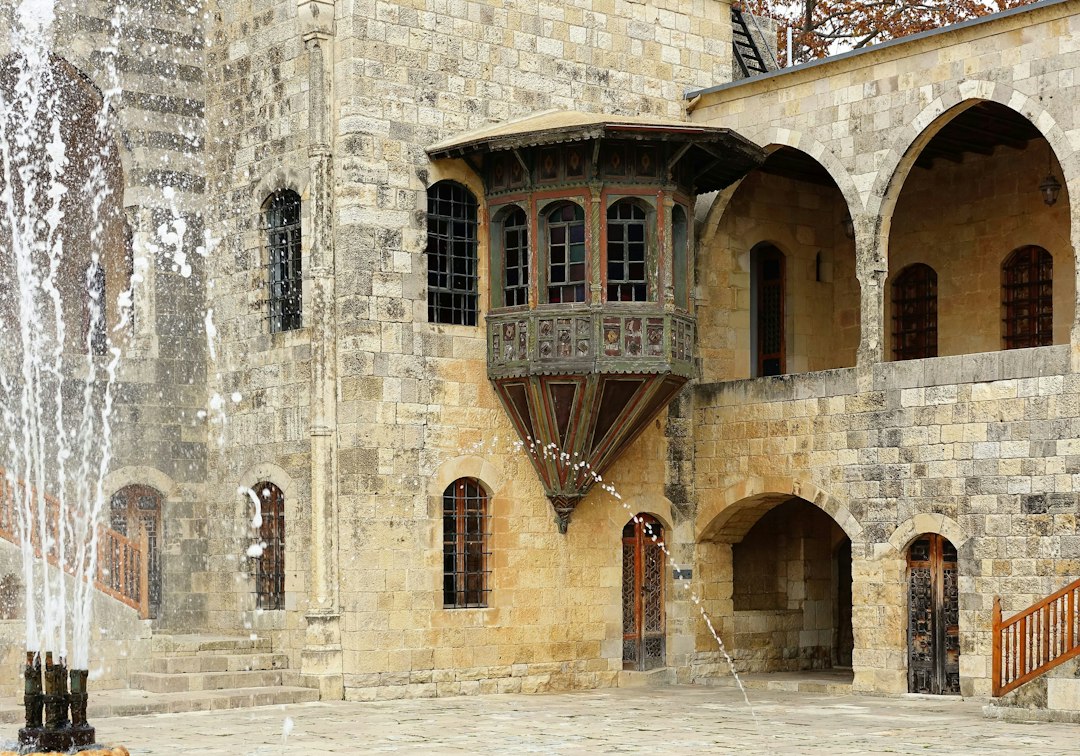

Over a thousand workers labored for thirty years on the construction of the Beiteddine Palace, completed around 1840 at the behest of Emir Bashir Shihab II, the powerful Druze ruler who governed Mount Lebanon for nearly half a century. The result is a complex of about 4,000 square meters of structures built on three natural terraces in the Chouf mountains, at an altitude of about 850 meters, less than fifty kilometers from Beirut. Walking through its courtyards means traversing an architecture that blends Ottoman, Venetian, and Arab styles in a balance that still surprises today with its visual coherence.
The palace is not a monument frozen in time: since 1943, the year of Lebanese independence, it has become state property, and since 1984 it has hosted the Beiteddine Art Festival every summer, one of the longest-running music festivals in the Middle East. This dual role — museum and living stage — gives the place an unusual vitality for a historical site of this magnitude.
The architecture of the three courtyards
The structure is divided into three distinct courtyards, each with a specific function in the original economy of the palace. The Dar al-Wousta, the central courtyard, is the architectural heart of the entire complex: here the horseshoe arches repeat in rhythmic sequences, adorned with arabesque decorations in white stucco that cast geometric shadows on the local limestone pavements. The proportions of the arches — slender but not excessive — create a sense of order that is rarely found in buildings of this scale.
The guest courtyard, the Dar al-Haramlik, was reserved for the women of the court and internal visitors. Compared to the central courtyard, it is more intimate, with a central marble fountain that still functions. The capitals of the columns mix stylized floral motifs with geometric elements, a detail worth observing closely by stopping for a few minutes before proceeding to the inner halls.
The hammams and Byzantine mosaics
Below the main levels of the palace are the thermal baths, among the best-preserved elements of the entire complex. The domes of the hammams feature circular openings made of colored glass that filter light, creating chromatic effects on the marble floor — a natural lighting system that the builders of the nineteenth century borrowed from classical Ottoman thermal architecture. The pools and water channeling systems are still visible and provide a concrete idea of the daily organization of the court.
On the lower floor of the complex, in the spaces that once served as stables and warehouses, the Byzantine Mosaics Museum is set up. The collection includes mosaic floors dating from the 5th to the 7th century A.D., recovered from archaeological sites in southern Lebanon. The largest panels reach several square meters and depict figurative scenes — hunts, exotic animals, intertwined geometric patterns — with a quality of execution that testifies to the wealth of the region in late antiquity. This museum is often overlooked by hurried visitors, but it deserves at least forty minutes of dedicated attention.
Details Worth Seeking
Among the less obvious details that an attentive visitor may notice: the calligraphic inscriptions engraved on the lintels of the main doors, which feature verses and dedications in classical Arabic. Many pass by without looking up. Similarly, the carved wooden grilles — the mashrabiyya — that close some of the upper floor windows are works of remarkable craftsmanship, with star-shaped geometric patterns that repeat without visible joints.
The panoramic terrace overlooking the Chouf valley offers a useful perspective for understanding the strategic position chosen by Bashir Shihab II: the palace visually dominates the underlying villages and controls the access routes from the coast. It is not an aesthetic choice, but a political one, and the architecture itself reflects this logic of power.
Practical Information for the Visit
The palace is located in the village of Beiteddine and can be reached by car from Beirut in about an hour via the road that climbs through Deir el Qamar. There is no direct bus connection from the capital: the most convenient way is to rent a car or arrange for a private taxi. The entrance ticket to the complex — including the mosaic museum — is around 5-8 US dollars, but it is advisable to check the updated rates directly on site as they may vary.
The best time to visit is in the early morning, preferably on weekdays, when organized groups are fewer and the morning light illuminates the courtyards from the east, enhancing the stucco reliefs. Allow at least three hours for a complete visit that includes the hammam and the mosaic museum: those who spend less time risk missing out on the most interesting sections of the entire complex.


