
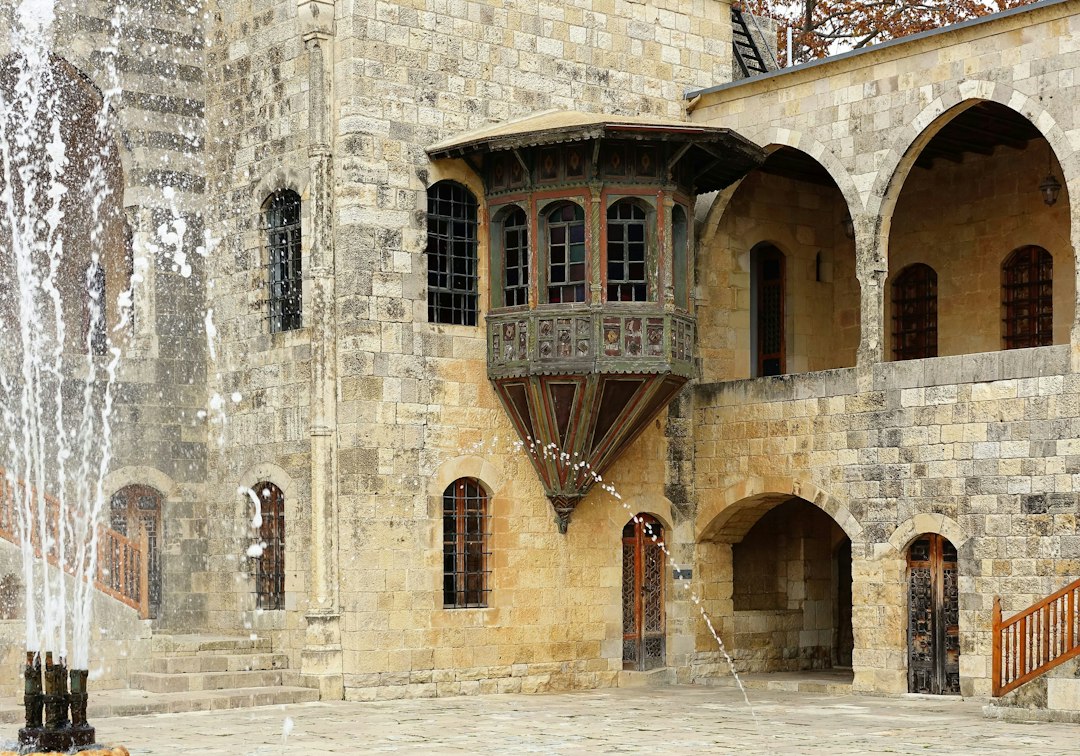

In the mountains of Chouf, about 50 kilometers southeast of Beirut, stands one of the best-preserved palace complexes in the Middle East. The Beiteddine Palace was built in the early 19th century at the behest of Emir Bashir Shihab II, the powerful Druze ruler who governed Mount Lebanon for over thirty years. Construction began around 1788 and lasted for about thirty years, involving local artisans and workers from various parts of the Ottoman Empire. The result is an architectural ensemble that occupies an area of about 100,000 square meters, distributed over terraces sloping down towards the valley.
What immediately strikes those who arrive at the palace is the stylistic coherence of the whole, despite the decades of construction. The architecture blends traditional Arab elements with Italian and Byzantine influences, visible both in the decorations of the interiors and in the layout of the open spaces. Beiteddine literally means "house of faith," a name that reflects the simultaneously regal and spiritual character of the place. Today, the palace is home to the Beiteddine Festival, a prominent international summer cultural event, but it remains open to visitors for most of the year as a national museum.
The architecture and the courtyards: stone and proportion
The entrance to the palace is through an imposing portal made of local limestone, which leads into the first of the three main courtyards. The Dar el-Baraniyyeh, the outer courtyard, was reserved for visitors and passing guests, while the Dar el-Wousta, the intermediate one, served as the transition area to the private apartments of the emir. Each courtyard is bordered by full-arch arcades and loggias decorated with muqarnas, the characteristic stalactite niches typical of medieval Islamic architecture, here reinterpreted in a more sober and geometric style.
The stone used for the construction is the same found throughout the Chouf region: a honey-colored limestone that changes shades with the daylight, becoming almost golden in the afternoon hours. The floors of the courtyards are made of alternating black and white marble, with geometric patterns reminiscent of the mosaics of the Byzantine churches in the region. Walking through these open spaces, with the central fountains and the hanging gardens in the background, offers an immediate understanding of how the palace was designed to impress without ostentation.
The Byzantine Mosaics and Museum Collections
One of the main reasons to visit Beiteddine is the collection of Byzantine mosaics preserved in the palace's underground, in the spaces that once served as stables. These mosaics, dating from the 5th to the 7th century AD, were recovered from various sites in southern Lebanon and transferred here for preservation. They depict scenes of hunting, animals, geometric figures, and floral motifs, with a color palette ranging from ochre to cobalt blue, surprisingly vibrant despite the centuries that have passed.
The museum also houses a collection of everyday objects from the time of Emir Bashir: traditional Lebanese costumes, jewelry, ceremonial weapons, and ceramics. Particularly interesting is the section dedicated to carved wooden doors and windows, where one can closely observe the quality of local craftsmanship: panels made of cedar and walnut with geometric inlays that required weeks of work for each individual piece.
The hammams and private apartments
Among the best-preserved spaces of the palace are the thermal baths, the hammams, with their domes pierced by small circular oculi that filter light into oblique beams. The walls are covered with marble and hand-crafted stucco decorations, featuring floral and calligraphic motifs. These environments provide a concrete idea of the level of refinement of court life in the Levantine nineteenth century.
The private apartments of the emir, accessible through the third courtyard, feature painted wooden ceilings with floral and star motifs, a decorative technique called ajami that combines painting with carving and gilding. Some original panels are still in situ, while others have been restored in the years following Lebanese independence, when the palace was declared a national monument.
Practical Information for the Visit
The palace can be reached from Beirut in about an hour by car, following the road that ascends towards Deir el-Qamar and then towards Beiteddine. There is no direct and reliable public transport service, so it is advisable to rent a car or arrange a private taxi from the capital. The entrance ticket is around 5,000 Lebanese pounds at the official exchange rate, but it is advisable to check the updated price at the time of the visit, as the country's economic situation is subject to fluctuations.
The best time to visit is early in the morning, between 9 and 11, when the sunlight illuminates the marble courtyards and tourist groups have not yet filled the spaces. Allow at least two and a half hours for a complete visit, including the underground areas with the mosaics. During the summer months, particularly July and August, the palace hosts concerts and evening performances as part of the festival, and daytime access may be limited on setup days.


