
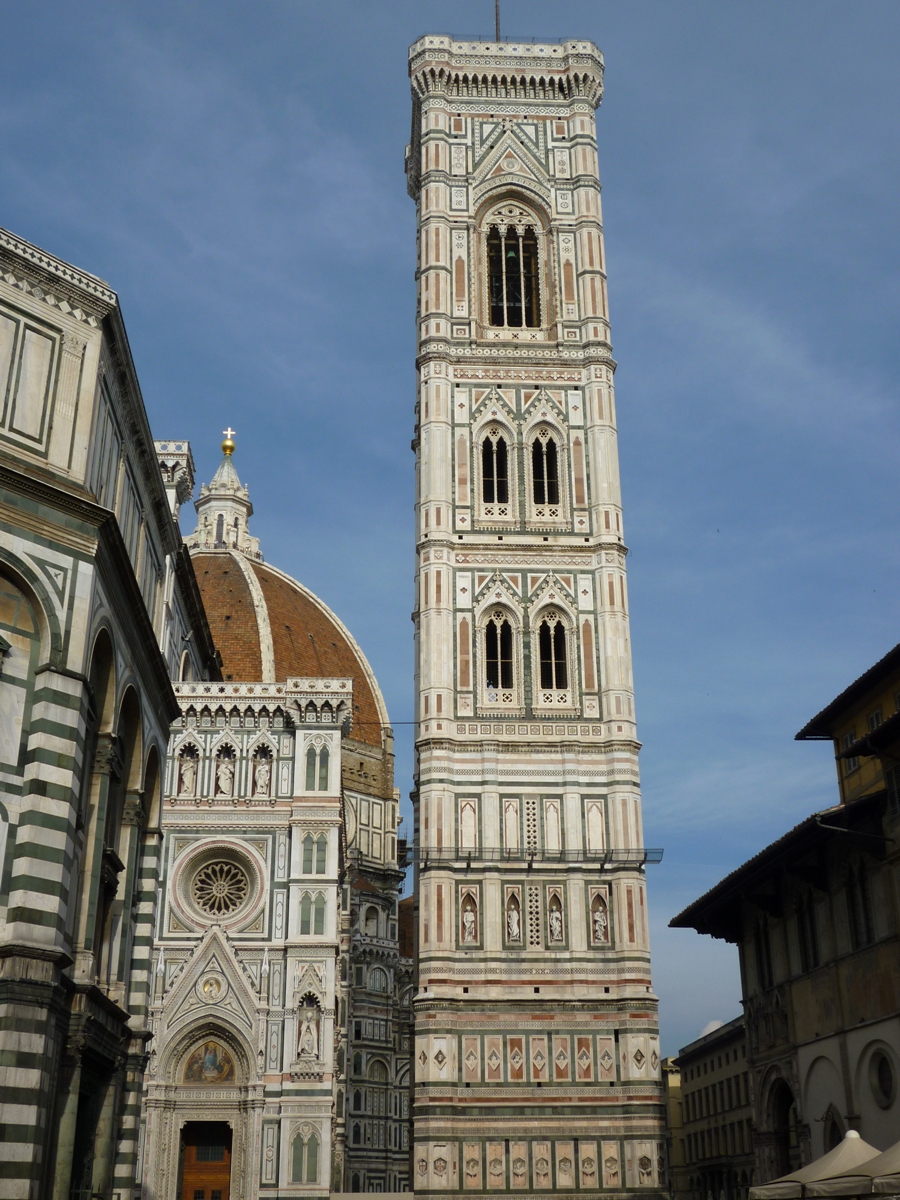

Giotto's Bell Tower in Florence is covered in white, red and green marble like those that adorn the Duomo; the bell tower was begun by Giotto in 1334.
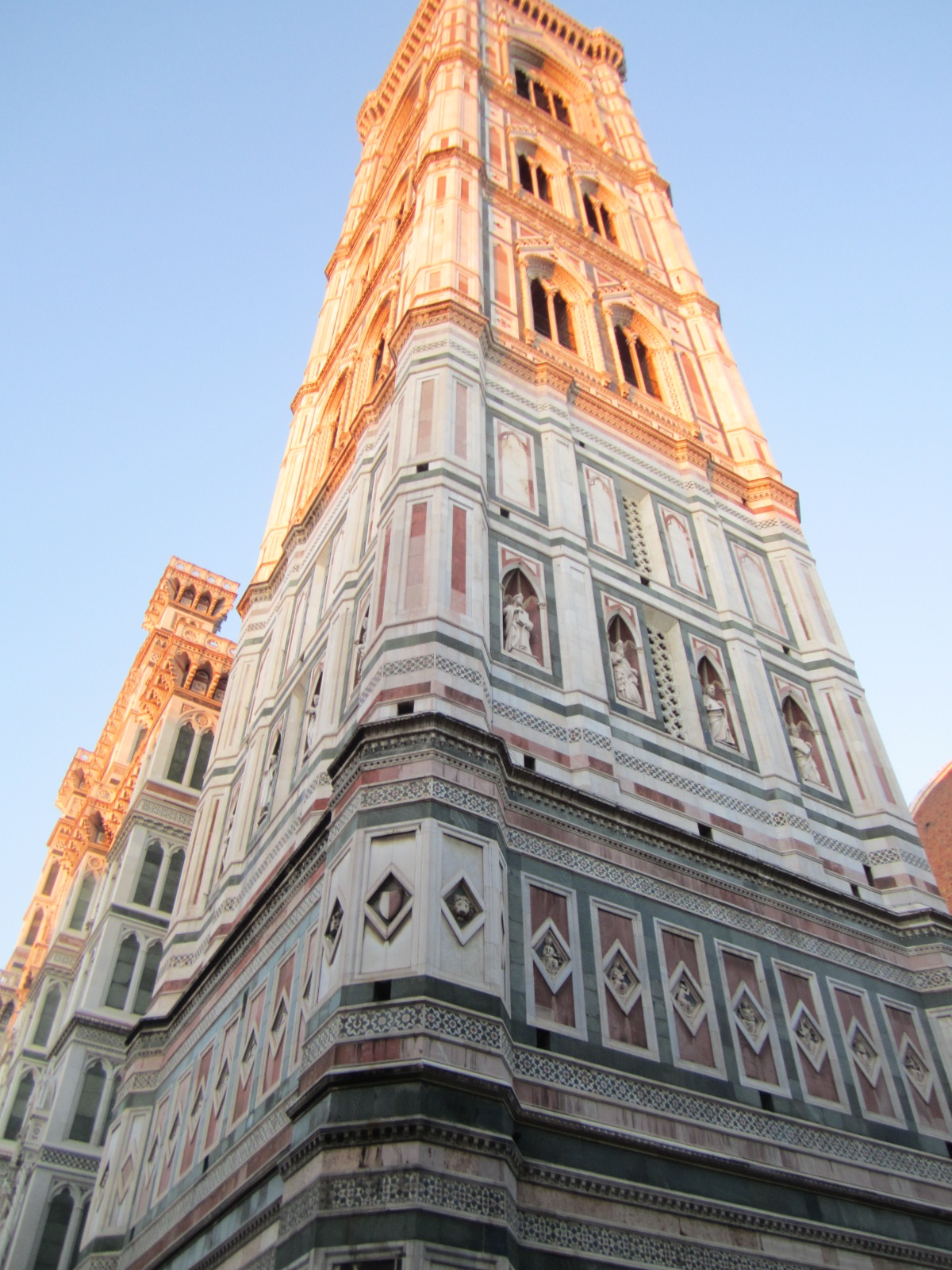
After Giotto's death (in 1337) the project was continued by Andrea Pisano, who finished the first two floors respecting Giotto's project; the bell tower was embellished with external decorations thanks also to the intervention of Alberto Arnoldi.
The works were then interrupted for two years (from 1348 to 1350) and then Giotto's Bell Tower was completed in 1359 (after the years of the plague in Florence) by Francesco Talenti.
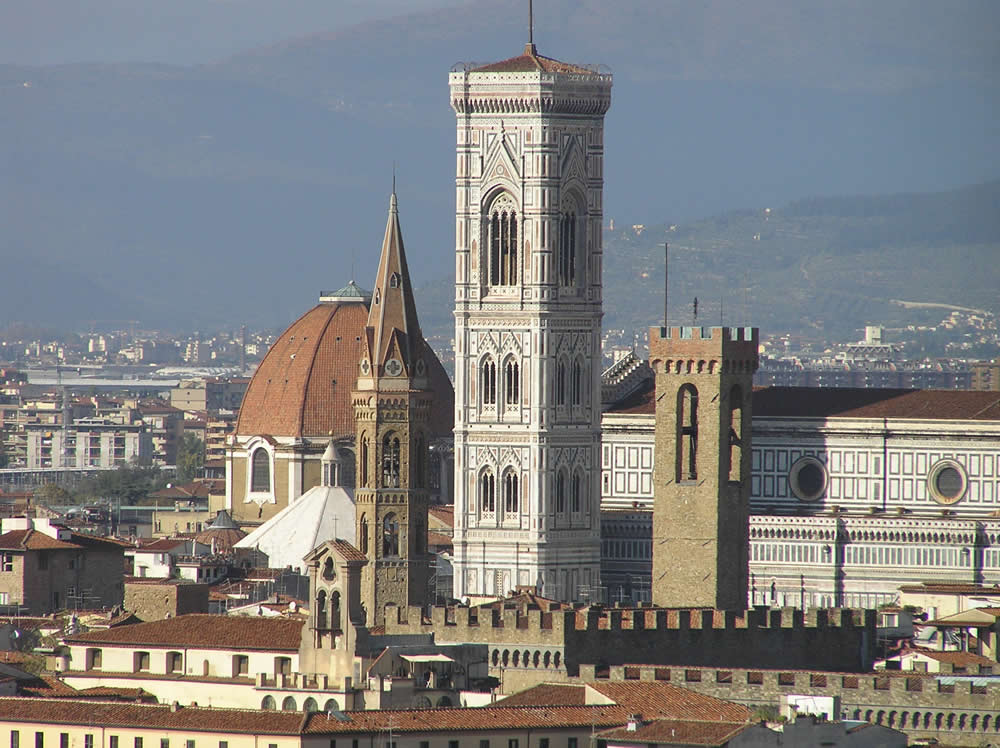
Talenti then completed the work by building a large terrace facing outwards at more than 400 steps from the ground which acts as a panoramic roof.
The construction of the bell tower was undertaken in 1334, when Giotto, appointed Master builder of the Duomo factory, omitted the church and turned his attention to this new architectural element. After his death in 1337, the direction of the works passed to Andrea Pisano and then, starting from 1348, to Francesco Talenti, who completed the bell tower in 1359 in the form we see today. The structure, slender and very elegant (84.70 x 14.45 m), has a square plan with angular buttresses in the form of polygonal pillars that rise to the top, and is divided horizontally by cornices that delimit five superimposed floors. The first zone, in which the door cuspidata is opened, is that one realized living Giotto and has reliefs within octagonal tiles performed, in part on sketch from the same Giotto, from Andrea Pisano. These led then the construction of the bell tower up to the third cornice, in compliance with the Giotto's project, and sculpted a good part of the second series of reliefs - others waiting for Luca della Robbia -.
In the second band he then prepared some niches that contained sixteen statues of prophets, sibyls and the Baptist, and above other blind niches. The next three floors were designed and built by Talenti: here the bands no longer have sculptural decorations but are decorated with coupled mullioned windows (for the first two bands) and a large three-light window, which create an impression of lightness and launch. The building is completed by a horizontal cantilevered cornice on brackets, ending with a fretwork balustrade similar to that of the nearby church; in the primitive project, most probably a spire crowning was also foreseen. In spite of the plurality of interventions, the bell tower appears to be a unitary structure especially thanks to the polychrome marble covering and to the slender angular buttresses which, going up to the top, connect the different floors. The building is exemplary of the ogival art of the fourteenth century, in which the forms of Gothic from beyond the Alps are tempered by an indispensable need for structural solidity and balance of volumes of classical ancestry.


