
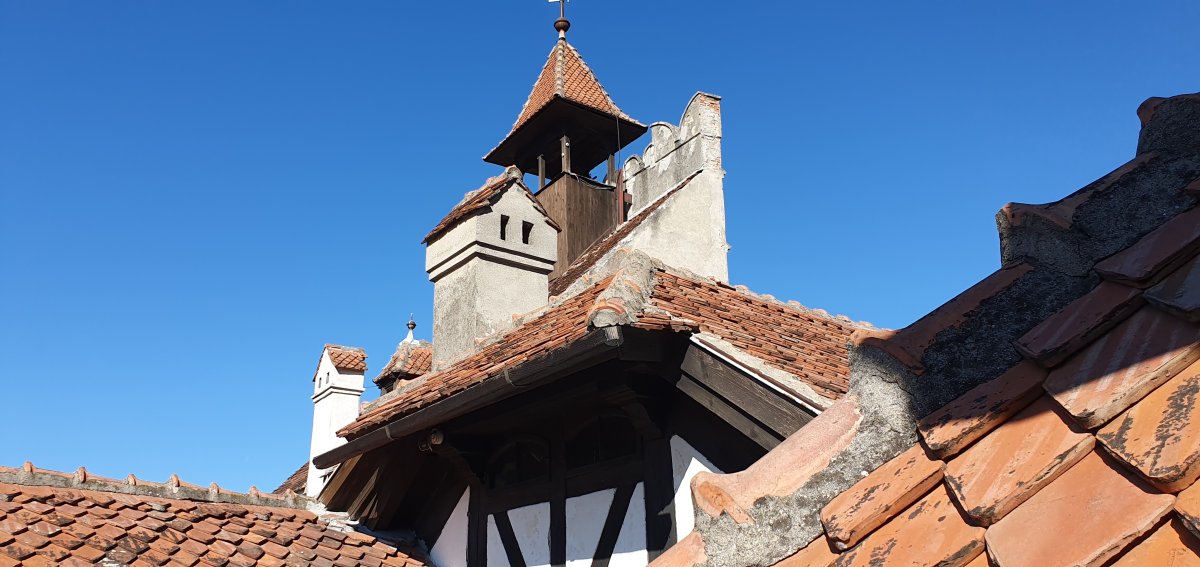

Perched on a rocky spur at about 760 meters above sea level, Bran Castle dominates the valley with its white towers and dark tiled roof, visible from afar along the road that connects Brașov to Câmpulung. The structure seen today mainly dates back to the 14th century, with construction work starting around 1377 at the behest of the Saxons of Brașov, who obtained from King Louis I of Hungary the right to build a fortress in exchange for military and customs services. That strategic location, on the border between Transylvania and Wallachia, was not accidental: the castle served as a customs checkpoint and defensive barrier against Ottoman invasions.

The connection with Vlad III of Wallachia, known as Vlad the Impaler and a source of inspiration for the literary character of Dracula created by Bram Stoker in 1897, is a subject of historical debate. Vlad may have briefly stayed in the castle, but he did not reside there permanently. This has not prevented the legend from taking root in the collective imagination, turning Bran into one of the most visited tourist destinations in Romania. However, those expecting only Gothic scenery will be surprised by the authentic historical and artistic richness that the castle holds.
The architecture: towers, courtyards, and secret passages
The layout of the castle is irregular, adapted to the natural shape of the rock on which it is built. Four towers of varying heights — the main one exceeds 57 meters from street level — are connected by walkways and internal galleries that develop over multiple levels. Climbing up the narrow and steep stone stairs is already a concrete physical experience: the steps worn by centuries, the low ceilings, and the arrow slits framing glimpses of the surrounding forest give the idea of a space designed for defense before comfort.
In the inner courtyard, an architectural element not to be missed is the octagonal well carved into the rock, which according to local tradition concealed a secret passage to the underground rooms. The outer walls clearly show the different construction phases: the darker and rougher stone of the medieval foundations contrasts with the later additions, including the modifications made in the 20th century during the period when the castle was the residence of Queen Marie of Romania, who received it as a gift in 1920.
The treasures of the museum: weapons, furniture, and royal furnishings
The museum setup distributed in the rooms of the castle is one of the most interesting in the country for the variety of objects on display. The collections of medieval weapons include swords, halberds, armor, and crossbows dating from the 14th to the 17th century, arranged along the walls of the rooms with explanatory panels in Romanian and English. Some pieces come from the Transylvanian region, while others were acquired from private European collections during the 20th century.
The rooms that house the furniture and furnishings of Queen Maria offer an interesting contrast to the austere medieval section. The sovereign, a granddaughter of Queen Victoria of England, had an eclectic taste that mixed elements of the Gothic revival with pieces of local Romanian craftsmanship. Inlaid tables, canopied beds, ceramics, and hand-embroidered fabrics testify to a deliberate attempt to create a national identity through decorative arts. The private chapel, with its Orthodox icons and wrought iron candelabra, is one of the best-preserved environments in the entire complex.
The park and the panoramic view
Surrounding the castle is a park of about 10 hectares that includes paths among the trees, small pavilions, and an area with traditional rural structures transported from other regions of Romania. Walking in the park allows one to observe the castle from the outside from different angles, better understanding the relationship between the structure and the rock that supports it. In autumn, when the beeches and oaks turn orange and red, the contrast with the white towers is particularly striking.
From the highest walkway of the main tower, on clear days, the ridges of the Bucegi Mountains to the south and the plain of Brașov to the north can be distinguished. It is one of the most effective observation points to understand why this pass was so strategically important for centuries.
Practical information for the visit
The castle is located in the municipality of Bran, about 30 kilometers from Brașov, accessible by bus from the Brașov station with regular frequency. The entrance ticket is approximately 45-50 Romanian lei for adults (equivalent to about 9-10 euros), with discounts for students and children. The complete visit, including the park, takes on average two hours.
The most useful advice is to arrive before 10 in the morning, especially in the summer months between June and August, when tourist buses drop off hundreds of visitors at the same time, making the internal stairs difficult to navigate. The narrower rooms, such as the weapons room, quickly become crowded and the experience suffers. During the week, off-season, the castle can be visited much more calmly with the opportunity to focus on architectural details without being swept along by the flow of groups.


