


This monument, second only in importance and size to the Colosseum, is situated within a green space in which other relics of the Roman city are harmoniously embedded: the Republican amphitheater, the first Roman masonry amphitheater; the octagonal building of the Imperial age; and the elliptical portico that surrounded the Imperial amphitheater. Built during the Flavian age, following the model of the Colosseum, between the end of the 1st century AD and the beginning of the 2nd century AD, the Campian amphitheater was restored and decorated with columns and statues by Hadrian, and inaugurated by Antoninus Pius, as the inscription found by Alessio Simmaco Mazzocchi in 1726 reads.

The amphitheater was built in the Flavian age, following the model of the Colosseum.
This grandiose edifice, capable of seating up to 60,000 spectators, with its vast underground chambers for staging lavish performances, replaced the ancient arena (130-90 B.C.), also known for the Spartacus revolt of 73 B.C., which was completely demolished in the late first century A.D. The construction of the two amphitheaters in an area already occupied by a vast necropolis is significantly linked to the origin of gladiatorial fighting, the funeral games held in honor of illustrious figures. A tomb, reconstructed in the space between the two arenas, suggests this connection.
Situated just outside the city walls, closely connected to the Via Appia, built in 313 B.C. by Appius Claudius Blind with the contribution of the Capuan aristocracy to connect Rome and Capua, the area still retains traces of this historical link. The main road of Santa Maria Capua Vetere, following the route of the Regina Viarum, passes through the arches of Hadrian's Arch, marking the western entrance to the ancient city.
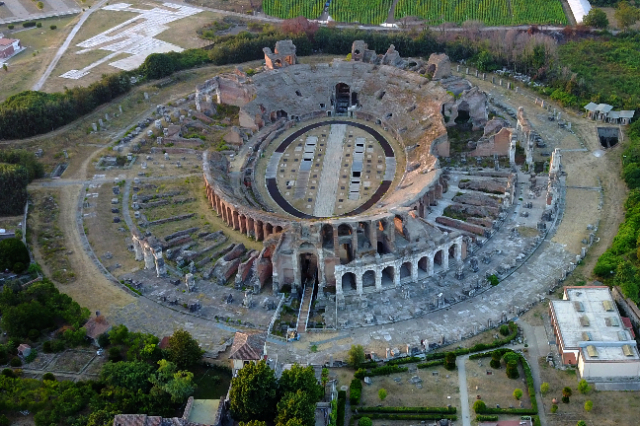
Although now in ruins, the amphitheater still hints at the grandeur of its ancient forms. The ancient paved plaza, surrounded by pillars through which the audience once flowed, still stands. The entrance, marked today by the only decorated pillar, with representations of Hercules and Silvanus, leads visitors into the remains of the monumental structure. The arcades of the portico, built with the strong stone of Mount Tifata and adorned with Doric-Tuscan half-columns, still stand, framing what remains of the other three levels that once rose about 44 meters. The monument culminated in a brick level, elegantly punctuated by windows and pilasters, topped by a cornice along which large corbels supported awning posts that protected spectators from the sun.
Symbols of the amphitheater are the busts of the deities that once adorned the arch keys of the first portico. Capua's gods guided spectators to their respective seating sections, a unique feature not found elsewhere. Particularly striking is the view of the two arches that still bear the images of Diana and Juno; passing under their "gaze" and heading toward the ambulatories adds to the site's charm.
Descending into the underground passages, visitors enter what looks like an underground museum, viewing fragments of columns, capitals and marble cornices among the sublime ruins, imagining lost splendor. Among the few remaining examples of Capuan statuary are Venus, Psyche and Adonis, preserved in the National Archaeological Museum in Naples, and Nike now in the archaeological museum of ancient Capua.
The function of the amphitheater changed with the abolition of gladiatorial games, banned by Emperor Honorius in 404 A.D., but performances, especially venationes, continued even after the damage caused by Genseric in 456 A.D., as evidenced by the restoration in 530 A.D. known from an inscription found in 1846. Between the mid-5th and 6th centuries AD, the northwestern area of the underground chambers was transformed into a Christian oratory. In the small "ship" built with pre-existing materials, faint traces of wall and vault frescoes, the floor adorned with marble slabs, and the suggestive altar embedded in the niche are still visible.
The ruin of the "Colossus" is linked to the end of the thousand-year history of ancient Capua. The looting and burning of the Saracens in 841 AD caused the relocation of the city. From 856 A.D., the population sought refuge in the meander of the Volturno River, the site of ancient Casilinum, where the "new Capua" would rise. The ancient city fragmented into three distinct boroughs named after the churches of St. Erasmus, St. Peter's and St. Mary Major, with the latter, beginning in the 18th century, developing into the modern city, emphasizing its historical identity under the name of Capua Vetere.
The city's name was Capua Vetere.
Declared a National Monument in 1822, it was opened to the public in 1913, and in 2013, to celebrate its centennial, a new phase was inaugurated in line with innovative public involvement policies, with a ticket office, bookstore and organic restaurant at the entrance to the archaeological area.


