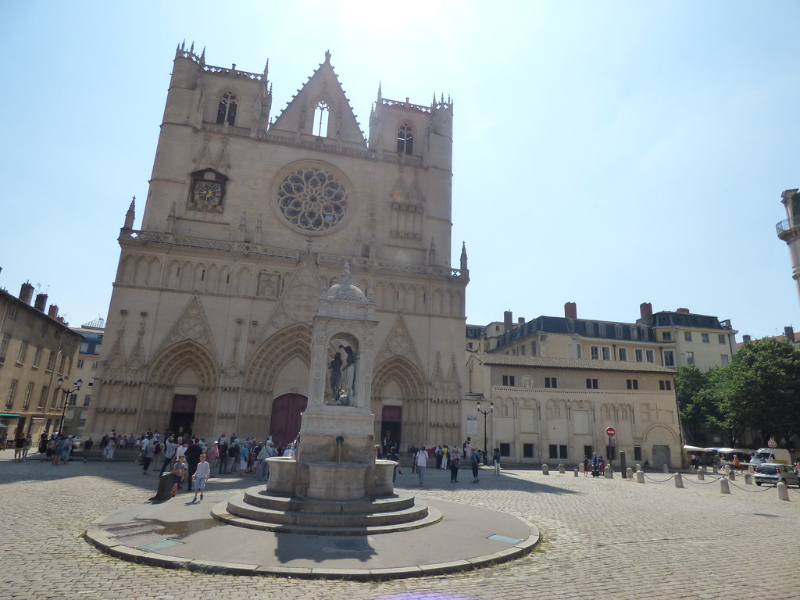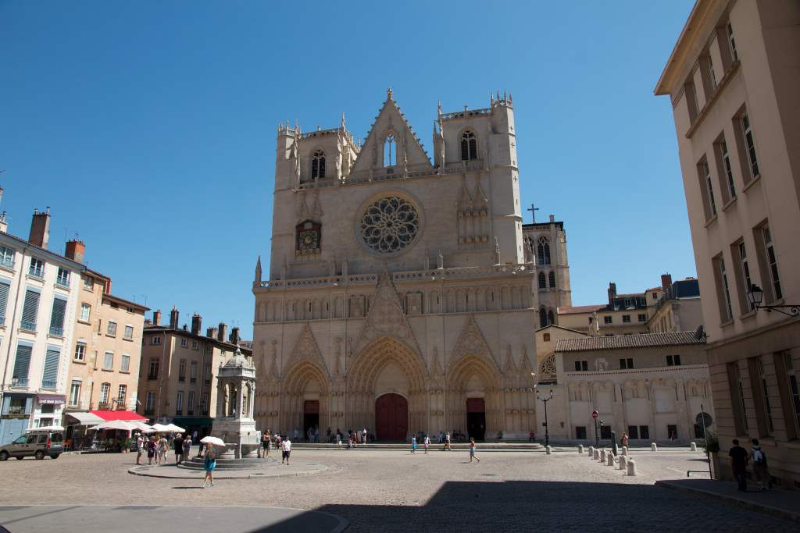

The Cathedral of St. John the Baptist in Lyon,a UNESCO World Heritage Site, is a cathedral, alongside the Rhone River in Lyon's old quarter. With the Basilica of Fourvière it contends for the role of the most important religious site in Lyon. It is dedicated to Saints Stephen and John the Baptist. The Cathedral stands on the site where there was a church already during the Merovingian period, whose place the present church took. In fact, this whole part of Lyon that stretches along the banks of the Saône has been a place where churches and places of worship have sprung up since the early Christian era. Today's cathedral, 20 meters wide and 30 meters high, was built between 1165 and 1481 and combines Romanesque and Gothic elements in its architecture.
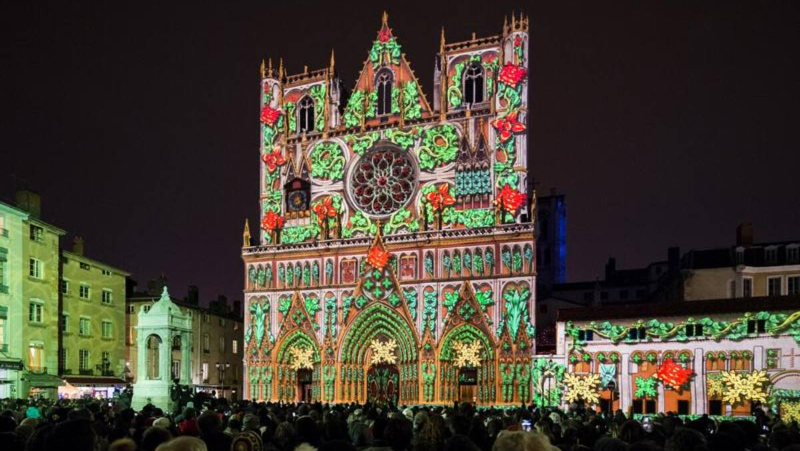
Since its construction, Saint-Jean Cathedral has been the scene of several important events, including the First and Second Councils of Lyon, the election of John XXII as Pope, the marriage of King Henry IV and Marie de Medici, and the appointment of Richelieu as cardinal. The façade was completed in 1480, nearly 4 centuries after work began, and underwent complex restoration work in 1982. The material used to build this fine example of Gothic-flamboyant architecture came, unfortunately, from Roman monuments in Lyon, particularly the Forum. It is traversed by two perforated horizontal balustrades. Around the three walnut wood doors are 280 small paintings. Above the large central triangle are visible statues of Our Lady with the Archangel Gabriel announcing to her that she would be the Mother of God. At the top the statue representing God dominates the whole.
The transition from Romanesque to Gothic is also evident inside, as one moves from the apse to the facade. The nave with Gothic vaults divided into six segments is remarkable. In the 80-meter-long nave, paintings depict 300 scenes from the Old and New Testaments. To the left and right of the altar, two large crosses recall the plan for the unification of the Catholic and Orthodox Churches, which was discussed at the Second Council of Lyon.
Two statues of John the Baptist and St. Stephen are enthroned at the end of the chancel. The church is named after these two saints, as its full name is Église Saint-Jean-Baptiste-et-Saint-Étienne.
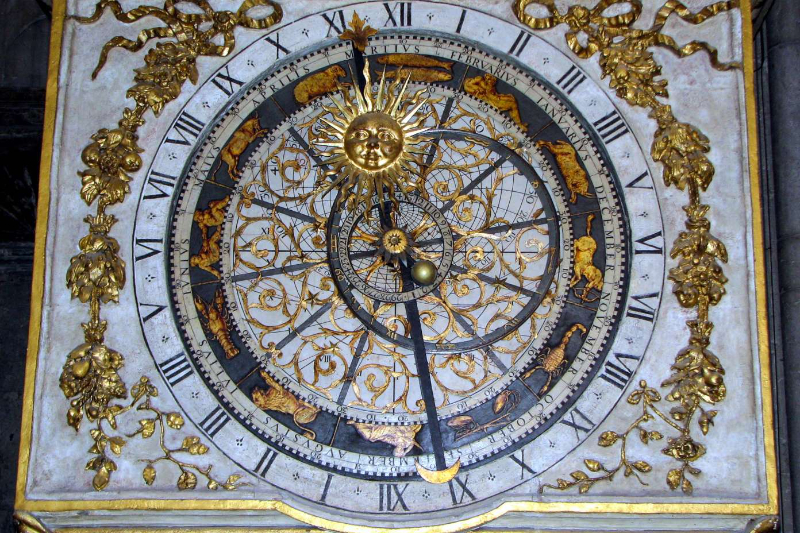
Also noteworthy are the stained glass windows, which particularly contain many shades of blue on the south side to keep out the heat of the sun, the two 6-meter-wide rose windows on the north and south facades, and the precious tapestries. The star of the interior, however, is perhaps the astronomical clock, one of the oldest in Europe. Built in 1400, it guarantees the exact date until 2019. The clock consists of a 1.80-meter square tower topped by an octagonal turret in which figures move. The two statues represent the first two bishops of Lyon, St. Irenaeus and Potinus. Each day at 12:00 noon, 2:00 p.m., 3:00 p.m. and 4:00 p.m. a little show begins with the angel on the left turning the hourglass, while the other on the right acts as conductor. The rooster crows three times, opening his beak and flapping his wings. Three of the six angels surrounding "The Heavenly Father" operate the hammer of the bells, and a hymn dedicated to St. John the Baptist begins, ending with a blessing from the Heavenly Father.