← Back

Church of San Francesco di Assisi

Piazza della Libertà, 50, 72017 Ostuni BR, Italia ★★★★☆ 181 views
Teresa Fauci
Ostuni
🏆 AI Trip Planner 2026

Get the free app

Discover the best of Ostuni with Secret World — the AI trip planner with 1M+ destinations. Get personalized itineraries, hidden gems and local tips. Free on iOS & Android.

🧠 AI Itineraries 🎒 Trip Toolkit 🎮 KnowWhere Game 🎧 Audio Guides 📹 Videos
Scan to download iOS / Android
Scan for AppGallery Huawei users

About Church of San Francesco di Assisi

Church of San Francesco di Assisi - Ostuni | Secret World Trip Planner

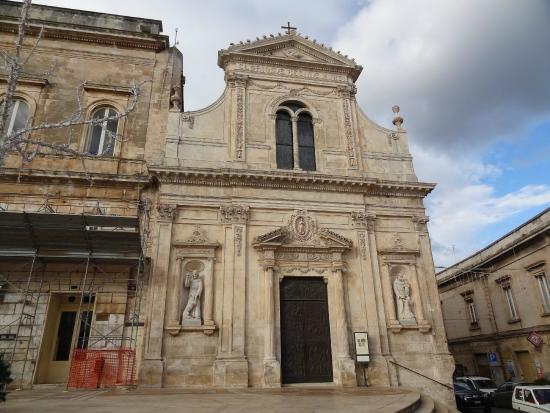
It was built in the fourteenth century on an area donated at that time to the order of Friars Minor. In the second half of the XVIII century, after the earthquake of 1743 that had deeply damaged the primitive medieval church, it was rebuilt by the architect from Ostuni, Gaetano Iurleo. The facade tries to resume the neoclassical scanning of the city palace, former Franciscan convent. In reality the sober element of neoclassicism in many points is softened by the curvilinear and fanciful forms of rococo. Both the pilasters and the moldings of the portal, of the niches and of the mullioned window are richly decorated with naturalistic elements, with spirals, with festoons and with shells. Valuable is the shaft of the mullioned window that, thanks to a fanciful interlacement of racemes, creates the sinuous effect of a twisted column. In the niches are placed the most representative saints of the Franciscan order. Precisely on the left there is the statue of St. Francis with the wolf while on the right St. Anthony in a charitable act. The bronze portal was realized by the Roman artist, Egidio Giarolo, in 1985 and reproduces the most significant episodes of the life of the Saint of Assisi. The interior, structured in the shape of a Latin cross, consists of a single nave illuminated by the eight oval openings of the dome. Among the many artifacts deserve attention the painted of the school of Luca Giordano, the wooden statue of the Immaculate dating back to the eighteenth century, the work of Giacomo Colombo and marble altars made by the brothers Morgese, Apulian, or Neapolitan masters. The main altar is characterized by multicolored marble inlays and mixtilinear frames that alternate with volutes. In this context, animated by graces and gentle movements, appear the two ceroferari angels, located on the horns of the high altar, attributed to Sanmartino, Neapolitan sculptor of the 18th century.
Church of San Francesco di Assisi - Ostuni | Secret World Trip Planner
🗺 AI Trip Planner 2026

Plan your visit to Ostuni

Suggested itinerary near Church of San Francesco di Assisi

MAJ+
500.000+ travelers worldwide
  1. 🌅
    Morning
    Church of San Francesco di Assisi
    📍 Ostuni
  2. ☀️
    Afternoon
    Church of St. Francis of Assisi in Ostuni
    📍 0 km · Ostuni
  3. 🌆
    Evening
    Church of the Holy Spirit | Ostuni
    📍 0.1 km · Ostuni

Buy Unique Travel Experiences

Powered by Viator

See more on Viator.com

Explore nearby · Ostuni

Frequently Asked Questions

The church was originally built in the fourteenth century on land donated to the Friars Minor order. After suffering severe damage from the 1743 earthquake, it was rebuilt in the second half of the eighteenth century by architect Gaetano Iurleo from Ostuni.
The facade combines neoclassical elements with rococo flourishes, featuring richly decorated pilasters, moldings, and a distinctive mullioned window with an interlaced design that creates a sinuous twisted column effect. The niches display statues of St. Francis with the wolf and St. Anthony, representing the Franciscan order.
The bronze portal was created by renowned Roman artist Egidio Giarolo in 1985 and depicts the most significant episodes from the life of St. Francis of Assisi. It serves as a striking modern addition to this historic church.
The interior features paintings from the school of Luca Giordano, an eighteenth-century wooden statue of the Immaculate by Giacomo Colombo, and marble altars by the Morgese brothers. The main altar is particularly noteworthy for its multicolored marble inlays and is adorned with two ceroferari angels attributed to Neapolitan sculptor Sanmartino.
The church is structured in the shape of a Latin cross with a single nave that is illuminated by eight oval openings in the dome, creating a bright and graceful interior space. This architectural design enhances the viewing of the numerous artistic treasures within.
Secret World Hidden places, real stories — plan your trip
Get the app
