
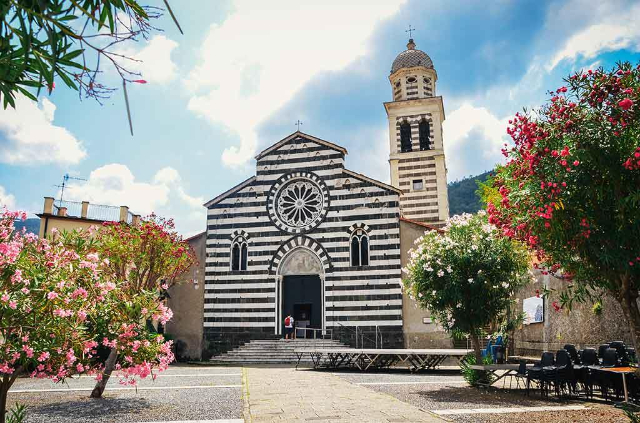

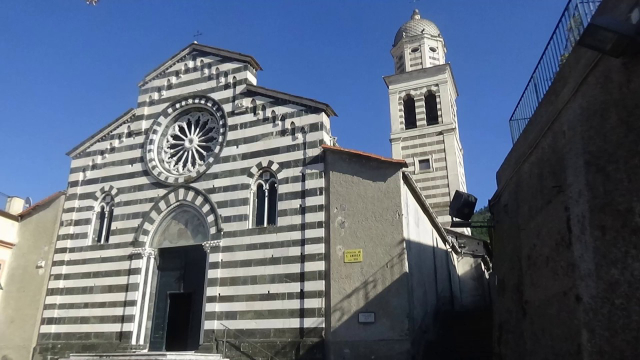
Among Levanto's churches, the most beautiful is probably the parish church of Sant'Andrea, a fine example of Ligurian Gothic easily recognizable by its black-and-white stone façade on which an important rose window stands out. Dating from the late 13th century, the church of Sant'Andrea echoes in its alternation of white marble and greenish serpentine the characteristic style of the churches of Genoa, an unmistakable sign of the widening political influence of the Serenissima towards the Ligurian Levant. Although altered during 15th-century renovations, the church retains elements of interest. The interior appears significantly altered by the addition of two naves, the enlargement of the apse, and the addition of roofing. The nave columns remain, echoing the two-tone color scheme of the facade. The high altar, of Genoese manufacture and made of white Carrara marble, dating from the mid-18th century, comes from the former Church of the Holy Trinity, now the Oratory of San Rocco. In the nave, on the triumphal arch, fresco with St. Jerome Penitent; the pulpit dated July 14, 1716, by an unknown Ligurian sculptor, depicts the titular saint and below the town coat of arms made of marble inlays. On the chancel walls the two side paintings depict St. Gregory the Great and St. Augustine, probably dating from the 18th century. In the chapel to the right of the latter is a canvas depicting the Adoration of the Magi, attributed to Andrea Semino, while in the left chapel is a 17th-century altarpiece on canvas depicting The Transit of St. Joseph, by Giovanni Battista Merano.
In the right aisle is a white Carrara marble slab carved in relief, depicting Levant Bishop Bartolomeo Pammoleo sculpted by Genoese sculptor Michele d'Aria; above the slab is a canvas depicting the Crucifixion by Dutchman Martinus Jacob van Doorn. Just beyond is the 16th-century painting of the Martyrdom of Saint Sebastian, enclosed in an elegant marble frame dating from 1577.


