

The black and white stripes of the tower can be seen from afar, even before the island of Ouessant materializes on the horizon. The Phare du Créac'h rises 55 meters above the western tip of the island, projecting a light that reaches a nominal range of about 34 nautical miles. It is not just a light signal: it is the guardian of one of the busiest maritime corridors on the planet, the Pas de Calais and the Sea of Iroise, where tens of thousands of ships transit each year between the Atlantic and the North Sea.

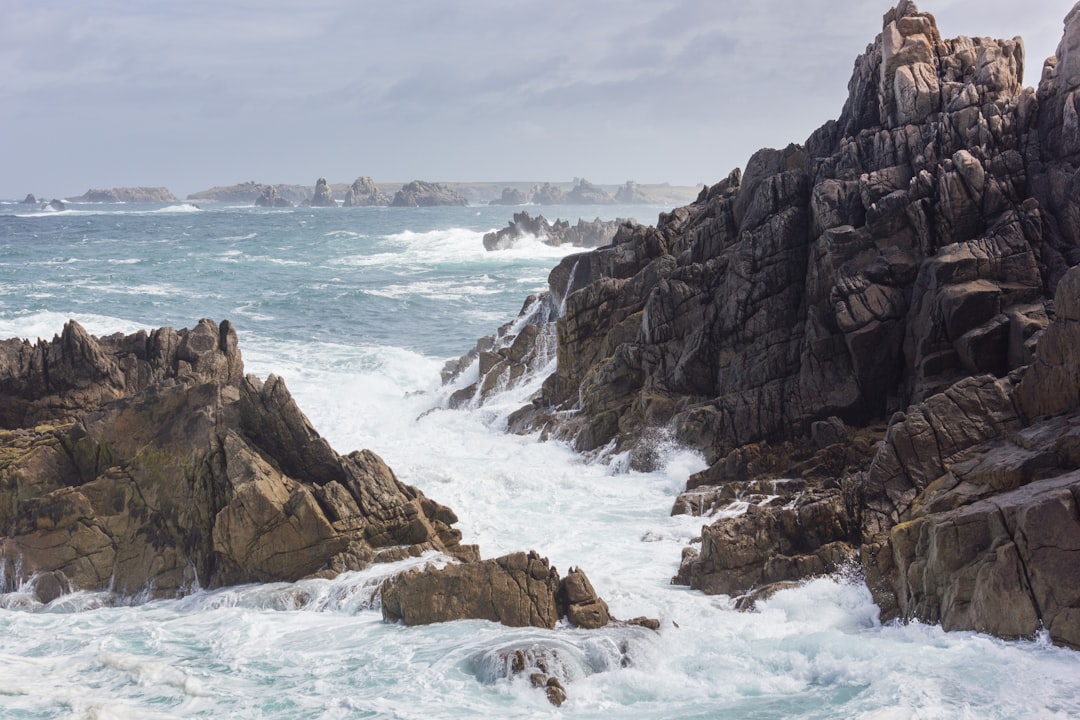
Ouessant itself is a frontier place. Reachable by ferry from the ports of Brest or Le Conquet, this Breton island of just 15 square kilometers has lived in symbiosis with the sea and its dangers for centuries. The rugged coasts, battered by the Atlantic winds, have swallowed countless vessels before modern lighthouses made navigation safer. The Créac'h came into operation in 1863, although its history of light signaling in this area dates back to earlier times.
A tower that reads like a book

Approaching the lighthouse on foot, walking along the grassy paths that cross the heath of the island, is an experience in itself. The black and white livery is not a random aesthetic choice: the color system of French lighthouses follows a precise logic of visual identification, so that sailors can recognize the signal even during the day. The Créac'h, with its three black bands on a white background, is unmistakable.
The structure is robust, designed to withstand the Atlantic storms that can be devastating in winter. The local granite walls convey a sense of absolute solidity. Looking up from the base of the tower, the bands narrow perspective-wise towards the lantern, where the Fresnel-type optical system — still an integral part of the installation today — produces the characteristic flashes visible at sea. The lighthouse emits two white flashes every ten seconds, a sequence that every passing sailor learns to recognize.

The Museum of Lighthouses and Maritime Signals
At the foot of the Créac'h is the Museum of Lighthouses and Beacons, housed in the historic buildings attached to the structure. It is one of the few museums in the world entirely dedicated to the history of maritime signaling, and its collection includes original Fresnel lenses of various sizes, ancient nautical instruments, and historical documentation on the construction and management of lighthouses along the French coasts.
The displayed lenses are the most visually stunning element: enormous prisms of worked glass that amplify and concentrate light in an extraordinarily efficient manner, the result of nineteenth-century technology still considered elegant in its engineering simplicity today. The museum allows visitors to understand how, before electrification, lighthouse keepers had to manually refill oil lamps and polish the lenses every day. The entrance ticket to the museum costs around 6-7 euros for adults, with reductions for children and families.
How to organize the visit
The ferry to Ouessant regularly departs from Le Conquet, with a crossing of about one hour, or from Brest with longer times. Penn Ar Bed is the company that manages the connections, and in high season it is advisable to book in advance. Once on the island, Créac'h can be reached on foot or by bicycle — bike rentals are available near the port of Lampaul — covering about 4 kilometers from the main inhabited center.
The best time to visit the lighthouse is early in the morning, when the slanting light enhances the color contrast of the tower and the coastal paths are still deserted. In summer, the island receives many visitors, but its limited size still allows for finding corners of solitude. In autumn and spring, with the typically cloudy sky and the wind bending the grass of the heath, the atmosphere becomes more austere and authentic: it is perhaps the time when Ouessant best reveals its nature as an Atlantic outpost.
Why the trip is worth it
The Créac'h is not a monument to photograph and leave. It is a place that invites you to stop and look at the sea with different eyes. From the cliff just a few steps from the tower, on clear days you can observe the international maritime traffic: oil tankers, container ships, and cruise ships following the mandatory routes of the traffic separation scheme of the Pas de Calais, one of the most complex navigation control systems in Europe.
This silent procession of hulls on the horizon — visible to the naked eye — makes the meaning of the lighthouse concrete. It is not a romantic symbol of the past: it is still today an active reference for those who navigate, a bright certainty in a stretch of sea that has written dramatic pages in the history of European seafaring.


