

A photograph taken in 1989 during a violent Atlantic storm has made the Jument Lighthouse one of the most recognizable symbols of Brittany. In the image, the keeper Théodore Malgorn looks out the door of the lighthouse as a colossal wave crashes against the red tower, completely engulfing it. That moment captured by Georges Gilbout transformed an already extraordinary structure into a global icon of the power of the sea.
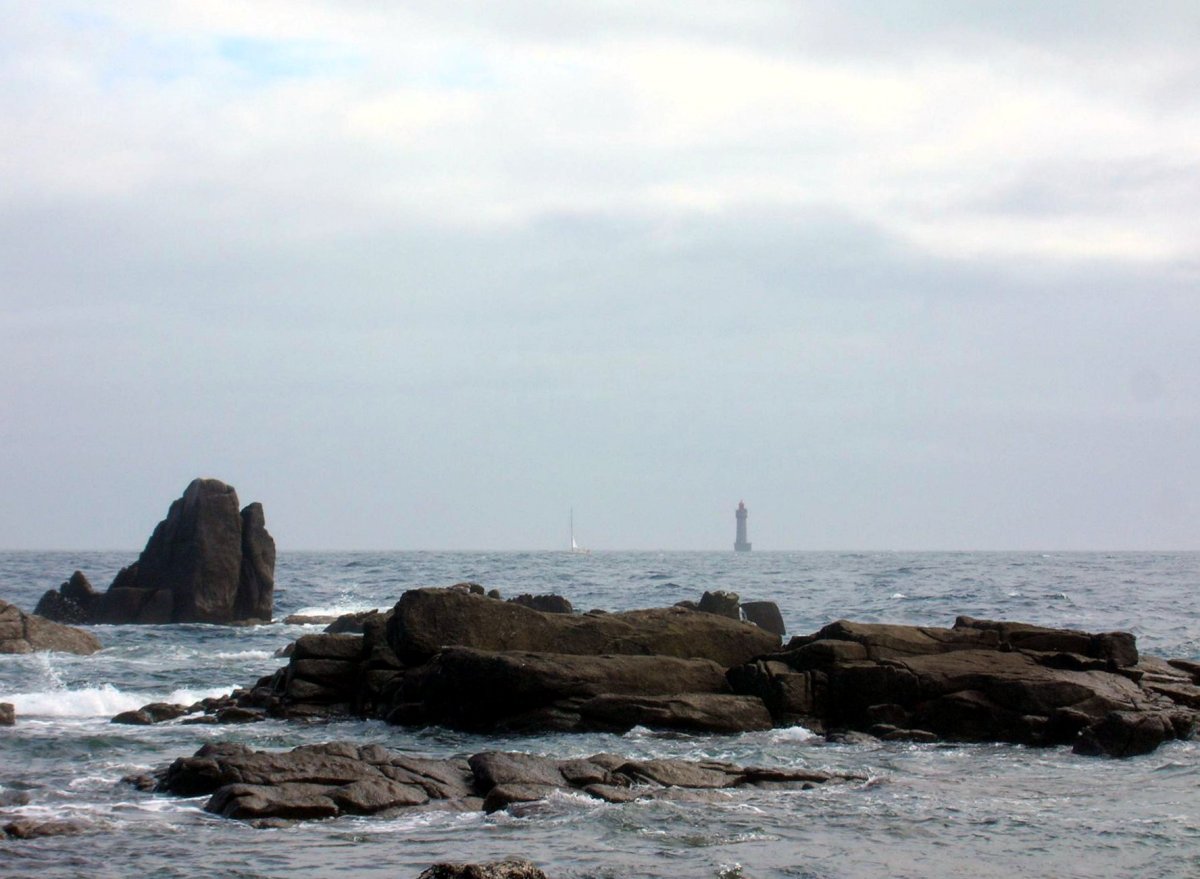
The lighthouse stands on a submerged rock called La Jument, just over three kilometers from the southwestern coast of the island of Ouessant, in the Finistère department. This area of the Atlantic is considered one of the most dangerous in Europe for navigation: powerful currents, treacherous seabeds, and frequent storms have caused dozens of shipwrecks over the centuries. It is no coincidence that right here, where the sea does not forgive, some of the most imposing lighthouses in the world have been erected.
A construction born from tragedy
The story of the Jument Lighthouse begins with a shipwreck. In 1896, the steamship Drummond Castle sank in the waters of Ouessant, causing the death of nearly two hundred people. The tragedy prompted a French engineer named Charles-Marie Potron to donate a considerable sum to the State to finance the construction of a new lighthouse in that area. The work began in 1904 and was completed in 1911, after seven years of construction under extreme conditions: the granite blocks were transported by sea and lifted onto the rock when conditions allowed, often with weeks of forced interruption.
The tower, about 47 meters tall, is entirely made of gray granite covered by a characteristic red band that makes it immediately recognizable. This coloring is not just aesthetic: it serves to distinguish the lighthouse from others in the area and to make it visible even in the reduced visibility conditions typical of Brittany. The original light has been replaced over time by more modern systems, but the external structure has remained substantially unchanged for over a century.
How to observe it up close
The Jument Lighthouse is not open for interior visits, but observing it up close is already an intense experience. From the island of Ouessant, boat trips regularly depart that take visitors to the waters surrounding the lighthouse, close enough to perceive the true scale of the tower and the currents that surround it. Some local companies also organize kayak tours for the more adventurous, although this option is recommended only for those with experience in open waters and in favorable weather conditions.
The easiest way to reach Ouessant is by ferry from Brest or Le Conquet, with crossings that last approximately two hours and thirty minutes or one hour and fifteen minutes, respectively. The company Penn Ar Bed operates the main routes with varying frequency depending on the season. Once on the island, you can get around by bicycle — the most used means of transport by the locals — to reach the viewpoints from which the lighthouse is visible on the horizon.
The right time to come
The summer months, between June and September, offer the most favorable conditions for sea excursions and visibility. However, those who want to see the lighthouse in its most dramatic version — with waves crashing against the tower during storms — should consider a visit in autumn or winter, keeping in mind that ferry crossings may be suspended in rough seas. In any case, it is always advisable to check the local weather forecasts before planning any boat excursions.
Even from the mainland, the Jument Lighthouse offers memorable views. The Pointe de Pern, at the western tip of Ouessant, is one of the best viewpoints on the island and allows you to see the red silhouette of the tower standing out against the open Atlantic. At sunset, with the slanting light coloring the sea, the scene has an almost unreal quality.
Ouessant, beyond the lighthouse
Ouessant itself deserves a visit that goes beyond just the lighthouse. The island hosts the Musée des Phares et Balises, dedicated to the history of Breton lighthouses, where original Fresnel lenses and documentation on the lighthouses of the area can be found, including material on the Jument Lighthouse. It is a useful stop to understand the historical and technical context before or after the sea excursion.
With an area of about fifteen square kilometers and a population of a few hundred inhabitants, Ouessant maintains an isolated and authentic atmosphere that contrasts with the more frequented tourist destinations of Brittany. Coastal paths traverse the entire island and allow for the discovery of landscapes of open moors, wind-battered cliffs, and hidden small bays. The lighthouse, in this context, is not just a point of interest: it is the visual synthesis of everything that makes this corner of the Atlantic so different from the rest of Europe.


