
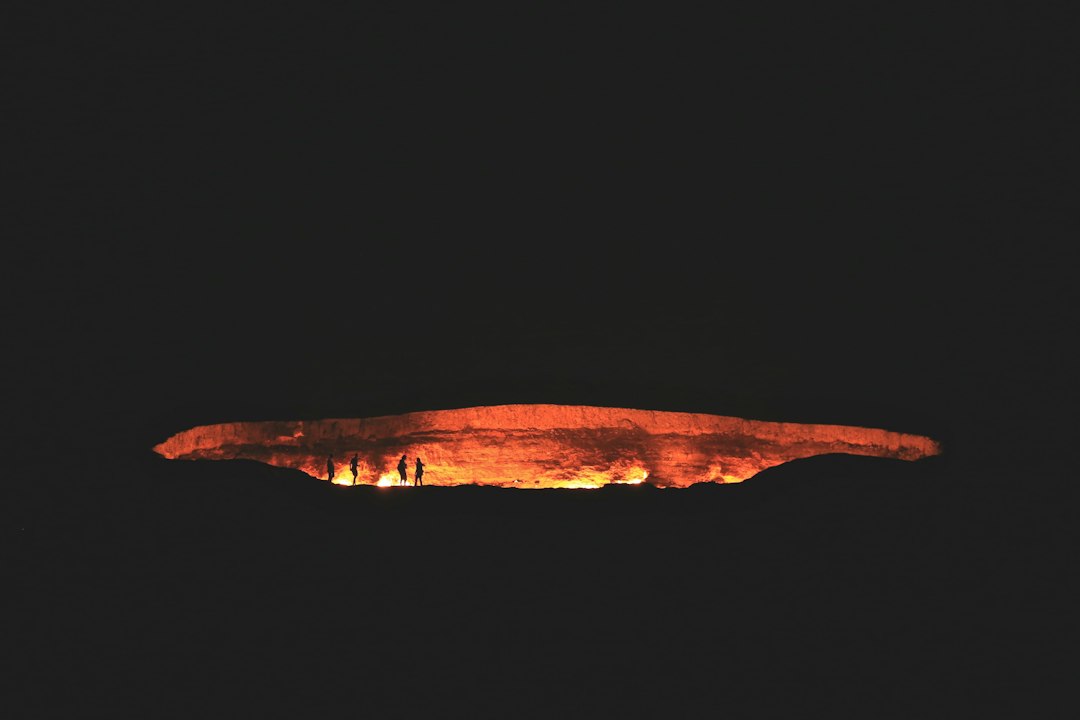

The first thing you perceive, as you approach the Darvaza crater at night, is the heat. Even before seeing the flames, the air becomes denser and warmer amidst the absolute silence of the Karakum desert. Then, suddenly, it appears: a chasm about 70 meters wide that has been burning continuously since 1971, when a Soviet drilling site collapsed under the weight of the machinery, opening an underground cavity filled with natural gas. To prevent the gas from dispersing into the atmosphere, the geologists of the time decided to set it on fire, convinced that it would burn out in a few weeks. Over fifty years have passed.
The site is located in the middle of Turkmenistan, about 260 kilometers north of Ashgabat, the capital, in a region of fine ochre sand dunes that appear motionless during the day and come alive with orange reflections at night. The official name is Darvaza, named after the nomadic village that once stood nearby, but tourists almost universally call it the Gateway to Hell. It is not an exaggerated metaphor: standing on the edge of the crater, the constant roar of the flames and the heat rising to your face produce a physical sensation that is hard to describe with ordinary words.
A landscape that exists only at night
A visit to the Darvaza crater makes sense almost exclusively at night. During the day, the fire is visible but loses much of its visual strength, crushed by the sunlight and the already high heat of the desert. When the sun sets and the sky of the Karakum becomes black and saturated with stars, the crater transforms into something completely different: the flames cast an orange light on the surrounding dunes, the edges of the pit glow like embers, and the entire scene has a hypnotic quality that keeps one awake for hours with nothing to do but watch.
The silence of the desert amplifies everything. There are no cities nearby, no traffic, no light pollution. Just the low, continuous sound of gas burning, the wind occasionally shifting the sand on the edges of the crater, and the sky. Those who have the opportunity to stop and sleep in a tent on the edge — something that many local tour operators arrange — describe waking up at dawn as an equally powerful experience: the flames fading with the morning light, the dunes returning to their natural color, and a sense of geographical solitude that is so total in few places in the world.
How to get there and what to expect logistically
Reaching Darvaza requires planning. The road from Ashgabat is partly paved and partly unpaved, and the final stretch through the desert is only passable with four-wheel drive vehicles. Most visitors arrive through organized tours by local agencies based in Ashgabat, which include transportation, guides, and camping equipment. A two-day tour with an overnight stay in the desert costs approximately between 100 and 200 dollars per person, depending on the agency and the group.
Turkmenistan is one of the most closed countries to international tourism: to enter, a tourist visa is required, which in most cases requires an invitation letter from a registered travel agency. Processing times vary, but it is wise to start the application at least a month before departure. Once in the country, travel is relatively free for tourists, but some areas require additional permits. The tourist infrastructure is limited: do not expect accommodation facilities along the road to Darvaza.
The Karakum Desert as a Context
The crater does not exist in isolation: it is surrounded by the Karakum Desert, one of the great deserts of Central Asia, which covers about 80% of the territory of Turkmenistan. The dunes that make it up are not static: they slowly shift with the wind, and the sand has a fine and almost powdery texture that settles everywhere. Walking on the dunes around the crater, especially at sunset, is an integral part of the experience: the view from the top of a dune, with the glow of the fire in the distance and nothingness all around, is hard to find elsewhere.
It is worth knowing that nearby there are two other craters of similar origin, one filled with water and one with bubbling mud, both produced by the same Soviet drilling activity of the 1970s. They are less spectacular than the fire crater, but they add an interesting geological context to the visit and are easily reachable in the same day. The most important practical advice: bring much more water than you think you will need. The combined heat of the Karakum sun and the flames of the crater quickly dehydrates, and supply points in the desert are nonexistent.
Why the trip is worth it
Darvaza is not a historical site, it has no architecture, it has no museums. It is an industrial accident that has produced something accidentally sublime. The fact that it has been burning for over half a century without interruption, that it survived the collapse of the Soviet Union and the isolation of Turkmenistan, that it continues to burn in the midst of one of the most remote deserts in Central Asia — all of this makes it a place unlike any other. People do not come to Darvaza to learn something or to follow a cultural itinerary. They come to stand still on the edge of a fire crater in the middle of nowhere, at night, and to understand how strange and beautiful the surface of the planet can be.


