
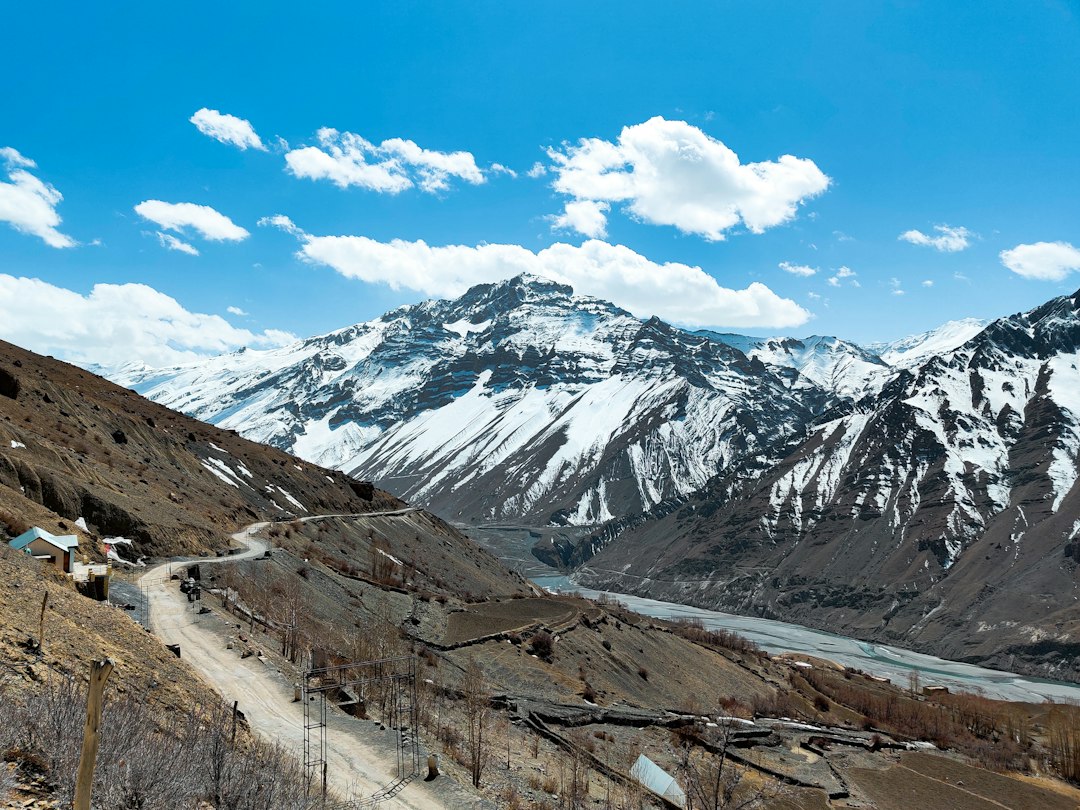

The water is an almost unreal turquoise, as if someone had poured precious ink into a cup of brown rock. At 4,100 meters above sea level, the lake of Dhankar floats above the world, nestled in a lunar landscape that seems to have come out of a high-altitude dream. No trees, no greenery: only sky, stone, and that impossible water that reflects the clouds of the Himalayas.

We are in the Spiti Valley, in the Indian Himachal Pradesh, one of the most remote and least accessible regions of the subcontinent. The lake is reached after a 45-minute hike from the Dhankar monastery, one of the oldest Buddhist sites in the valley, whose construction dates back over a thousand years and literally clings to a rocky wall above the confluence of the Spiti and Pin rivers. The lake is the culmination of that vertical pilgrimage.
A landscape that takes your breath away — literally
Those who arrive here after traveling the road from Kaza, the administrative center of the Spiti Valley about 33 kilometers away, already know that the altitude is felt. But nothing truly prepares you for the visual impact of the lake. The surrounding land is arid, ochre and gray in color, marked by erosions that look like ancient scars. In this high-altitude desert context, the presence of a turquoise mirror of water is something genuinely disorienting.
The lake is of glacial origin and its size is modest — it is not a large alpine basin, but a small hidden gem that reveals itself only when you surpass the final ridge of the path. The surface changes color with the light: early in the morning it tends towards emerald green, in the central hours it shifts to a deep blue. Around, the bare mountains create a natural amphitheater that amplifies the silence.
The Dhankar Monastery: the Starting Point
Before ascending to the lake, it is worth stopping at the Dhankar Monastery, which is also the official starting point of the trail. The monastic complex, which belongs to the Sakya Buddhist school, is considered one of the oldest monasteries in the Spiti Valley. The original structures have been restored several times over the centuries, but the architectural layout retains a distinctly recognizable medieval character. Inside, there are statues and thangkas of considerable value, and the monks who reside there welcome visitors with discreet hospitality.
The village of Dhankar, which surrounds the monastery, is inhabited by a few dozen families and offers an authentic glimpse into life at high altitude in Spiti. The stone and sun-dried mud houses, the flat roofs loaded with firewood for the winter, the terraced fields cultivated with barley and potatoes: every detail tells a millennia-old story of resilience against the extreme conditions of this corner of the world.
How to get there and when to go
The best season to visit Dhankar Lake is between June and September, when the road that crosses the Spiti Valley is open to traffic. In the winter months, the mountain passes that connect the valley to the rest of India are closed by snow, making the area practically inaccessible. The Rohtang Pass and the Kunzum Pass are the two main passes to monitor before planning the trip.
From Kaza, you can reach the village of Dhankar in about 45 minutes by car along a dirt road. There is no regular public transport to the monastery, so it is advisable to rent a vehicle with a driver in Kaza or arrange for a shared jeep. The trail to the lake starts from the monastery and is clearly marked, although steep: sturdy hiking shoes are essential, and at that altitude, even those in good physical shape should walk slowly to avoid symptoms of altitude sickness.
Practical tips for a mindful visit
Anyone who has not spent at least two or three days acclimatizing at similar altitudes should avoid rushing the ascent to the lake. Symptoms of altitude sickness — headache, nausea, shortness of breath — can appear quickly at 4,100 meters, especially if arriving from lower altitudes without an adequate adjustment period. Kaza is located at about 3,800 meters and serves as a good base for acclimatization before tackling more challenging hikes.
There are no accommodations or refreshment points near the lake, so it is essential to bring enough water and food. The monastery has a small guesthouse with basic accommodations, useful for those who want to enjoy the lake at dawn or dusk, when the light transforms the landscape into something even more spectacular. Bringing warm clothing is essential: even in summer, the wind at that altitude can be biting.


