
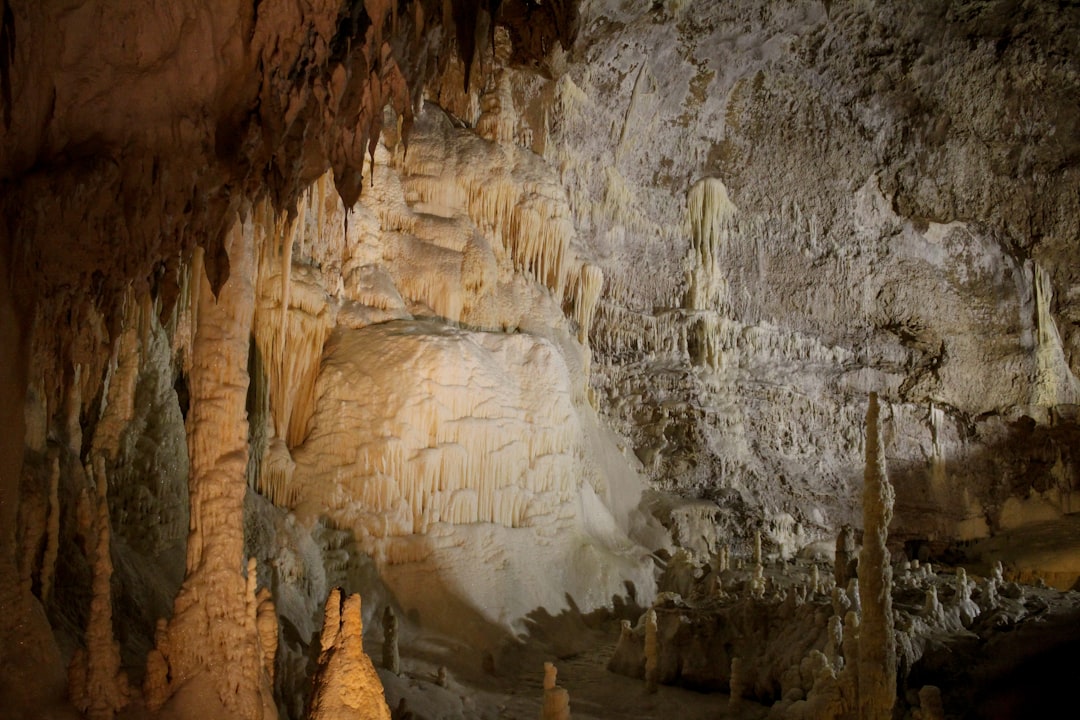

One hundred twenty meters below the surface of the Marchigian hills, the air becomes still and the temperature drops to a constant eleven degrees Celsius, summer or winter. It is here, in the heart of the Umbrian-Marchigian Apennines, that one of the most spectacular karst systems in Europe opens up: the Frasassi Caves, discovered in their vastness in 1971 by a group of speleologists from the Italian Alpine Club. Since that moment, this labyrinth of caves has revealed to the world an underground beauty that defies all expectations.
The first great surprise is purely architectural: the Ancona Hall, the main cave, measures about 180 meters in length, 120 in width, and 200 in height. It is such an immense space that, as local guides love to remind, it could contain the Milan Cathedral inside with ample margin. Standing in the center of this hall and looking up, where the vault disappears into darkness, produces a sense of vertigo that no photograph can truly capture.
Forests of white stone and alabaster columns
What makes Frasassi different from many other caves is the quality and concentration of the calcitic formations. The tourist paths — about 1.5 kilometers of illuminated galleries — traverse environments where stalagmites rise from the ground like trees in a petrified forest, some several meters tall, others thin like candles. The dominant color is an almost blinding white, due to the purity of the calcium carbonate deposited over millennia by water slowly filtering from the overlying rock.
The stalactites descend from the ceiling in formations that resemble tents, organ pipes, and waterfalls frozen in time. In some places, stalactite and stalagmite have fused into columns that can reach considerable heights. The guides explain that these structures grow at a rate of about one centimeter every hundred years: looking at a three-meter tall column means looking at three hundred thousand years of geological history.
The underground lakes and the hidden ecosystem
The Frasassi system is not just rock and crystals. In its depths, rivers flow and underground lakes open up, some of which are visible from the tourist path. The water, where it reaches the surface, has absolute transparency that allows you to see the bottom even at considerable depths. These aquatic environments host a specialized ecosystem: in the waters of the caves live organisms adapted to total darkness and the particular chemical conditions of the environment, including some species of endemic crustaceans.
One of the most relevant scientific curiosities concerns the presence of chemolithoautotrophic bacteria that survive without sunlight, deriving energy from the oxidation of sulfur present in the waters. This discovery has made Frasassi interesting not only for geologists but also for biologists studying life forms in extreme conditions, with possible implications for research on extraterrestrial environments.
How to organize the visit
The Frasassi Caves are located in the municipality of Genga, in the province of Ancona, in the gorge of the Sentino. The standard tourist route lasts about 75 minutes and covers the most scenic part of the system. There are also adventure routes for those who want to go beyond the illuminated paths, with different levels of difficulty and durations ranging from two to six hours, which require advance booking and technical clothing provided in part by the organizers.
The constant temperature of eleven degrees means that even in July it is necessary to bring a sweater or a jacket. Non-slip sole sneakers are recommended, while heels are not advised on the wet path. Tickets for the standard visit are around fifteen euros for adults, with reductions for children and groups. The most useful advice is to book online during summer weekends, when the queues at the entrance can become considerably long. The months of April, May, and September offer a good compromise between reduced attendance and pleasant external weather conditions to explore the gorge and the nearby medieval village of Genga as well.
The context: the Frasassi Gorge
The caves do not exist in isolation. The Sentino Gorge, the limestone canyon that hosts them, is a protected natural environment of great beauty, accessible on foot along well-marked trails. Birds of prey nest on the rocky walls, and the Sentino River flows at the bottom of the gorge with clear waters. A few minutes' walk from the entrance of the caves is the hermitage of Santa Maria Infra Saxa, a medieval sanctuary built literally inside a natural cavity of the rock, which testifies to how these caves have fascinated man long before their modern speleological exploration.
Frasassi is easily reachable by car from the A14 motorway, exiting at Fabriano and following the signs for Genga. The drive from Ancona takes about an hour. There is no direct train connection to the gorge, but some seasonal bus services depart from the Genga-Serra San Quirico station during the summer months.


