


At a 35 meters above the desert floor, the Burdah rock arch stands out against a sky that in Jordan takes on impossible shades, from burnt orange to deep purple. It is not a monument built by man, it has no inauguration date engraved on a plaque: it is the result of millions of years of wind erosion on the red sandstone of Wadi Rum, that vast desert plateau in southern Jordan that the Bedouins still call the Valley of the Moon.

Um Frouth, also known as Burdah Rock Bridge, is one of the highest natural arches in the world accessible on foot. That measurement — 35 meters between the base of the arch and the ground — is not an abstraction: when you are underneath it, your head tilted back, the silence of the desert amplifies every little sound of the wind flowing through the stone, and you immediately understand why this place attracts climbers, photographers, and travelers from every continent.
How to get there and what to expect

Wadi Rum is located about 320 kilometers south of Amman and less than an hour's drive from Aqaba, the port city on the Red Sea. The main access point is the Wadi Rum Visitor Centre, where it is mandatory to register and, for many excursions, hire a local Bedouin guide. Entrance to the protected area of Wadi Rum costs approximately 5 Jordanian dinars per person, but excursion prices vary considerably depending on the operator and the duration of the tour.
To reach Um Frouth Rock Arch, most visitors set off in a 4x4 jeep with a Bedouin guide, traveling along red sand tracks among rock formations that rise dozens of meters high. The arch is not visible from the main road: it requires a short trek on foot through a rocky passage, with a final stretch that involves a non-technical rock climb but requires free hands and shoes with good grip. The total time to reach the arch and return is generally two to three hours, including the jeep ride.

The geology that can be touched
The rock of Wadi Rum is primarily Nubian sandstone, formed hundreds of millions of years ago when this region was covered by an ancient sea. The erosion from wind and water has worked for centuries on the vertical walls, creating arches, cracks, and pillars that look like deliberate sculptures. The surface of the rock that can be touched during the climb to Um Frouth is grainy, almost sandy, with shades ranging from brick red to ochre yellow depending on the exposure to light.
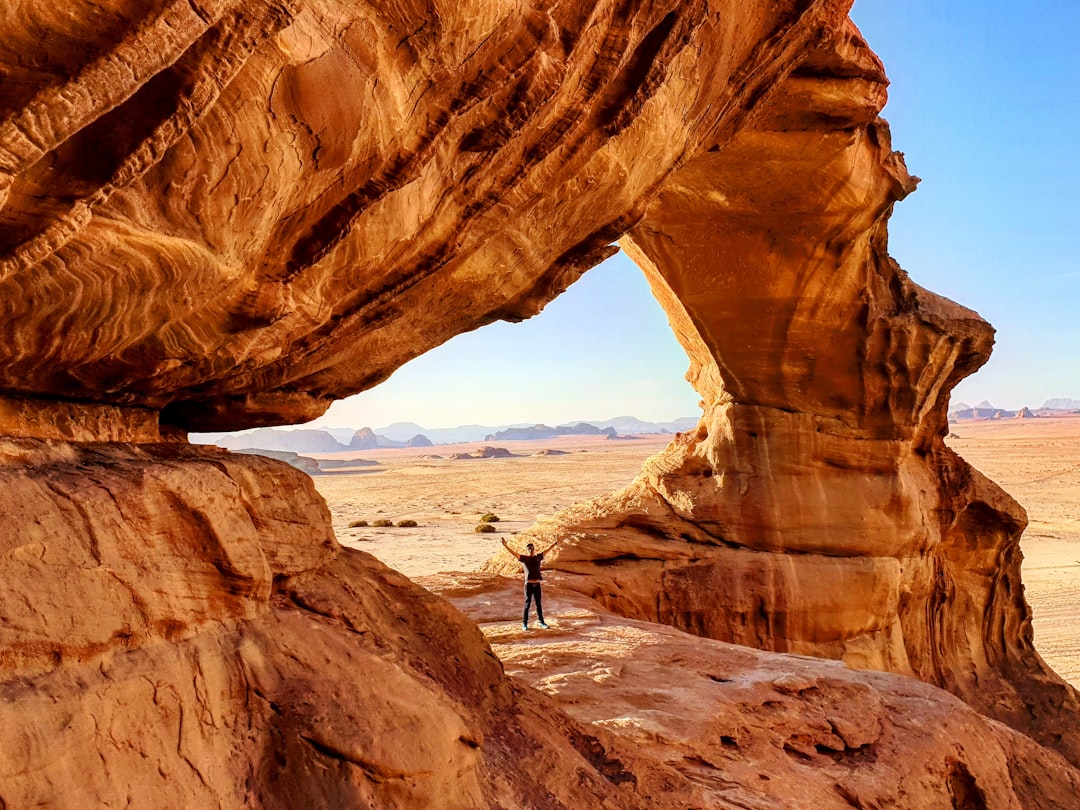
From the top of the arch, if the guide accompanies you to the summit, the panorama embraces a landscape that has no equivalents in Europe: fine sand dunes, rock massifs that emerge flat like tables, and in the distance — on clear days — the line of Saudi Arabia can be glimpsed. It is one of those places where human scale is physically, concretely, not metaphorically resized.
The right time to visit
The Wadi Rum desert can be visited all year round, but the most favorable months are October, November, March, and April, when daytime temperatures range between 20 and 28 degrees Celsius. In summer, between June and August, the heat can exceed 40 degrees, making any hiking exhausting and potentially dangerous without adequate hydration. In winter, nights drop below freezing, and the night sky — free from light pollution — offers an extraordinary astronomical display.
The most useful practical advice: leave for Um Frouth in the early morning hours, ideally by 8:00 AM. The morning slanting light enhances the colors of the red rock in a way that noon cannot replicate, and it avoids the most intense heat during the ascent. Bring at least two liters of water per person, regardless of the season, and do not wear open sandals for the final part of the trail.
Why this arch, among many
Wadi Rum has numerous natural arches, but Um Frouth stands out for a combination of relative accessibility and immediate visual impact. It does not require technical climbing gear, but it is not reached by simply walking: that small dose of physical effort is part of the experience, and when you arrive under the stone arch, you feel as though you have earned the view. The Bedouin guides who accompany visitors know every crevice of the rock and often tell local legends related to the formations, adding a narrative layer to what would otherwise be just geology.
Wadi Rum was declared UNESCO World Heritage Site in 2011, a recognition that has helped regulate tourism and preserve both the natural landscape and the evidence of the ancient Nabatean civilizations present in the area. Um Frouth Rock Arch is part of this heritage: not a postcard, but a place that is understood only by standing under its stone arch, with the desert wind blowing through the opening.


