
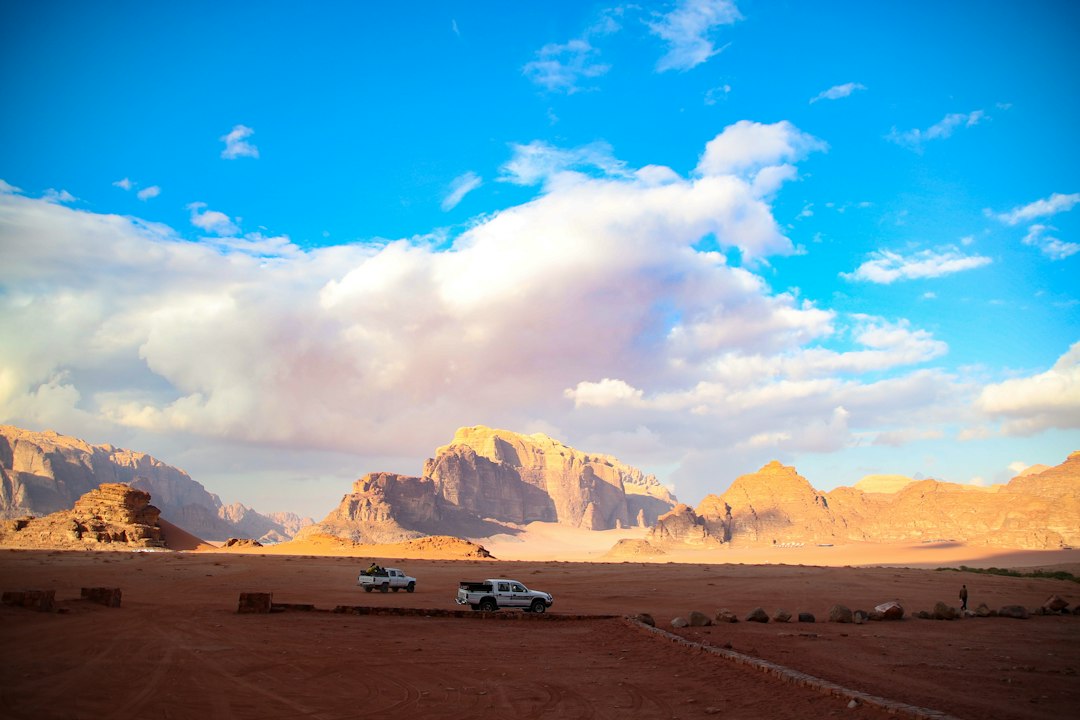

The sun touches the horizon and the red sandstone walls of Wadi Rum begin to burn. It is not a metaphor: the rock, rich in iron oxides, absorbs and reflects light so intensely that the plateaus seem incandescent. It is at this moment, between 5:00 PM and 7:00 PM depending on the season, that Bedouin guides lead visitors to the most remote viewpoints of the protected area, away from the tent camps and the tracks beaten by off-road vehicles.
Wadi Rum is a desert valley in southern Jordan, about 60 kilometers from Aqaba and 120 from Petra. Since 2011, it has been recognized as a UNESCO World Heritage Site under the name Wadi Rum Protected Area, which covers about 74,000 hectares of desert. But the numbers do not prepare one for the visual experience of the sunset: a color sequence that goes from bright orange to violet, to a deep crimson that seems to tint even the air.
The geology that creates the spectacle
What makes the sunset in Wadi Rum different from any other desert is the composition of the rock. The monoliths and plateaus that dominate the landscape are primarily made of Nubian sandstone and granite, two materials with different shades and reflections that react to the setting light in opposite ways. The sandstone, porous and rich in iron minerals, turns towards red and copper. The granite, darker and denser, absorbs light and becomes almost black as the sky turns purple.
The highest mountain in the area is Jabal Rum, which reaches 1,754 meters above sea level. During sunset, its silhouette stands out against the sky like a theatrical silhouette. From elevated positions on the smaller plateaus, at altitudes between 900 and 1,200 meters, one can observe how the shadow slowly descends along the vertical walls, creating a sharp line between the rock still illuminated and that already immersed in darkness.
The role of Bedouin guides
Access to the protected area is regulated and requires passing through the Wadi Rum Visitor Centre, located at the entrance of the village. The entrance ticket for foreign visitors currently costs 5 Jordanian dinars, but most tourists book excursions with local guides, who know the routes to viewpoints not marked on standard tourist maps.
The guides belong to the Bedouin tribes of Zalabia and Zawaideh, historically linked to this territory. They know which plateau offers the best view based on the season and the position of the sun. During the off-road journey through the sand — a trip that can last from 20 to 45 minutes — they explain the local names of the rock formations and tell how the desert changes its appearance throughout the year. The silence that greets visitors once they get out of the vehicle is almost physical: broken only by the wind and, occasionally, the distant call of a desert raven.
What to observe during sunset
Positioning oneself on an open plateau facing west, the color sequence lasts about 40-50 minutes. In the first phase, the slanting light enhances the textures of the rock: every crack, every geological layer becomes visible with a precision that the direct light of noon does not allow. One can observe the Nabataean and Thamudic inscriptions carved on the walls of some formations — ancient scratches dating back over two thousand years that the Bedouin guides can point out with precision.
In the central phase of the sunset, when the sun is just below the horizon, the sky to the east turns a cobalt blue while to the west it still burns. It is the moment when the valley floor sand, which during the day appears almost white, takes on an intense golden hue. Bringing binoculars allows one to catch details on the distant walls that would otherwise escape notice.
Practical tips for organizing your visit
The best time to watch the sunset in Wadi Rum is from March to May and from September to November: the temperatures are mild, between 15 and 25 degrees at sunset, and the light is particularly warm. In summer, the heat can exceed 40 degrees during the day, but the sunset remains spectacular even if the wait can be tiring.
Those who want to experience the complete experience should book at least one night in one of the Bedouin camps within the protected area: after sunset, the darkness is total and the night sky of Wadi Rum is among the clearest in the Middle East, with exceptional visibility of the Milky Way. Bringing warm layers is essential: even in spring, the temperature can drop by 15 degrees in just a few hours after sunset. Sunset excursions can be booked directly at the Visitor Centre or through the camps, and usually last between 2 and 3 hours including the guide.


