
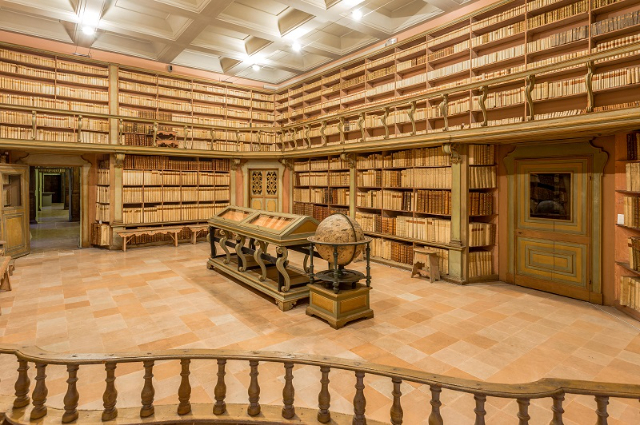

The Gambalunga Civic Library in Rimini was opened in 1619, on a bequest from Alessandro Gambalunga in the palace of the same name, where it is still housed, in the center of Rimini. The palace built in the early seventeenth century by Alessandro Gambalunga. Its original core consists of Gambalunga's library, donated by him in 1617 to the Municipality of Rimini for public use through a bequest in his will. First located in the rooms on the ground floor, where the Municipal Film Library is currently located, in the early 1970s it was moved to the second floor, once the home of the founder and his heirs.
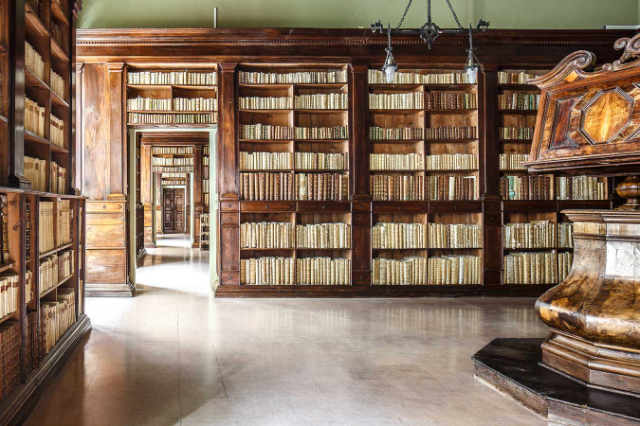
In 1610 he laid the foundation stone of the family mansion, which would be finished in 1614 and cost him seventy thousand scudi, while the library, which in terms of its size and value has no comparable local precedent, in addition to satisfying the interests of a cultured and intellectually curious man, seems aimed at a collective use of the library: in fact, law texts - Gambalunga's disciplinary, if not professional, specialization - were flanked by Greek and Latin classics (with a particular predilection for Cicero), good Italian authors from Dante to Tasso, ancient and modern historians, travelers' reports, treatises on grammar, poetics and rhetoric, manuals on theology and devotion, and scientific writings, especially on medicine and astronomy. Alessandro Gambalunga died on August 12, 1619. The last thought, the extreme apprehension of Alessandro Gambalunga had been for the library, to the fate of which he likely tied the perpetuation of a "surname, or lineage" that, having risen vertically within a couple of generations, risked, for lack of direct heirs, to become extinct just as quickly. By virtue of the will, in the second half of the 19th century the City of Rimini would also inherit the superb Gambalunga palace. In 1620, the library's inventory recorded 1438 volumes and about 2,000 works, and the manuscript, Ovid's 'Metamorphoses'
Today, the library's rich bibliographic, iconographic and documentary holdings consist of 293879 books, of which 60,000 are ancient, 384 incunabula, 5,000 cinquecentine, 16,605 books and audiovisuals of the Film Library, 7,144 engravings and drawings, more than one million photographic images on various media, as well as various documentary collections and funds, thus representing the most important repository of the community's cultural heritage. The photographic archive, established in 1974 as a special section of the Library, offers for public consultation the public and private memories of the city in the form of iconographic documents. The ancient printed collections are mostly located in the four antique rooms, the first three set up in the first half of the 17th century by Librarian Moretti with severe walnut scans, the fourth in the mid-18th century with scans in elegant Venetian style designed by painter Giovan Battista Costa. Here one can admire Gambalung's characteristic bindings, adopted by Gambalunga himself and taken up by his arrangement by subsequent librarians until about the middle of the eighteenth century. Made of white or green-dyed parchment, brown calfskin or red morocco, they are decorated with gold and blind-stamped fillets and bear in the center of the plates the arms (a bare leg cut by an oblique band, on which shine a comet star and a crescent moon) and the name of the founder. The Gambalunga Civic Library, was listed among the most beautiful libraries in the world, in the volume by the Taschen publishing house, with photographs by Massimo Listri: The world's best beautiful libraries, 2018.
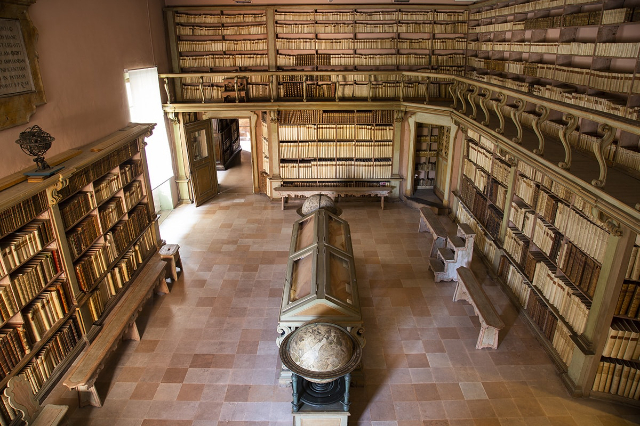
In 2019, on the occasion of the 400th anniversary of its founding, the Library was joined by the donation of semiologist Paolo Fabbri, of a collection of ancient books that belonged to his mother Tina Mirti, a gesture that is in keeping with the tradition of the institution founded in 1619. The texts number some 50, including philosophical works such as Malebranche's The Search for Truth, classical texts by Cicero, Seneca, Tacitus, Theophrastus, verse texts, including a beautiful Orlando Furioso, and religious ones (St. Augustine, devotional manuals). But also eighteenth-century treatises on the channelization of rivers or the construction of mathematical instruments, and even an Essai sur l'histoire naturelle due Polype insecte: a small book accompanied by scientific drawings, an example of the scientific accuracy of the eighteenth century, the Age of Enlightenment.


