
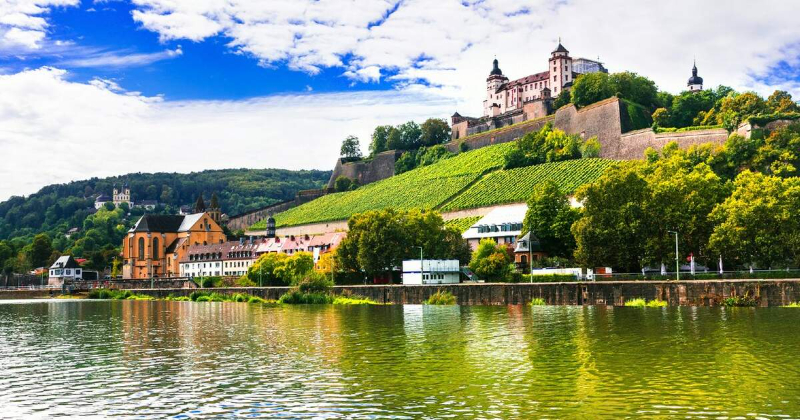

German wine is synonymous with the Riesling. It’s sweet, fruity, seemingly designed for sipping on a sunny day—or, really, all day. But while Riesling may be the star of Germany’s Mosel and Rhinegau regions, it’s hardly recognized in Franconia. Instead, the vino of choice is Silvaner (the local favorite), Bacchus (known as the “wine for women”), or the Riesling-Madeleine Royal hybrid, Müller-Thurgau—wines so supremely local that Franconia’s signature vessel, the Bocksbeutel, is virtually unseen outside the region, let alone throughout the world. White wines dominate the landscape, at roughly 80 percent of the grapes planted. But the handful of reds grown are uniquely Franconian. A typical Rotling is the Franconian rendition of rosé in which vintners grow red grapes but treat them as if they were white, yielding a deeply fragrant white wine that just so happens to be blushing. Domina, the most common red, is inelegant and unrefined compared to virtually anything out of France, but what the wine lacks in grandeur it makes up for in flavor, with a dark, full body and rich in tannins.
Whatever your tipple, just know that Franconians classify their wine in three ways: New, Classic, and “the Great,” where New wines are for everyday drinking (something like a summertime Bacchus to quench thirst while, say, talking to friends on an old stone bridge and listening to Ed Sheeran covers sung in German); Classic wines encompass the dinner-party table—a delicate Silvaner you’d buy for a birthday or that Müller-Thurgau you got for your birthday and guiltily downed while watching Game of Thrones—and “the Great” wines are your once-in-a-lifetime, I’m-too-afraid-to-open-this-bottle variety: the Picasso of wines, a look-but-don’t-touch. Würzburg is the capital of the region’s wine country. It may not be Burgundy or Tuscany—certainly not in terms of the spittle required to even pronounce the name—but those hundreds lining the Alte Mainbrücke’s popular watering hole Alte Mainmühle don’t care. Wine here is poured in the German fashion, which means that, like beer, it’ll overflow out of the glass and eventually onto your white top.


