
← Back

Government Palace

Piazza Unità d'Italia, 34121 Trieste, Italia ★★★★☆ 347 views
Patrizia Bonetti
Trieste
🏆 AI Trip Planner 2026

Get the free app

Discover the best of Trieste with Secret World — the AI trip planner with 1M+ destinations. Get personalized itineraries, hidden gems and local tips. Free on iOS & Android.

🧠 AI Itineraries 🎒 Trip Toolkit 🎮 KnowWhere Game 🎧 Audio Guides 📹 Videos
Scan to download iOS / Android
Scan for AppGallery Huawei users

About Government Palace

Government Palace - Trieste | Secret World Trip Planner

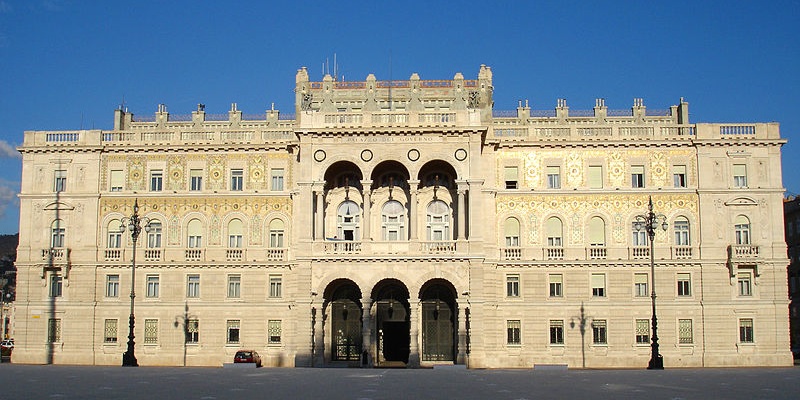
The palace is in Jugendstil (Germanic variant of French Art Nouveau or English Art Nouveau imposed in reaction to the raging Biedermeier style). Built between 1904 and 1905 by Viennese architect Emile Artman in place of a modest 18th-century palace. It is the Government Palace that was first the seat of the Autrian Lieutenancy and today houses the Prefecture. On the main facade the coats of arms of Austria (double-headed eagle) have been changed to those of the Savoy family (shield with white cross on a red background), while on the side facades the originals have been left. The mosaics are made of Murano glass. The mosaics on the facades were made in Innsbruck to the design of the Viennese Giuseppe Straka and depict ornamental and figured motifs. On two levels allegorical male and female heads of practical and intellectual activities are repeated; In 1764, at the behest of Empress Maria Theresa of Austria, the palace of the Captain-Lieutenant was built on the basement basin of the Mandracchio. Demolished in 1899, on the same site stands the present Government Palace, built between 1901 and 1905 to the design of Viennese architect Emil Artmann, which, like many of the buildings in Trieste built near the sea, rests on a 160-cm-thick platform supported by 3,000 concrete piles in order to counteract the instability of the subsoil.

Government Palace - Trieste | Secret World Trip Planner

Of quadrangular plan with a central courtyard, it has externally a horizontal facade partition consisting of an ashlar basement in white stone up to the second floor level, an upper band covered with mosaic decoration, and the stone balustrade of the roof terrace. On the main façade there is a loggia with two superimposed levels divided into three archivolted bays, supported at the bottom by columns and pilasters repeating the ashlar motif of the first level of the building and at the top by plain columns with Ionic capitals. On the balustrade of the terrace above the loggia are groups of cherubs of allegorical significance. Stylistically, the building is inspired partly by Renaissance architecture and partly by the Viennese Sezession style.
Government Palace - Trieste | Secret World Trip Planner
🗺 AI Trip Planner 2026

Plan your visit to Trieste

Suggested itinerary near Government Palace

MAJ+
500.000+ travelers worldwide
  1. 🌅
    Morning
    Government Palace
    📍 Trieste
  2. ☀️
    Afternoon
    Trieste : Caffé degli Specchi, the most famous café in the city
    📍 0 km · Trieste
  3. 🌆
    Evening
    The church of San Nicolò dei Greci
    📍 0.2 km · Trieste

Buy Unique Travel Experiences

Powered by Viator

See more on Viator.com

Explore nearby · Trieste

Frequently Asked Questions

The Government Palace is built in Jugendstil, the Germanic variant of French Art Nouveau, which was a reaction against the Biedermeier style. This distinctive architectural approach is evident in its decorative mosaics and ornamental design elements created by Viennese artist Giuseppe Straka.
The current Government Palace was constructed between 1904 and 1905 by renowned Viennese architect Emile Artman, replacing an 18th-century palace that originally served as the seat of the Austrian Lieutenancy. It was built on a special foundation of 3,000 concrete piles supporting a 160-cm-thick platform to combat the unstable subsoil near the sea.
The mosaics are crafted from Murano glass and were designed by Viennese artist Giuseppe Straka, featuring both ornamental and figured motifs. On two levels, the mosaics display allegorical male and female heads representing practical and intellectual activities, adding artistic significance to the building's exterior.
The main facade displays the coats of arms of the Savoy family (a shield with a white cross on a red background) instead of the original Austrian double-headed eagle, reflecting changes in governance. The original Austrian coats of arms have been preserved on the side facades, creating an interesting contrast that tells the building's political history.
The main facade features a prominent loggia with two superimposed levels divided into three archivolted bays, supported by columns and Ionic capitals. Above the loggia on the terrace balustrade are decorative groups of cherubs with allegorical significance, while the base is constructed in white ashlar stone extending to the second floor, topped with mosaic decoration.