Trip.Planner
En · Travel Guide
Travel Guide · 2026 Edition

15 Hidden Gems in London — beyond the postcard

What the city keeps in plain sight, and why most people still miss it

L
Words by
Lena Hofmann
Updated
20 September 2026
Read time
12 minutes
Includes
15 places · interactive map
15 Hidden Gems in London — beyond the postcard
There is a particular kind of invisibility that only very famous cities can produce. London has mastered it. The place is so thoroughly documented — by guidebooks, by Instagram grids, by the collective memory of twenty million annual visitors — that a strange inversion occurs: the more a thing is written about, the less people actually see it. They photograph it, certainly. They stand in front of it. But seeing is a slower, more inconvenient business, and London rarely rewards the impatient.

I have been coming here for longer than I care to admit, first as a student who thought the Tube map was a kind of treasure chart, later as someone paid to look more carefully. What I have learned is that the city's genuine surprises are rarely buried. They are not down unmarked alleyways (though some are). They are not accessible only to those with connections or insider passwords. More often, they are simply adjacent to something famous — a step to the left of the crowd, a door that everyone assumes is locked, a plaque that everyone assumes is decorative.

The fifteen places and stories gathered here are not secret in the conspiratorial sense. Several of them sit within a few hundred metres of Trafalgar Square. What makes them feel hidden is a combination of pace, context, and the particular human tendency to stop looking once we think we already know what we are looking at. London depends on that tendency. It is how the city keeps its best material to itself, in plain sight, waiting for whoever slows down long enough to notice.

At a glance

  1. London: The Embassy of the Republic of Texas: a sovereign nation on St James's Street
  2. Big Ben, the symbol of London - Secret World: what the name actually means
  3. The Smallest Police Station in the UK: Trafalgar Square's overlooked column
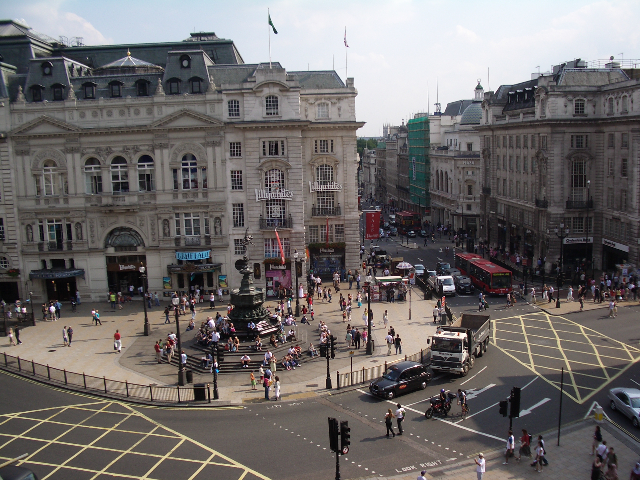
  4. Piccadilly Circus: the collar that became a circus
  5. Turner and the Battle of Trafalgar: the painting that contains an argument

  6. The painting Venus and Mars by the artist Botticelli: a Florentine joke in a London room
  7. Koh-i-Noor, la Montagna di Luce: the diamond that carries a disputed history

  8. Sunday roast: a true British classic: the meal that organises the week
  9. The English Breakfast: the full architecture of the morning
  10. England: Bread and butter pudding: the dish that made virtue of necessity
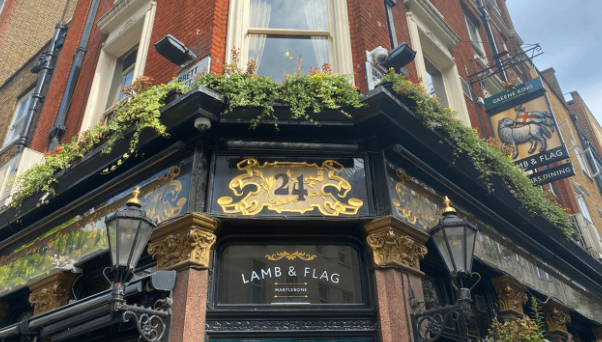
  11. Lo storico Lamb and Flag Pub: the pub that Dryden's attackers used as an exit
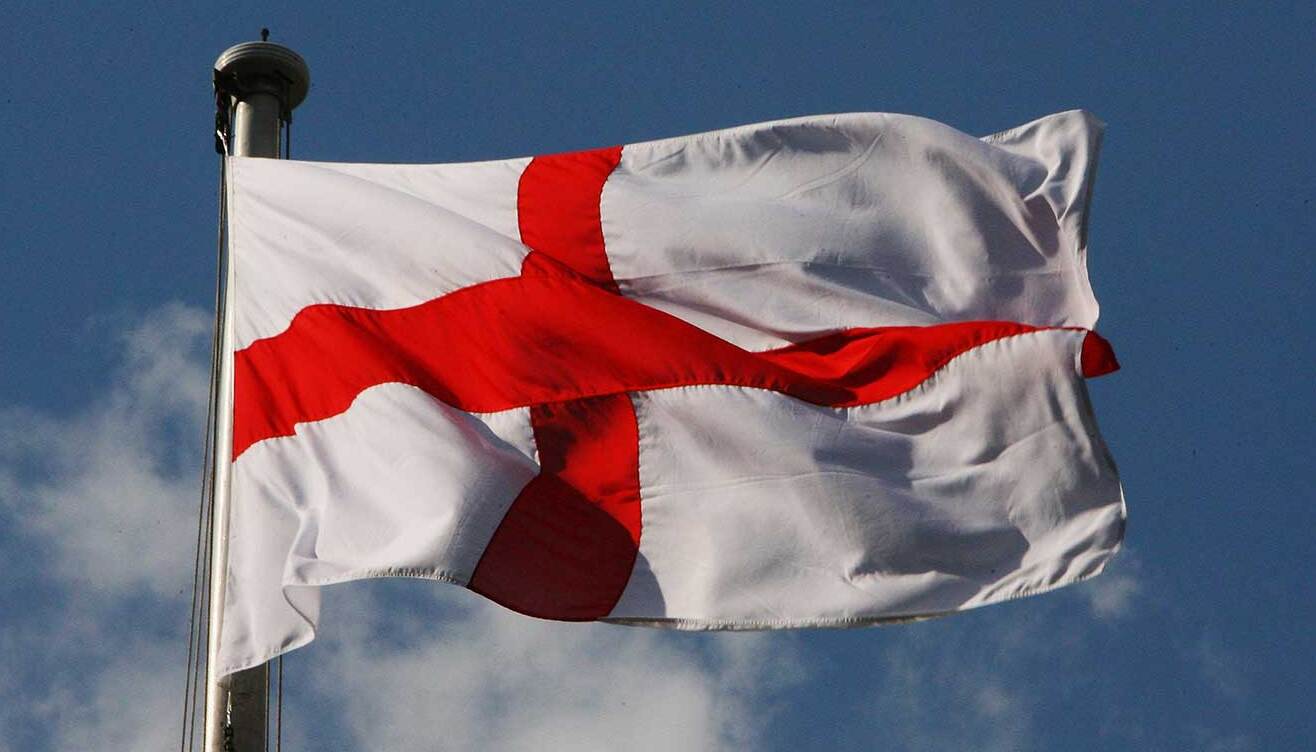
  12. How England Ended Up Stealing the Flag of Genoa: the cross that crossed the Channel
  13. Secret World vs Google Trips: il migliore trip planner per Londra 2026: the question of how to navigate a city this large
  14. AI Trip Planner 2026: pianifica Londra con l'intelligenza artificiale: the new layer on an old map
  15. AI Trip Planner 2026: pianifica Londra con l'intelligenza artificiale: navigating 272 stations without losing the plot
Part one — The essentials
1 Historic Site · 0.7 km

London: The Embassy of the Republic of Texas: a sovereign nation on St James's Street

London: The Embassy of the Republic of Texas: a sovereign nation on St James's Street
Between 1836 and 1846, Texas was not a state but a republic — and it maintained a diplomatic presence in London at 4 St James's Street, a Georgian townhouse that had no particular reason to look extraordinary and, consequently, still does not. Today a small alleyway plaque is the only physical evidence that an independent Texas once conducted foreign affairs from this postcode. The building itself, constructed in 1730, went on to house other tenants without any apparent awareness of its geopolitical footnote.

What makes this spot genuinely arresting is not the plaque itself but the thought experiment it invites. St James's Street remains one of London's most quietly patrician addresses — hat shops, wine merchants, gentlemen's clubs. That a short-lived cattle republic once pressed diplomatic claims from here feels less like history and more like a very dry joke that nobody bothered to explain.
Insider tip The plaque is easy to walk past even when you are looking for it. Stand at the St James's Street end of Pickering Place and let your eyes adjust to the narrow passage — it rewards the pause.
2 Historic Site · 0.8 km

Big Ben, the symbol of London - Secret World: what the name actually means

Big Ben, the symbol of London - Secret World: what the name actually means
Every visitor photographs it. Very few know what they are actually naming when they say 'Big Ben.' The tower is Elizabeth Tower. The clock is the Great Clock. Big Ben is exclusively the name of the great bell inside — a cast-iron fact that most people, including many Londoners, have never had occasion to register. The bell weighs approximately 13.7 tons and was named, most likely, after Sir Benjamin Hall, the Commissioner of Works at the time of its installation in the 1850s, though a rival theory credits a celebrated heavyweight boxer of the era.

The distinction matters not because pedantry is a virtue but because it illustrates something true about London: the city's most recognised symbols are routinely misidentified, and the correct version of the story is almost always more interesting than the shorthand.
Insider tip The best view of the tower that avoids the worst of the tourist compression is from the Lambeth Bridge end of the Embankment, looking northeast in late afternoon light — the angle is less reproduced than the Westminster Bridge shot.
3 Curiosity · 0.1 km

The Smallest Police Station in the UK: Trafalgar Square's overlooked column

In the southeast corner of Trafalgar Square, disguised as an ordinary lamp post or, depending on which account you read, built into a small stone column, sits what is reputedly the smallest police station in the United Kingdom. It is no longer operationally used as a station — it holds, at best, one officer and a telephone — but its existence speaks to a particular Victorian ingenuity about urban surveillance. The idea was that a lone constable could observe the square's crowds and call for backup if a demonstration turned difficult.

Thousands of people pass through Trafalgar Square daily without registering it. It is not hidden. It is simply not the thing anyone came to see, which in London amounts to the same thing.
Insider tip Look for it on the corner nearest Whitehall — it is genuinely small enough that a group photograph taken nearby will often accidentally include it in the background without anyone noticing.
4 Square · 0.6 km

Piccadilly Circus: the collar that became a circus

Piccadilly Circus: the collar that became a circus
The name 'Piccadilly' derives not from any grand civic aspiration but from a frilled collar — the piccadill — that was fashionable in the seventeenth century. A tailor named Robert Baker made enough money selling this collar to build himself a house, which locals promptly nicknamed Piccadilly Hall, and the name migrated to the surrounding area with the casual permanence that only London place names seem to achieve. The 'circus' simply means a circular junction, which the square technically is not anymore.

The neon signs and the statue of Eros (which is actually Anteros, a different deity entirely — another London misidentification) draw the crowds. But the etymology is the thing worth carrying away: one of the world's most recognised addresses is named after a collar that went out of fashion four hundred years ago.
Insider tip The statue's correct identification as Anteros — god of requited love, not Eros — is marked on some older guidebooks but rarely on the signs nearby. It was designed by Alfred Gilbert and unveiled in 1893.
Part two — A little deeper
5 Art & Museum · 0.1 km

Turner and the Battle of Trafalgar: the painting that contains an argument

Turner and the Battle of Trafalgar: the painting that contains an argument
J.M.W. Turner's full title for his most celebrated work tells you more than the shortened version ever could: 'The Fighting Temeraire tugged to her last berth to be broken up, 1838.' Turner knew the Temeraire — she had fought at Trafalgar, one of the most decisive naval engagements in British history — and he was painting not just a ship but a meditation on obsolescence, on the replacement of sail by steam, of the heroic past by industrial utility. The ghostly white hull being towed by a squat, smoke-belching tugboat is a composition built around ambiguity, not sentiment.

The painting now hangs in the National Gallery, which is free to enter and perpetually crowded near the Impressionists. The Turner room tends to be quieter, which is either a failure of public taste or an opportunity, depending on your disposition.
Insider tip Arrive at the National Gallery when it opens and go directly to the Turner rooms before the school groups arrive. The painting is large enough that you need distance to read it properly — do not let the crowd compress you.
6 Art & Museum · 0.1 km

The painting Venus and Mars by the artist Botticelli: a Florentine joke in a London room

The painting Venus and Mars by the artist Botticelli: a Florentine joke in a London room
Completed around 1485 by Sandro Botticelli, 'Venus and Mars' is a painting that rewards close attention and repays it with a quiet, Renaissance-era joke. Mars, god of war, sleeps in post-coital exhaustion while Venus — alert, composed, fully clothed — watches him with an expression that art historians have described as everything from tenderness to mild contempt. Small satyrs play with his armour and weapons, rendering the god of war entirely defenceless. The wasps in the upper right corner are likely a reference to the Vespucci family, who may have commissioned the work — their name derives from the Italian for wasp.

The painting hangs in the National Gallery. It is not the room's most visited work. That is precisely why it is worth finding.
Insider tip The wasp detail in the upper right is genuinely small — bring your reading glasses or step closer than feels polite. The gallery's room 58 contains it alongside other Botticelli works that provide useful context.
7 Curiosity · 0.0 km

Koh-i-Noor, la Montagna di Luce: the diamond that carries a disputed history

Koh-i-Noor, la Montagna di Luce: the diamond that carries a disputed history
The Koh-i-Noor — 'Mountain of Light' in Persian — sits in the Tower of London as part of the Crown Jewels display, and it is one of the few objects in the world whose mere presence in a room constitutes an ongoing diplomatic incident. Originating in India, the diamond passed through Mughal, Persian, Afghan, and Sikh hands before arriving in Britain following the annexation of the Punjab in 1849. India, Pakistan, Iran, and Afghanistan have all at various points requested its return. Britain has not returned it.

Most visitors to the Crown Jewels are focused on the Imperial State Crown or the Sovereign's Orb. The Koh-i-Noor, set into a smaller crown, tends to attract less of the immediate crowd — which gives you a moment to consider what it means for an object to be simultaneously a jewel and a grievance.
Insider tip The Crown Jewels viewing is conveyor-belt style at peak times — you will be moved along. Visit on a weekday morning in the off-season if you want to stand still long enough to actually think.
8 Food · 0.0 km

Sunday roast: a true British classic: the meal that organises the week

Sunday roast: a true British classic: the meal that organises the week
The Sunday roast is not a dish so much as a temporal institution. Eaten anywhere between noon and five in the afternoon on Sundays, it is the meal around which a certain kind of British weekend still organises itself. The components — roasted meat (beef, lamb, pork, chicken, or turkey), roast potatoes, vegetables, gravy, and the non-negotiable Yorkshire pudding — vary by region, by household, and by the particular convictions of whoever is cooking. What does not vary is the social function: it is a meal designed to be eaten slowly, in company, without urgency.

Finding a genuinely good Sunday roast in London requires some navigation. The gastropub version, which arrived in force in the 1990s, ranges from excellent to perfunctory. The domestic version, eaten at a friend's table, remains the gold standard and is not available to most visitors.
Insider tip Look for pubs that still serve roasts only on Sundays rather than treating it as a permanent menu item — the seasonal commitment tends to correlate with the quality of the cooking.
Part three — Off the obvious path
9 Food · 0.0 km

The English Breakfast: the full architecture of the morning

The English Breakfast: the full architecture of the morning
The full English breakfast is, in its ideal form, not an everyday occurrence but a considered event — saved, as its own cultural logic dictates, for weekends and holidays when the morning has enough room for it. The 'full' in the name is literal: it is a breakfast that is full of different things, and the canonical list — bacon, eggs, sausages, baked beans, grilled tomatoes, mushrooms, black pudding, toast — is subject to fierce regional and personal negotiation. What constitutes a proper full English in Manchester is not quite what constitutes one in London.

In the capital, the best versions tend to be found not in hotel dining rooms but in the kind of all-day café that has been operating since before the area became desirable. These places are harder to find than they used to be, but they exist.
Insider tip A café that has laminated menus and has not updated its prices to reflect the neighbourhood's gentrification is usually a reliable indicator of an honest full breakfast. Do not be put off by the décor.
10 Food · 0.0 km

England: Bread and butter pudding: the dish that made virtue of necessity

England: Bread and butter pudding: the dish that made virtue of necessity
Bread and butter pudding is one of those preparations that began as an act of domestic economy — stale bread, butter, eggs, milk, sugar, raisins, layered in a dish and baked until the top is crisp and the interior is yielding — and became, over centuries, a genuine comfort food with a devoted following. It is traditional British cuisine in the most literal sense: a recipe born from the imperative not to waste, elevated by the discovery that the constraints themselves produced something worth eating.

In London, it appears on menus across the price spectrum, from school canteens to Michelin-listed restaurants where it arrives deconstructed and costs considerably more than the original frugality would suggest. The best versions remain the simplest.
Insider tip If you see it listed as a daily special rather than a permanent dessert, that is a reasonable sign that someone made it that morning with actual stale bread rather than fresh bread artificially aged.
11 Bar & Pub · 0.5 km

Lo storico Lamb and Flag Pub: the pub that Dryden's attackers used as an exit

Lo storico Lamb and Flag Pub: the pub that Dryden's attackers used as an exit
The Lamb & Flag in Covent Garden sits at the end of Rose Street, a narrow alley that most people walking through the area do not register as a thoroughfare. The pub dates to the seventeenth century and carries the kind of layered history that London pubs accumulate without particularly trying: the poet John Dryden was allegedly attacked nearby in 1679, an event colourful enough to have given the alley a former nickname that polite contemporary signage tends to omit. The interior is genuinely old — low ceilings, uneven floors, the particular atmosphere of a room that has not been significantly redesigned in living memory.

Covent Garden is one of London's most visited areas. The Lamb & Flag is two minutes from the piazza. The alley entrance is easy to miss, which means the pub is reliably less crowded than everything around it.
Insider tip The upstairs room is smaller and quieter than the ground floor. If you are trying to have a conversation rather than simply occupying space, head up the narrow staircase.
12 Curiosity · 0.0 km

How England Ended Up Stealing the Flag of Genoa: the cross that crossed the Channel

How England Ended Up Stealing the Flag of Genoa: the cross that crossed the Channel
The St George's Cross — a red cross on a white field — has been England's emblem since the Middle Ages, and popular folklore has long credited Richard the Lionheart with adopting both the flag and the patron saint from the city of Genoa during the Crusades. Genoa had used the cross as its emblem for centuries before it became England's, and the story — whether fully accurate or partially mythologised — raises an interesting question about national symbols: how many of them are borrowed, adapted, or quietly appropriated from elsewhere, and how many of those origins have been quietly forgotten?

In London, the flag flies over churches dedicated to St George and appears on the kits of the England football team. The Genoese connection is not widely advertised.
Insider tip The church of St George in Bloomsbury and the older St George's, Hanover Square both offer architectural context for the saint's long presence in London — neither is typically crowded on a weekday afternoon.
Part four — Around and beyond
13 Travel Planning · 0.0 km

Secret World vs Google Trips: il migliore trip planner per Londra 2026: the question of how to navigate a city this large

Secret World vs Google Trips: il migliore trip planner per Londra 2026: the question of how to navigate a city this large
London has over 170 museums, more than 40 historic markets, and a Tube network with 272 stations. The city is, by any measure, too large to navigate by instinct alone — and the gap between a well-planned visit and an improvised one is measured not in missed highlights but in wasted hours on the wrong platform, in queues for things that could have been booked, in the particular exhaustion of a city that never quite does what you expect it to. The question of how to plan — which tools to use, how much structure to impose on spontaneity — is itself a travel decision worth making consciously.

The best approach tends to be a loose framework rather than a minute-by-minute itinerary: anchor points in each area, walking distances understood in advance, and enough flexibility to follow the city when it offers something unplanned.
Insider tip Build your itinerary around Tube zones rather than landmark categories — grouping by geography rather than theme saves more time than any single planning tool.
14 Travel Planning · 0.0 km

AI Trip Planner 2026: pianifica Londra con l'intelligenza artificiale: the new layer on an old map

AI Trip Planner 2026: pianifica Londra con l'intelligenza artificiale: the new layer on an old map
London attracts roughly twenty million international visitors a year, each arriving with different expectations, different physical stamina, different appetites for spontaneity versus structure. The emergence of AI-assisted travel planning represents a genuine shift in how that diversity of need can be addressed — not because artificial intelligence understands cities, but because it can process constraints (time, budget, location, interest) faster than any static guidebook. The British Museum alone requires a minimum of three hours to see meaningfully; the Tower of London, the same. Without some prior structuring, the day fills with transit and queuing before it fills with experience.

What AI planning tools cannot yet do is replicate the knowledge of someone who has walked the same street in different weathers and different decades. The two approaches are not in competition.
Insider tip Use any planning tool to handle logistics — opening hours, Tube routes, booking windows — and reserve your own judgment for the decisions that require taste rather than information.
15 Travel Planning · 0.0 km

AI Trip Planner 2026: pianifica Londra con l'intelligenza artificiale: navigating 272 stations without losing the plot
AI Trip Planner 2026: pianifica Londra con l'intelligenza artificiale: navigating 272 stations without losing the plot
The London Underground has 272 stations spread across eleven lines and nine fare zones. It is one of the world's oldest metro systems and one of the most legible, thanks to Harry Beck's 1931 diagrammatic map — a design decision that prioritised clarity over geographic accuracy and has influenced transit maps globally ever since. The map is not to scale, which means that journeys that appear long on the diagram are sometimes walkable, and vice versa. Knowing which is which is one of the small competencies that separates a confident London visitor from an anxious one.

The Tube is also, on certain lines and at certain times, considerably slower than walking. The distance between Covent Garden and Leicester Square stations — two stops on the Piccadilly line — is approximately 260 metres.
Insider tip Download a geographic (to-scale) map of central London alongside the standard Tube map and compare them before planning any journey under a mile. You will walk more and wait less.
London does not hide its best material. It simply presents too much of it, all at once, without hierarchy or instruction. The result is a city where the genuinely interesting and the merely famous exist at the same volume, and where most visitors — overwhelmed by the noise — gravitate toward what they already recognise. That is not a criticism of visitors. It is a description of how very large, very old cities work.

The places and stories gathered here are not secret. They are adjacent. They require a slightly different angle of attention — the willingness to read the plaque, to ask what the name actually means, to sit in the quieter room rather than the crowded one. London rewards that willingness consistently and without fanfare. It has been doing so for a very long time, and it will continue doing so long after the current cohort of must-photograph landmarks has been replaced by whatever comes next. The city is patient. The question is whether the visitor can afford to be.
🏆 Pocket guide

Take this guide with you.

Save it offline, get walking directions, and discover thousands more places like the ones you just read.

Save offline Smart routes Hidden gems
Scan to download iOS / Android
Scan for AppGallery Huawei users

All places, on a map

Map data © OpenStreetMap contributors.

Frequently asked questions

How much does it cost to visit most of the cultural sites mentioned in this article?

The National Gallery, which houses both the Turner and the Botticelli, is free to enter. The Tower of London, where the Crown Jewels including the Koh-i-Noor are displayed, charges an admission fee and is worth booking in advance online to avoid the longest queues. The Lamb & Flag pub costs only what you order. The street-level curiosities — the Texas embassy plaque, the smallest police station, the Piccadilly Circus area — cost nothing at all.

What is the best time of year to visit London if you want to avoid the largest crowds?

Late January through early March and mid-October through November offer the most manageable crowd levels at major sites. The weather is colder and wetter, but indoor attractions — galleries, museums, historic pubs — are precisely the kinds of places that benefit from a quieter room. Summer, particularly July and August, brings the highest visitor volumes and the longest queues.

Is the London Underground the best way to get between the sites mentioned here?

For distances under about a mile in central London, walking is often faster than taking the Tube once you account for the time spent descending, waiting, and ascending again. The area around Trafalgar Square, Covent Garden, St James's Street, and the National Gallery is compact enough to cover largely on foot. Use the Tube for longer cross-city journeys and consider an Oyster card or contactless bank card rather than paper tickets.

Where can I find a genuinely good Sunday roast in London without booking weeks in advance?

The gastropub scene in areas like Islington, Stoke Newington, and parts of south London offers reliable Sunday roasts at a range of price points. Booking a week ahead is generally sufficient for most places; the venues that require months of advance notice tend to be destination restaurants rather than neighbourhood pubs. Arriving slightly before service begins — around noon — often secures a table at places that do not take reservations.

How should I plan a first visit to London to make sure I see the less-visited things alongside the famous landmarks?

Structure your days by neighbourhood rather than by a ranked list of attractions. Each area of central London contains both famous and overlooked material within walking distance of each other — the Trafalgar Square area alone contains the National Gallery, the smallest police station, and easy access to St James's Street. A loose geographic framework, combined with some advance reading about what each area actually contains beyond its headline attraction, will consistently surface more than a purely landmark-driven itinerary.

🏆 Read this offline

Save it to your phone.

Bookmark this guide, plan your trip offline, and discover thousands of places like these.

Bookmark Plan offline 60 languages
Scan to download iOS / Android
Scan for AppGallery Huawei users
Secret World Hidden places, real stories — plan your trip
Get the app
