
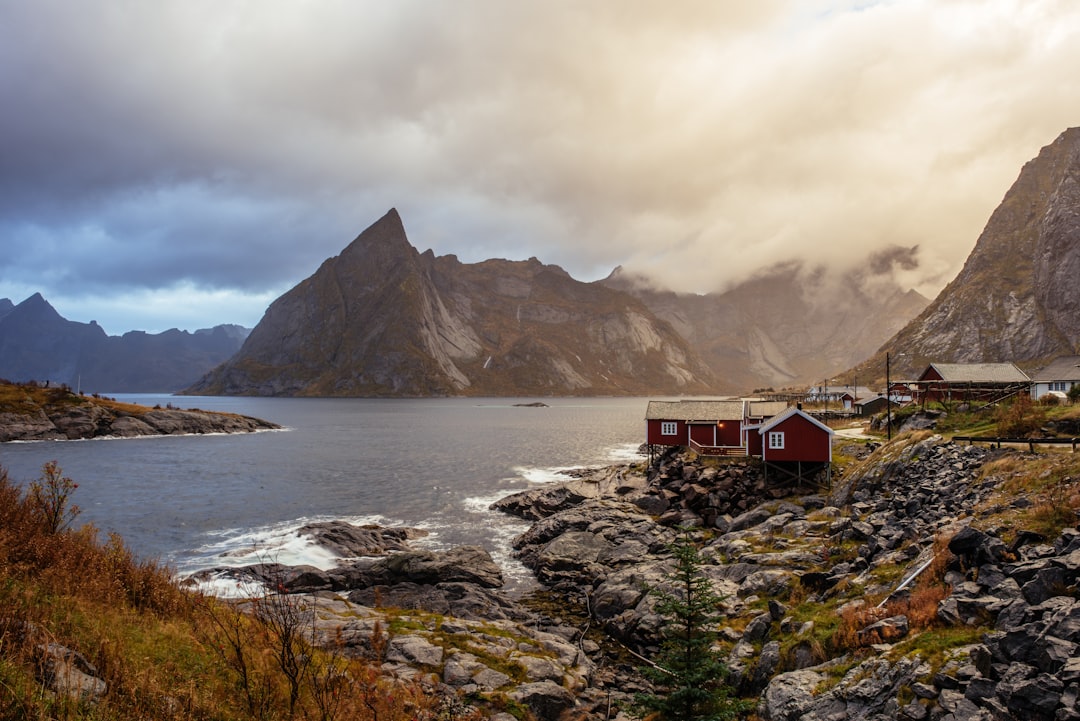

At the first light of dawn, when the fog slowly retreats from the still waters of the fjord, the rorbuer — the traditional red-painted fishing cabins — reflect in the water with an almost unreal precision. We are in Hamnøy, one of the smallest and most photographed villages in the Lofoten archipelago, in the municipality of Moskenes, in Nordland county, Norway. Here, the landscape is not a postcard constructed in a studio: it is the result of centuries of life tied to Arctic cod fishing, which has shaped every building, every pier, every color.

The rorbuer of Hamnøy are not just simple scenic decorations. These stilt structures, originally built to accommodate fishermen during the winter season of cod fishing — the fishing of cod — date back to a tradition that has its roots in medieval Norway. Even today, many of them are rented out as tourist accommodations, allowing visitors to literally sleep on the water, with the towering mountains looming just a few meters away.
The viewpoint of Hamnøy: what can be seen and from where
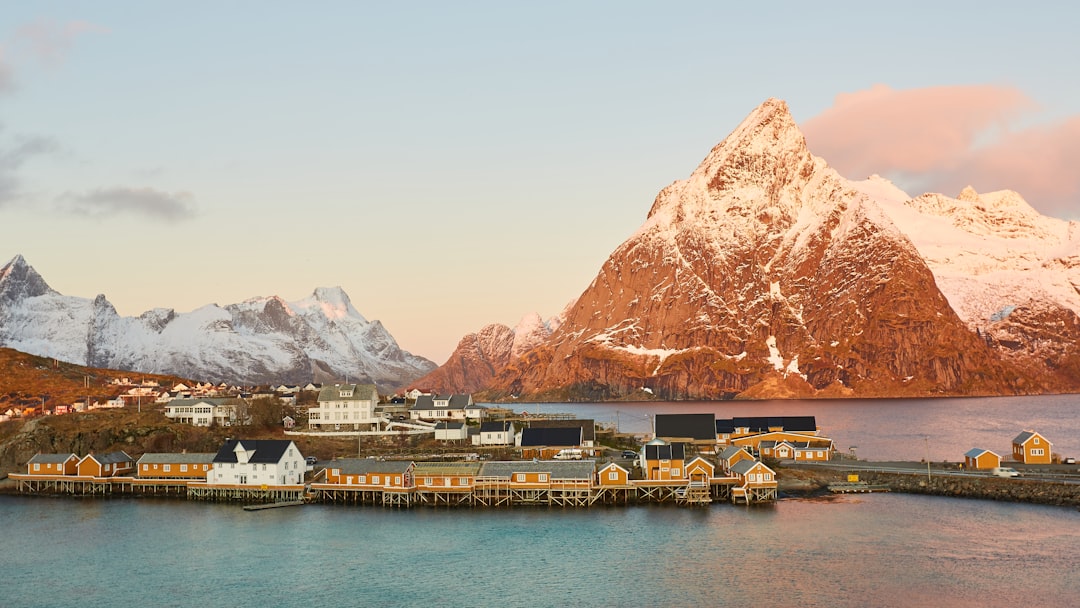
The most famous observation point is located along the E10, the state road that crosses the Lofoten Islands from east to west. There is a marked parking area just before the small bridge that connects Hamnøy to the main road. From here, the view is immediate and frontal: the red cabins stand out against a backdrop of rocky peaks that exceed 600 meters in altitude, among which the sharp silhouettes of the mountains that characterize the silhouette of Moskenes stand out.
What makes this glimpse unique compared to other villages in the Lofoten is the visual compactness of the scene: in just a few square meters of framing, water, reflections, painted wooden architecture, and vertical mountain walls coexist. There is no need to walk long distances or tackle challenging trails — the iconic photograph can be taken directly from the edge of the road or from the parking lot, which explains why this corner has become one of the most reproduced in all of Scandinavia.

The Lighthouses and Light in the Lofoten: A Phenomenon to Understand
Talking about Hamnøy means talking about light. The Lofoten Islands are located beyond the Arctic Circle — Moskenes is about 68 degrees north latitude — which produces two opposite and equally spectacular phenomena: the midnight sun from May to July, and the polar nights from November to January, when the sun does not rise at all. In both cases, the quality of light illuminating the red cabins of Hamnøy is radically different from that of Mediterranean latitudes: more slanting, more golden, with long shadows that enhance the textures of wood and the reflections on the water.

During the midnight sun, the light never completely sets, creating a photographic condition that professionals call permanent golden hour. The orange and pink hues that tint the walls of the rorbuer during these hours are the main reason why many photographers plan their trip to the Lofoten Islands between late May and early July. In winter, on the other hand, the possibility of seeing the northern lights reflected in the fjord adds an additional layer of magic to this already extraordinary landscape.
How to get there and when to go

Hamnøy can be reached by traveling along the E10, the only road that connects the Lofoten Islands. Starting from Svolvær, the main center of the archipelago, the journey to Moskenes and Hamnøy takes about two and a half hours by car, crossing a series of bridges and tunnels that connect the different islands. Alternatively, it is possible to reach Moskenes by ferry from Bodø, on the Norwegian mainland: the crossing takes about three and a half hours and already offers a first glimpse of the coastal landscape.
The most important practical advice is this: arrive at the viewpoint at least one hour before sunrise or sunset, especially in summer, when the parking lot quickly fills up with camper vans and cars with tripods on the roof. Parking is free but space is limited. If you visit in winter, always check the road conditions: the E10 may be subject to temporary closures due to snow or ice, and temperatures regularly drop below freezing. A stay of at least one night in a local rorbuer — prices typically range from 150 to 300 euros per night depending on the season — allows you to experience the sunrise and sunset without the pressure of time.
Hamnøy in the context of the Lofoten
Hamnøy is not an isolated village: it is just a few minutes' drive from Reine, often cited as one of the most beautiful villages in Norway, and from Sakrisøy, another small cluster of rorbuer on the water. Together they form a sequence of views that follow along the E10 like frames of a movie. Each village has its own angle, its own combination of light and mountains, but Hamnøy retains a particular quality: simplicity. A few dozen buildings, a bridge, the water, and the rocks. Nothing more, nothing less.
For those traveling with the goal of photographing or simply stopping to look, Hamnøy offers something that many tourist spots have lost: the feeling that the landscape exists independently of you, that it was there before and will continue to be there after. The red cabins were not built to be photographed — they were built to withstand the wind and the North Sea. The fact that they are also beautiful is simply a side effect of necessity.


