
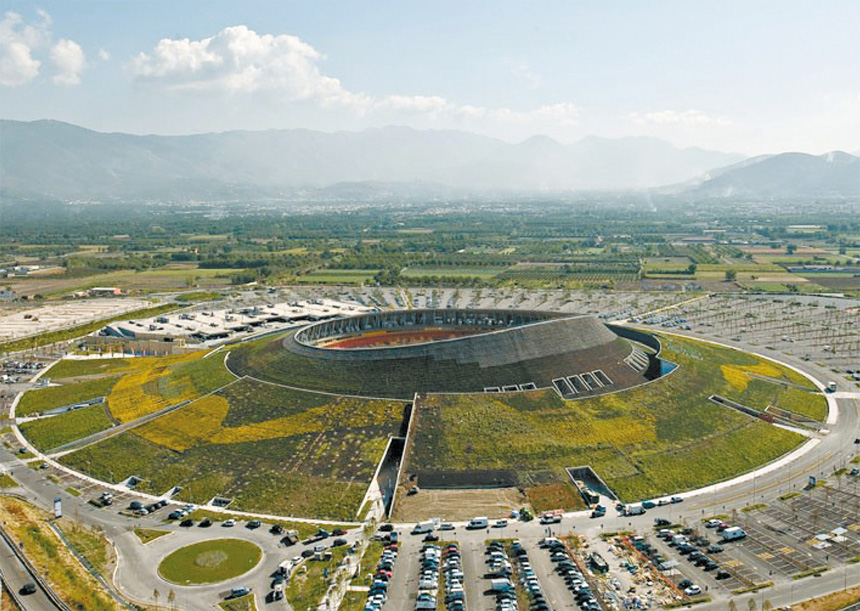

The "Vulcano Buono" by Renzo Piano is one of the most surprising and least celebrated projects by the Genoese architect: a shopping center, but also a work of land art and environmental architecture, built between 1995 and 2007 in Nola, in the countryside north of Naples.
It’s not a real volcano, of course, but an inverted artificial crater, a huge green artificial hill up to 41 meters high, with a base diameter of about 320 meters and an inner "mouth" of 170 meters. From the outside, it looks like a soft mountain covered in grass, rosemary, sage, roses, and thousands of Mediterranean plants (around 350,000 specimens planted): it almost blends into the Campanian landscape, ironically dialoguing with Mount Vesuvius visible on the horizon.
Renzo Piano conceived it as a contemporary version of the Greek agora and the traditional market: at the center is an enormous void, an open elliptical square that serves as the social heart. Here, events, concerts, meetings, and markets take place; around it revolve shops, a hypermarket, restaurants, a multiplex with 2,000 seats, leisure spaces, and even a small hotel. It’s a shopping center disguised as a landscape, where shopping takes a backseat to the idea of a place for collective gathering.
Little-known peculiarities and details
- The roof is alive and (partially) accessible: the covering is an inclined rooftop garden with paths and panoramic viewpoints overlooking Vesuvius. It’s not just aesthetic: it provides natural thermal insulation, reduces summer heat, and filters light through special solar-controlled skylights. Many visitors don’t know you can walk "on top of the volcano"!
- Geological and mirror-like inspiration: Piano didn’t copy Vesuvius but created a kind of inverted mirror. The truncated-conical profile is soft and welcoming (hence "buono"), contrasting with the threatening cone of the real volcano. It’s a play of opposites: destruction vs regeneration, lava vs green, ancient vs contemporary.
- The internal light is magical: thanks to a system of zenithal skylights and curved white walls, natural light gently penetrates the crater all day, creating long, evocative shadows like in a natural amphitheater. The artificial lighting (designed by Piero Castiglioni) turns the square into a lunar stage at night.
- A very long and "political" project: started in '95 for the Interporto Campano (logistics hub), it faced huge delays, changes in purpose, and was inaugurated only in 2007 with Romano Prodi present. Piano defended it as an experiment in civil architecture against land consumption: instead of scattering big-box stores and parking lots, he concentrated everything in one "volcano" and returned green to the countryside.
- Almost hidden curiosity: inside the crater there is a small pine forest (or central green area) recalling the pre-eruption Vesuvian woods. It’s a tribute to the geological memory of the territory, but also a reminder of fragility: a "good volcano" that never erupts, yet reminds us that Campania lives in the shadow of a real one.
Today, Vulcano Buono is somewhat underrated: many see it only as a slightly strange mall, but for those who look closely, it’s a masterpiece of landscape-integrated architecture, a hybrid between building, hill, and public square. Renzo Piano always described it as an attempt to "bring people back to meet face to face, like in the ancient agora, but inside a form that speaks of our territory."
If you’re near Nola, climb the green roof and look at Vesuvius: you’ll understand why they call it "the good volcano". ?


