
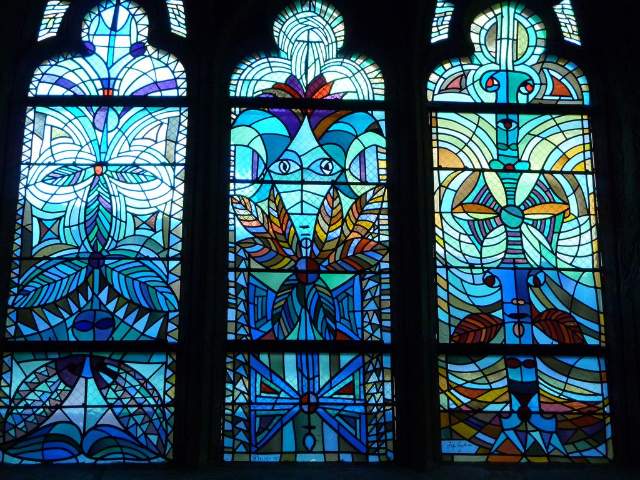

Metz is a city located in the northeastern part of France, known for its rich history and architectural heritage. Among its notable attractions are the stained glass windows created by the avant-garde artist Jean Cocteau, which adorn a neighborhood church.
The church in question is the Saint-Maximin Church, situated in the Quartier de la Grange-aux-Bois neighborhood of Metz. Jean Cocteau, a prominent French artist known for his contributions to various art forms, including literature, film, and visual arts, was commissioned to design the stained glass windows for this church.
Cocteau's stained glass windows at Saint-Maximin Church are known for their distinctive and abstract style. Departing from traditional religious iconography, Cocteau's designs embrace a more modern and unconventional aesthetic. His use of geometric shapes, bold colors, and abstract forms creates a visually striking composition that stands out in contrast to traditional stained glass designs.
This project was one of the final works of Jean Cocteau before his death in 1963. It represents a unique fusion of contemporary artistic expression with the sacred space of the church. The stained glass windows of Saint-Maximin Church are a testament to Cocteau's innovative approach and his ability to transform traditional mediums into modern artistic expressions.
Visitors to Metz have the opportunity to admire Cocteau's stained glass windows at Saint-Maximin Church, experiencing the vibrant colors, abstract patterns, and unique artistic vision that he brought to this final project. The windows serve as a visual representation of the city's commitment to embracing artistic experimentation and innovation, creating a captivating juxtaposition between traditional religious spaces and avant-garde artistic expression.


