
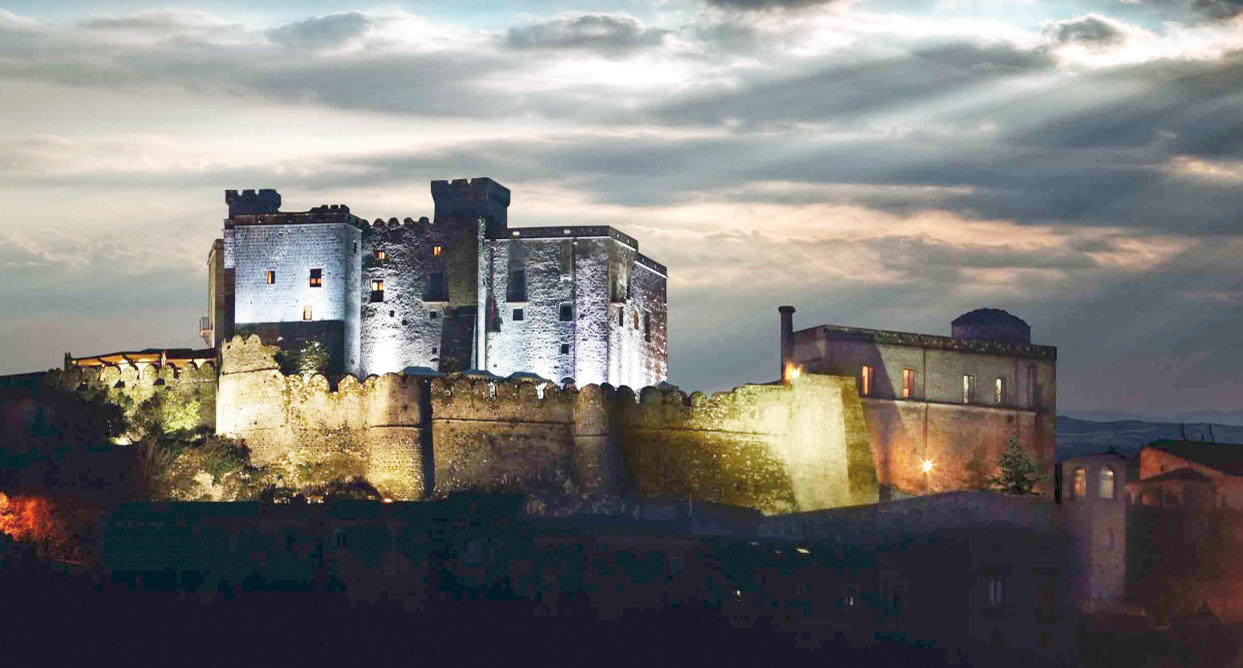

Limatola Castle, which towers above the ancient medieval village, stands guard over the valley furrowed by the Volturno River, between the Taburno massif, Mount Maggiore and the Tifatini mountains. Possibly built on pre-existing defensive structures, Samnite first and Lombard later, but documented from the 12th century, it is characterized by a mighty polygonal wall plan. Designed as a defensive structure, it performed essentially residential functions, however.

The interventions promoted by Charles I of Anjou date back to 1277, to be recognized in the ogival vaulted rooms adjoining the oldest part of the structure corresponding to the rectangular-shaped keep. To the Counts Della Ratta, feudal lords of Limatola from 1420, are ascribable the interventions on the outermost walls and renovations and extensions implemented in some rooms on the stairs and loggias, of declaredly Renaissance taste. Also Francesco Gambacorta and Caterina Della Ratta, in the second decade of the 16th century carried out interventions on the defensive structures and on the Palatine Church of St. Nicholas, which, however, preserves the original Romanesque portal.
Significant seventeenth- and eighteenth-century interventions were due to the Gambacorta, Mastelloni and Lottieri d'Aquino families, who succeeded each other as feudal lords in Limatola: the decorations of the Chapel, the seventeenth-century frescoes in the guest quarters with scenes from Gerusalemme Liberata and the eighteenth-century ones on the main floor with illusionistic architecture, landscapes, girals and grotesques. In 1806 the castle was bought by the Canelli family, gradually falling into a state of total decay.
It is currently owned by the Sgueglia Family, which has restored it and made it functional for receptive and cultural activities.


