
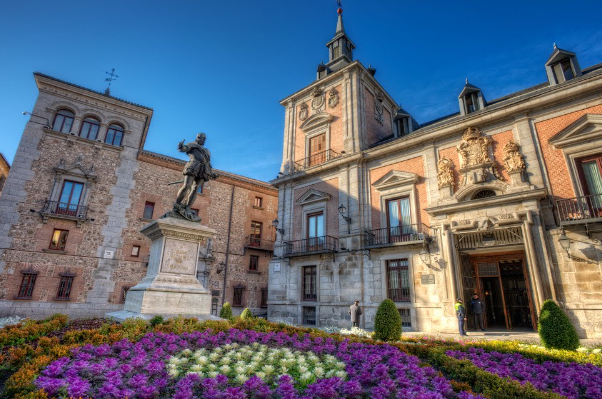

Nestled in the heart of Madrid, Plaza de la Villa is a captivating square that whispers tales of Spain's rich history and cultural heritage. As you step into this historic enclave, you are enveloped by an air of timelessness, where cobblestones echo with the footsteps of centuries past. This square is not just a location; it is a living chronicle of Madrid's evolution from a medieval town to a bustling metropolis.
The origins of Plaza de la Villa date back to the Middle Ages, when it served as a central hub for the village of Madrid. It was strategically positioned near the old Moorish city walls, highlighting its importance as a focal point of communal life. During the 15th century, the square gained prominence with the construction of the Torre de Lujanes, a Gothic-Mudejar tower that stands as one of the oldest buildings in the city. Legend has it that this tower once held King Francis I of France captive after his defeat at the Battle of Pavia in 1525, adding layers of intrigue to its storied walls.
Architectural enthusiasts will find Plaza de la Villa a treasure trove of styles. The Casa de Cisneros, built in the 16th century, showcases a splendid blend of Plateresque and Renaissance styles. Its façade, adorned with decorative stonework and elegant balconies, speaks to the artistic sensibilities of the Spanish Renaissance. Meanwhile, the Casa de la Villa, constructed in the 17th century, exemplifies the Herrerian style, characterized by its solid, austere lines. This building served as Madrid's town hall until 2007, and its interiors host exquisite artworks, including portraits of Spanish monarchs and notable figures.
Beyond its architectural allure, Plaza de la Villa is a vibrant tapestry of local culture and traditions. It is a gathering place for Madrileños during festivals and community events. Notably, the feast of San Isidro, Madrid's patron saint, sees the square come alive with traditional costumes, music, and dance. Locals and visitors alike participate in chotis dances, a hallmark of Madrid's cultural identity, celebrating the city's spirit with every step.
Gastronomy in and around Plaza de la Villa is a delightful exploration of Spanish flavors. Nearby eateries offer a taste of Madrid's culinary staples, such as cocido madrileño, a hearty chickpea stew, and callos a la madrileña, a spicy tripe dish that reflects the city's rustic roots. For those with a sweet tooth, churros con chocolate provide a perfect end to a meal. Pair these with a glass of Vermouth, a beloved local aperitif, to experience a quintessential Madrilenian indulgence.
While the square itself is a well-trodden path, it holds lesser-known curiosities that reward the attentive traveler. Look closely at the Torre de Lujanes, and you'll notice an astrological clock, a rare feature hinting at the scientific interests of its era. Another hidden gem is the discreet markings on the stones of the Casa de la Villa, believed to be stonemasons' signatures, offering a personal touch from those who built this historical landmark.
For visitors planning a trip, the best time to experience Plaza de la Villa is during the spring and fall months, when Madrid's weather is mild and the square's charm is at its peak. Early mornings offer a serene ambiance, perfect for leisurely exploration, while evenings bring a lively atmosphere as locals gather in nearby cafes. As you wander, take time to admire the intricate details of the buildings and the stories they hold. Keep an ear out for the peal of bells from the nearby Iglesia de San Pedro el Viejo, adding to the square's timeless allure.
In the heart of Madrid, Plaza de la Villa stands as a testament to the city's enduring legacy. It is a place where history, art, and culture converge, inviting each visitor to step into a narrative that continues to unfold with every visit.


