
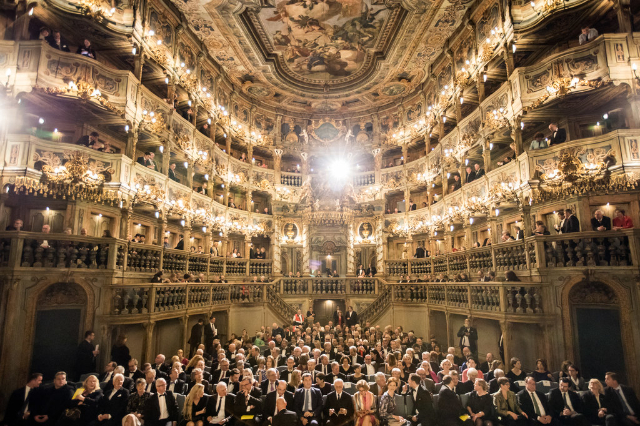

The Margrave's Opera House, whose Logentheater is made entirely of wood, is considered to be the most beautiful and largest preserved Baroque theatre in Europe from the 18th century. The Margrave's Opera House was built between 1746 and 1750 on the occasion of the engagement of Elisabeth Friederike Sophie, the daughter of Margrave Friedrich and Wilhelmine, to Duke Carl Eugen of Württemberg. The building with its strict facade was erected by the Bayreuth court architect Joseph Saint-Pierre. Giuseppe Galli Bibiena, from a famous Bolognese theatre family, was commissioned to furnish the interior. Its serious, Italian baroque style is very different from the rather cheerful Bayreuth rococo and sets the Margrave's Opera House apart from other famous buildings in the city. Although it was not completely finished at the wedding in September 1748, the theatre was inaugurated on the occasion of the festivities with performances of the operas "Il trionfo d'Ezio" and "Artaxerxes". The libretto for the opera "Artaxerxes" was written by Margravine Wilhelmine herself, who had a distinct artistic streak.


