
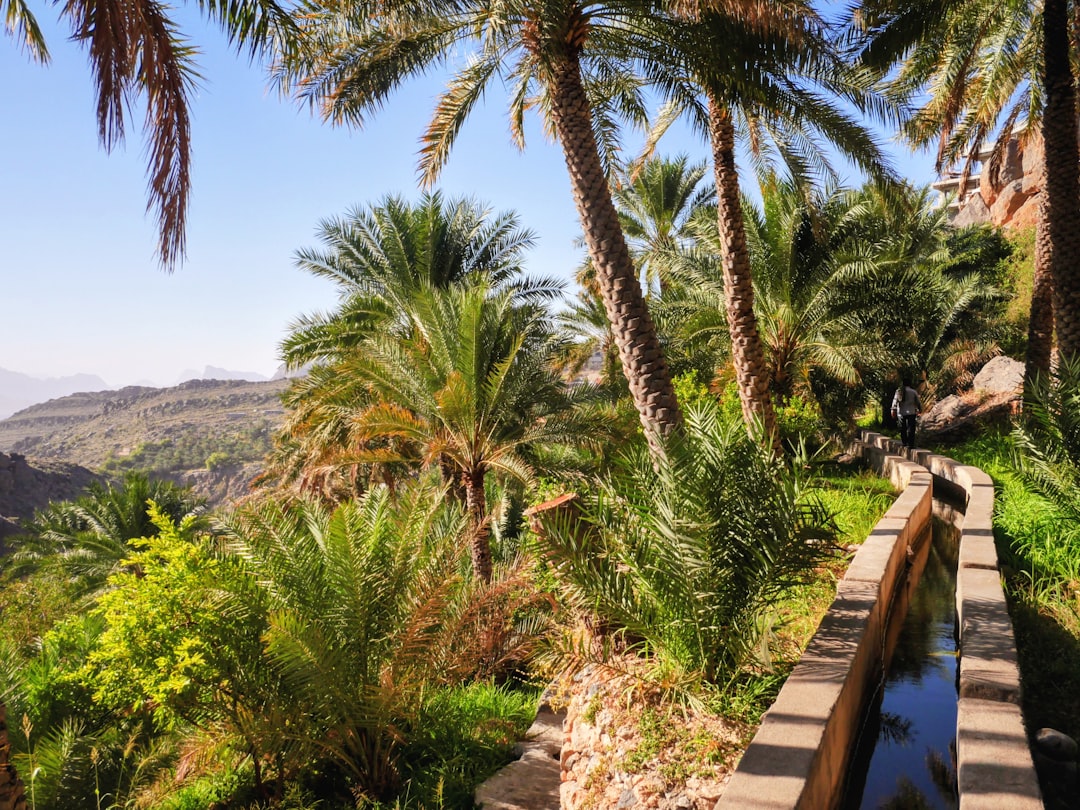

The water flows silently through ancient stone channels that are five centuries old, nourishing hanging gardens of date palms that seem to defy gravity. This is the first sound that greets those who arrive at Misfah al Abriyyin, a village nestled in the limestone rock of the Hajar mountains, in the Ad Dakhiliyah region, inland from Oman. The mud and stone houses overlap one another along the cliffside, as if the village had been carved directly from the mountain rather than built upon it.
What makes this settlement extraordinary is not only its age — its origins date back about five hundred years — but the fact that it is still alive. The families of the Abriyyin tribe continue to cultivate the agricultural terraces, maintain the traditional irrigation system called falaj, and pray in the village's historic mosque. It is not an open-air museum, but a real community that has chosen not to abandon its roots.
The falaj: a millennia-old hydraulic engineering
The falaj system of Misfah al Abriyyin belongs to an engineering tradition that UNESCO recognized as a World Heritage Site in 2006, listing the falaj of Oman among the intangible and tangible assets of exceptional universal value. These are underground and surface channels that capture water from the aquifers of the mountain and distribute it by gravity to the cultivated fields. In Misfah, the path of the falaj is visible at various points in the village: narrow stone channels that run along the alleys, cross courtyards, and descend towards the terraced gardens.
Walking along the main path of the village, one can observe how water is still distributed according to a traditional schedule that assigns each family a specific irrigation turn. The date palm gardens that extend below the village are fertile and well-maintained: banana trees, lemons, and pomegranates grow in the shade of the palms, in a surprisingly cool microclimate compared to the surrounding desert plain.
The mosque and rock architecture
At the center of the village stands the historic mosque, a small building made of local stone and white plaster, with a simple and stout minaret that rises against the rock of the slope. The architecture reflects the traditional Ibadhi style of Oman: essential, without superfluous ornaments, with narrow openings to keep the interior cool during the hottest hours. The mosque is still in use for the daily prayers of the local community.
The traditional houses made of mudbrick — raw clay and straw bricks — show construction techniques that have remained unchanged for centuries. Some houses are partially abandoned, with collapsed roofs revealing the interior, but many are still inhabited or restored. The alleys are so narrow that at certain points the walls of the houses almost touch, creating shady corridors that provide shelter from the sun even during the hottest hours of the day.
How to visit Misfah al Abriyyin
The village is located about 200 kilometers southwest of Muscat, accessible by car via the road that crosses the Hajar mountains towards Nizwa and then continues towards the Al Hamra area. The last stretch of road leading up to the village is paved but narrow and has sharp curves: a 4x4 vehicle is not essential, but it is advisable to proceed with caution. Parking is available at the entrance of the village, from where you continue on foot.
The best time to visit is early in the morning, between six and nine, when the slanting light illuminates the terraces and the temperatures are still bearable — in summer, the days easily exceed 35 degrees even at altitude. Visiting the village takes about two hours for those who want to walk through all the alleys and descend to the gardens. There is no formal entrance ticket, but it is respectful practice to buy something from the local families who sell dates, lemons, or crafts. Dressing modestly is important, especially near the mosque, which is open to non-Muslims only from the outside.
Why it's worth the trip
Misfah al Abriyyin is not easily accessible nor particularly convenient to visit, and this is exactly why it is worth going there. Tourist flows are still limited compared to other Omani destinations, and the village maintains a tangible authenticity. Sitting on the edge of a falaj canal, listening to the sound of water, and watching an elder of the village check the flow of irrigation as his ancestors have done for five consecutive centuries is an experience hard to find elsewhere in the Arabian Peninsula.
Oman has managed to protect places like this with a heritage conservation policy that prioritizes cultural continuity over mass tourism development. Misfah al Abriyyin is one of the most compelling examples: a place where the past is not preserved in a display case, but continues to breathe.


