
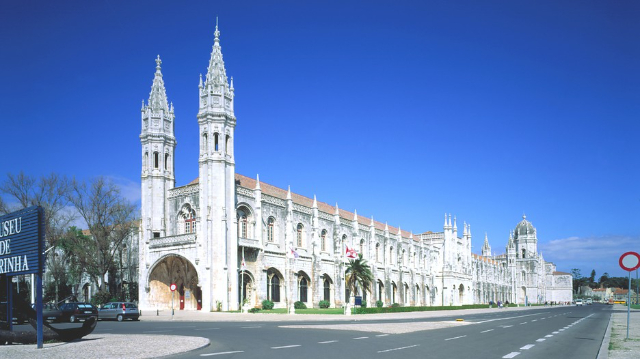

Nestled in the vibrant heart of Lisbon, the Monastero dos Jerónimos stands as a testament to Portugal's rich maritime heritage and architectural grandeur. As you approach this iconic monument, the intricate limestone façade draws you in, whispering stories of exploration and faith from the age of discoveries.

The monastery's origins date back to the early 16th century, commissioned by King Manuel I in 1501 to commemorate Vasco da Gama's successful voyage to India. This monumental project was funded by the wealth accumulated from the spice trade, reflecting a period of immense prosperity for Portugal. Built on the site of a former hermitage where monks prayed for the safety of sailors, the monastery was entrusted to the Order of Saint Jerome, from which it derives its name. For nearly four centuries, the monks inhabited the monastery, offering spiritual guidance and support to seafarers embarking on perilous journeys.
The architectural splendor of the Monastero dos Jerónimos is a superb example of the Manueline style, a distinctive Portuguese take on Late Gothic architecture. The style is characterized by elaborate ornamentation, incorporating maritime motifs such as ropes, anchors, and armillary spheres, reflecting Portugal's naval prowess. The southern portal, designed by Juan de Castilho, is a masterpiece in its own right, adorned with intricate carvings of saints, royal figures, and fantastical creatures. Inside, the church's soaring nave and vaulted ceilings create an atmosphere of awe and reverence, while the serene cloisters invite visitors to wander and reflect amidst their ornate columns and lush greenery.

Beyond its architectural beauty, the monastery holds immense cultural significance for Lisbon. It is not only a symbol of the city's golden era but also a repository of art. Within its walls lie the tombs of notable figures such as Vasco da Gama and the revered poet Luís de Camões, whose epic works capture the spirit of Portugal's Age of Discovery. The monastery's connection to Lisbon's cultural fabric is further celebrated during local festivals, such as the annual Festas de Lisboa in June, where the city comes alive with music, dance, and vibrant parades.
Gastronomy around Monastero dos Jerónimos offers a delightful exploration of Portuguese flavors. Just a stone's throw away is the renowned Pastéis de Belém bakery, where the original recipe for Portugal's beloved custard tarts, pastéis de nata, has been a closely guarded secret since 1837. Savoring one of these warm, cinnamon-dusted pastries is an essential experience for any visitor. Pair it with a bica, a strong Portuguese espresso, for a classic local treat. The area also offers a variety of traditional Portuguese dishes, from freshly grilled sardines to hearty bacalhau (salted codfish) preparations.
Hidden within the grandeur of the monastery are lesser-known curiosities that often escape the eyes of hurried tourists. One such treasure is the small, but exquisitely decorated, Chapter House. Often overlooked, this peaceful chamber is adorned with beautiful azulejos (hand-painted tiles) depicting scenes from Portugal's maritime history. Another intriguing detail is the presence of small, playful gargoyles perched along the cloister's edges, each with a unique expression that adds a touch of whimsy to the solemn architecture.
For those planning a visit, the Monastero dos Jerónimos is best experienced in the early morning hours or late afternoon, when the light casts a golden hue over the limestone, enhancing its intricate carvings. To avoid the crowds, consider visiting on weekdays or during the off-peak seasons of spring and autumn. Make sure to allocate ample time to explore not just the main church and cloisters, but also the adjoining Museu Nacional de Arqueologia and the Museu da Marinha, both of which offer further insights into Portugal's storied past.
As you stand before the Monastero dos Jerónimos, let its walls speak to you of a time when Lisbon was the heart of the world, its sailors charting unknown seas and its poets dreaming of distant lands. This monument is more than just stone and history; it is a living narrative of Portugal's enduring spirit and its indelible mark on the world.


