



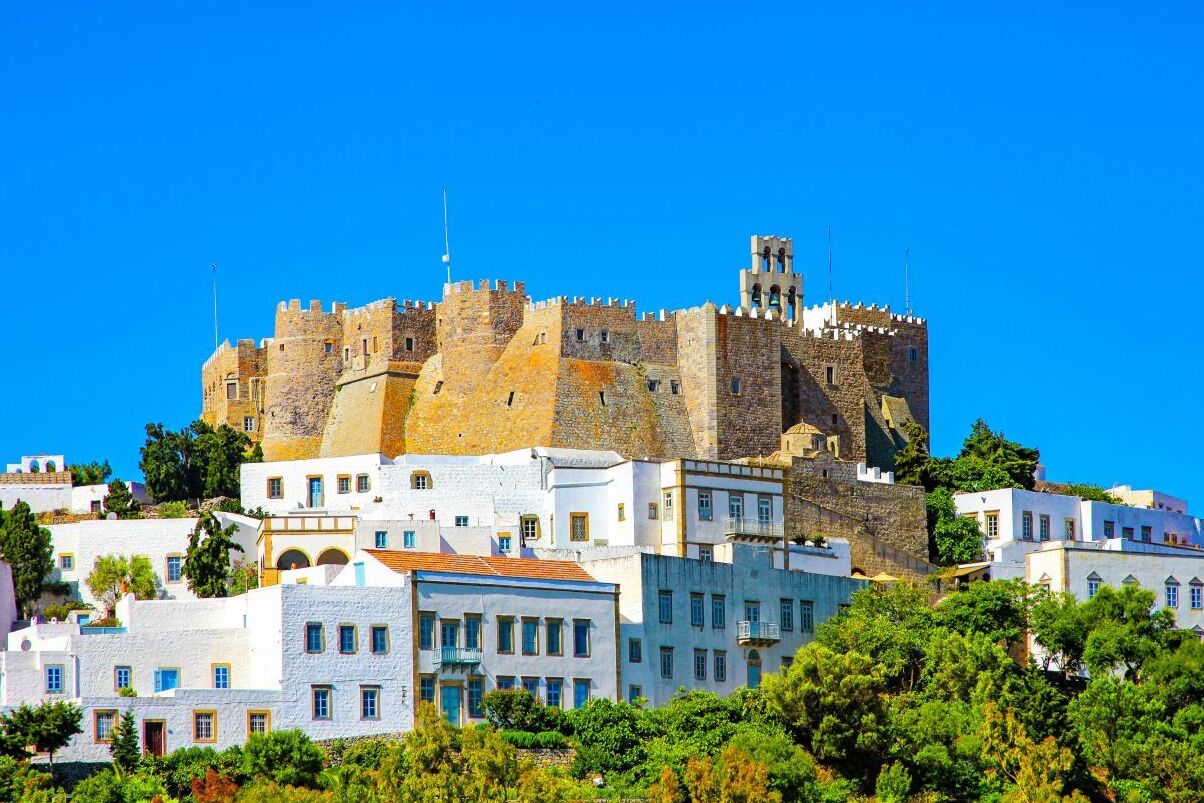
In Roman times the island of Patmos was a place of exile and the disciple of Jesus, St. John in 95 AD found himself on the island because he had been condemned to exile for two years. Patmos is in fact explicitly mentioned in the work as the place where he had his visions and wrote the Apocalypse, the last of the 27 books of the New Testament. The cave of St. Anne, where this would have happened is considered one of the most important places of Christianity. That is why Patmos is called the "Jerusalem of the Mediterranean". The monastery was founded by St. Christodulos during the Arab period, in the 11th century and was later named after St. John the Theologian. Patmos was almost deserted when this gifted and educated monk, St. Christodoulos in 1088 asked and obtained the management of the entire island from the Byzantine Emperor Alexius I Comnenus, to found a monastery in honour of St. John the Evangelist. St. Christodoulos remained on Patmos until 1108 when he was forced to leave because of the invasions of Turkish pirates and died the same year in Evia. His dream, however, continued to inspire other monks who continued his work in the following centuries and expanded the monastery between the 15th and 17th centuries. The foundation of the monastery of St. John the Theologian marked the beginning of a cultural and religious journey that led the island to become a point of reference for all Christianity. From that moment on the island of Patmos underwent an amazing development, not only culturally but also economically. Over the centuries, in almost a millennium of history, the monastery of St. John has always remained active and preserves frescoes and ancient documents of great value. The island of Patmos has been declared holy by the patriarchate, the synodic act and the law 1155/81 of the Greek state. The monastery together with the town of Chora and the Cave of the Apocalypse were named a UNESCO World Heritage Site in 1999, for their high universal value. The monastery seen from the outside looks like a fortress for its imposing walls 15 meters high. It was in fact built on the highest peak of Patmos with the idea of building a place well defensible from pirates. By the time of the monk's death, the construction of the massive outer walls of the main church (the so-called Catholicon), the refectory and some of the twenty cells that the monks have today were completed. The interior of the monastery has many courtyards, cloisters and 10 chapels. In the central courtyard, with three large arches built in 1698, is the Katholikon, consisting of the main church, the chapel of St. Christodulo and the chapel of the Virgin. The chapel dedicated to the Virgin has a rectangular plan and houses the oldest frescoes of the monastery, dating back to the end of the 11th century. Inside the church, with a Greek-cross plan and central dome, there is an iconostasis from 1820 and some frescoes from the 17th century.
