
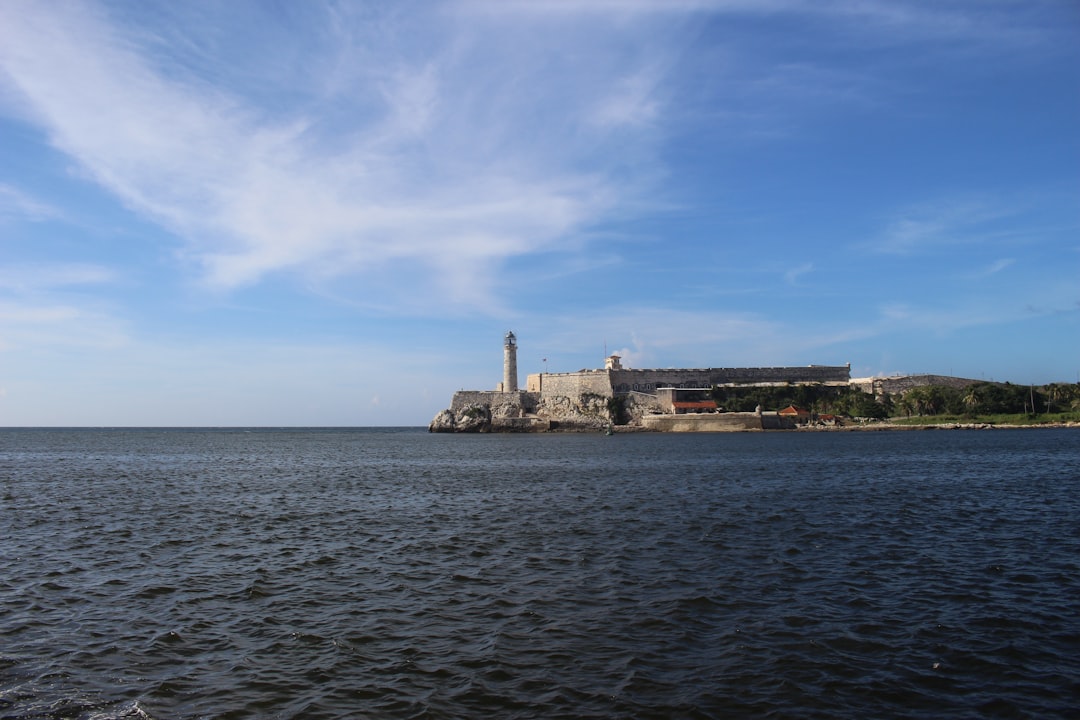

The light of the lighthouse of the Castillo del Morro has guided sailors to the entrance of Havana Bay since 1844, the year the tower was erected above the already existing Spanish colonial fortress. Looking up from the shore, the cylindrical structure made of white limestone stands out clearly against the Caribbean sky: about 25 meters tall, the tower is visible from kilometers away and constitutes one of the most recognizable profiles of all of Cuba.

The castle on which the lighthouse stands — the Castillo de los Tres Reyes del Morro — was built between 1589 and 1630 by the Italian military engineer Giovanni Battista Antonelli, commissioned by the Spanish Crown to defend the port from pirates and enemy attacks. Centuries later, the addition of the lighthouse transformed this defensive structure into a bright landmark, both for navigators and for visitors who today climb up there to admire one of the most intense views of Havana.
The fortress and the tower: history written in stone

Walking along the walls of Castillo del Morro, one immediately notices the thick walls several meters high, built with blocks of locally quarried stone worked by hand. The original cannons are still positioned on the terraces overlooking the sea: they are not reproductions, but authentic pieces dating back to the colonial era, and their presence gives an immediate sense of how strategically vital this place was for the Spanish Empire. The moat that surrounds part of the fortress is now dry, but its depth still tells the defensive function of the entire structure.
The lighthouse itself, added in the 19th century, has maintained its operational function for decades before being partially modernized. The lantern at the top of the tower is still active, although the original oil mechanisms have been replaced over time. Climbing the internal steps of the tower — narrow and steep, as is often the case in historic lighthouses — requires a bit of attention, but the effort is immediately rewarded by the view that opens up at the top.
The sunset view: Havana seen from above
The best time to visit the Castillo del Morro is undoubtedly the late afternoon, when the sun begins to set in the west and the golden light pours over the bay. From here, the view encompasses the entire entrance of the harbor and, on the other side of the water, the silhouette of Old Havana: you can recognize the domes and bell towers of the historic center, the pastel colors of the colonial buildings, and the Malecón waterfront stretching eastward. It is a perspective that no point within the city can offer, because only from across the bay can you see Havana as a coherent whole.
In the evening hours, the ceremony of the Cañonazo de las 9 — the cannon shot fired every evening at 9:00 PM from the nearby Fortress of San Carlos de la Cabaña — adds a sound and scenic element to the experience. Soldiers in period costume repeat a ritual that dates back to the colonial period, when the cannon signaled the closing of the city gates. Witnessing this moment is included in the visit route of the area and remains one of the most authentic shows that Havana offers to visitors.
How to get there and practical information
The Castillo del Morro is located on the peninsula of Casablanca, across the bay from the historic center. The most characteristic way to reach it is by the ferry that departs from the Luz dock, in the heart of Habana Vieja: the crossing takes a few minutes and costs a symbolic amount in Cuban pesos. Alternatively, you can take a taxi through the underwater tunnel that connects the two shores, but the ferry already offers a nice view of the harbor.
The entrance ticket to the Morro-Cabaña complex — which includes both the castle with the lighthouse and the Fortaleza de San Carlos de la Cabaña — is around 6-8 CUP or equivalent for foreign tourists, although prices may vary. It is advisable to dedicate at least two to three hours to the entire area, especially if you want to witness the cannon ceremony. Wearing comfortable shoes is essential: the stone floors of the fortresses are uneven and slippery, and climbing to the lighthouse tower requires a steady step. Early morning is ideal to avoid the heat and organized groups; late afternoon, on the other hand, is the right time for the light and the cañonazo.
A symbol that withstands the test of time
What strikes you the most, standing at the foot of the lighthouse of Castillo del Morro, is the continuity: the same limestone that Antonelli had cut in the sixteenth century still supports the tower that someone decided to build in 1844 to illuminate the sea. Three centuries of history overlap in just a few square meters, seamlessly. It is not nostalgia, it is architecture that has simply continued to do its job.
Havana is a city that tends to overwhelm the senses with noise, colors, and music. Coming here, to the other shore, means earning a moment of distance and relative silence, from which to view the city with different eyes. The lighthouse is not just a viewpoint: it is the place from which one understands the shape of Havana, the way it has clung to the bay for four centuries.


