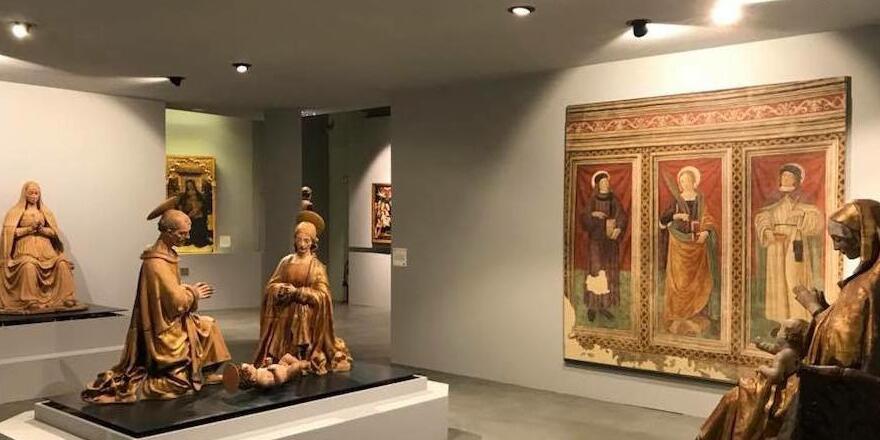

MUNDA - The National Museum of Abruzzo The archaeological section (room A), consists of finds from Amiternum, Aveia and Peltuinum, important Italic and Roman centres in the L'Aquila basin, including the Amiternino Calendar (about 20 A.D.) and stone reliefs depicting a gladiator fight (1st century B.C.) and a funeral ceremony (1st century A.D.). The Middle Ages in Abruzzo (Room B) is documented by an exceptional collection of Madonnas, which for its richness and artistic quality has very few comparisons in the national and international field: some very rare and precious 13th century painted icons (Madonna "de Ambro", Madonna di Sivignano, Madonna di Montereale), and numerous wood carvings; majestic and sacred are those of the Romanesque-Byzantine culture, dating back to the 13th and 13th centuries (Madonna di Lettopalena, Madonna delle Cocanelle); slender and supple fourteenth-century ones, which reveal in the sweetness of the face and the refinement of the lines the spirituality and grace of the new Gothic art (Madonna di Fossa, Madonna di San Silvestro). The fifteenth century (room C) opens with dazzling paintings on a background of pure gold: among them the Triptych of Beffi (1410-1415), attributed to Leonardo di Sabino from Teramo. Evidence of the early Renaissance in Abruzzo are the paintings by Andrea Delitio and the wooden sculptures by Giovanni di Biasuccio and Silvestro dell'Aquila (San Sebastiano, 1478). Among the paintings of Franciscan subject and patron (Room D) stands out the polyptych depicting St. John of Capestrano and stories from his life, the work of an unknown master of complex culture, to whom is also attributed the painting depicting St. Francis receives the stigmata. In the sixteenth century (room E) emerges the highly original personality of Saturnino Gatti, recently renounced among the leading figures of the Italian Renaissance. The Museum exhibits two paintings on wood by this artist (Madonna degli Angeli, 1505; Madonna del Rosario, 1511) and several terracotta sculptures (Nativity scene of Tione and Sant'Antonio Abate, 1512), saved from the earthquake and admirably restored. The exhibition concludes with paintings by important masters of the seventeenth-century Neapolitan (room F): Mattia Preti, Bernardo Cavallino, Jusepe de Ribera, Andrea Vaccaro, Massimo Stanzione.