
← Back

Museum of Mummies

Via della Rocca Loc. Precetto, 05034 Ferentillo TR, Italia ★★★★☆ 271 views
Claudia Armani
Ferentillo
🏆 AI Trip Planner 2026

Get the free app

Discover the best of Ferentillo with Secret World — the AI trip planner with 1M+ destinations. Get personalized itineraries, hidden gems and local tips. Free on iOS & Android.

🧠 AI Itineraries 🎒 Trip Toolkit 🎮 KnowWhere Game 🎧 Audio Guides 📹 Videos
Download on the App Store Get it on Google Play
Scan to download Scan to download

Art, Theaters and Museums · Ferentillo

Museum of Mummies - Ferentillo | Secret World Trip Planner

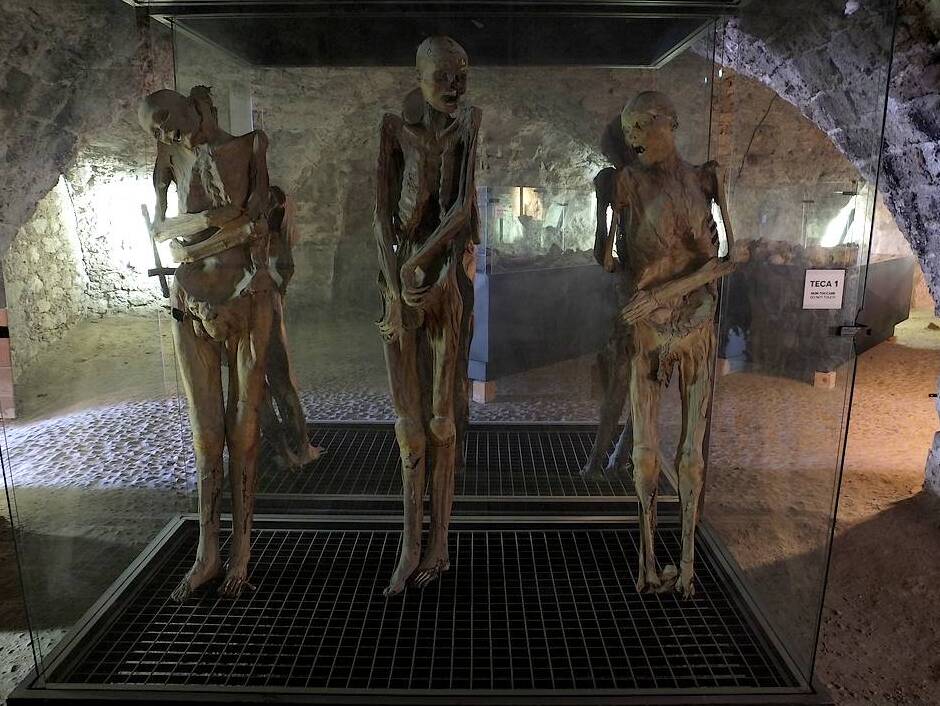
The Museum of the Mummies is a museum located in Ferentillo that exhibits the ancient mummies of the inhabitants of the village. Dipped in the green Valnerina, inside the fluvial Park of the river Nera, it hides one of the most suggestive and important places of the whole Umbria. Divided by the river Nera in two villages, Precetto and Matterella, Ferentillo has been for centuries a cultural and religious centre of remarkable importance. Importance which is expressed today by the numerous architectural, artistic and archaeological testimonies. The crypt of the church of Santo Stefano, today Museum of the Mummies of Ferentillo, was born after the great urbanistic and artistic flowering of the country wanted by the family Cybo at the end of the XV century (in particular with Lorenzo and Franceschetto Cybo). This urbanistic project foresaw the building of new churches in the whole territory of Ferentillo, one of which, dedicated to Santo Stefano, would have been built near the Borgo di Precetto in an area which hosted a medieval church of the XIIIth century. The medieval church, however, was not demolished, on the contrary it was used as a base for the foundations of the new place of worship. The modified spaces occupied by the pillars made possible an alternative use of the church incorporated in the new structure, which in fact became the sepulchral crypt of the "upper" church. The crypt was then filled with earth (probably material resulting from the working of the stone used to build the upper church) which inevitably changed the level of the original floor. From the sixteenth century onwards all the dead of the Borgo di Precetto were buried here (the practice of burial was presumably the responsibility of the Order of Friars Minor Capuchin) until the enactment of Napoleon's Edict of Saint Cloud "Décret Impérial sur les Sépultures" extended to Italy in 1806, prohibited any burial within the city walls and cemeteries were established outside the city (the last burial in the crypt was May 18, 1871). In addition to prohibiting the burial, it was ordered the exhumation of the bodies inside the crypt and only then was it possible to ascertain the perfect mummification of some of them. The crypt still has architectural and artistic elements dating back to the medieval church of the thirteenth century. In fact, one can see the ancient entrance portal, the remains of the apse (demolished to make room for the pillars) and frescoes from the 14th and 15th centuries. The floor is made up of the earth used for burials, compacted as a result of the dripping action of the mountain spring water that penetrates through the ceiling (on the north side you can see the living rock on which the building rests). Since its discovery (especially since the 19th century), this place has become famous for its collection of mummified bodies, attracting the interest of many scholars and visitors. It is because of this great interest that in 1992 it was decided to create a new museum and to use new display cases for the preservation of the bodies. Today the Crypt - Museum of the Mummies of Ferentillo is one of the most visited museums in Umbria.

Museum of Mummies - Ferentillo | Secret World Trip Planner
🗺 AI Trip Planner

Plan your visit to Ferentillo

Suggested itinerary near Museum of Mummies

MAJ+
500.000+ travelers worldwide
  1. 🌅
    Morning
    Museum of Mummies
    📍 Ferentillo
  2. ☀️
    Afternoon
    Abbey of San Pietro in Valle
    📍 3.3 km · Ferentillo
  3. 🌆
    Evening
    Village of Tripozzo
    📍 4.4 km · Ferentillo

Buy Unique Travel Experiences

Powered by Viator

See more on Viator.com

Explore nearby · Ferentillo

Frequently Asked Questions

The Museum of the Mummies is located in Ferentillo, a village in Umbria, Italy, nestled in the scenic Valnerina valley within the fluvial Park of the river Nera. The village is divided into two parts (Precetto and Matterella) by the river Nera, making it easily accessible by car or regional transport through Umbria's countryside.
The Museum of the Mummies is housed in the crypt of the church of Santo Stefano, which was built on the foundations of a 13th-century medieval church during the Renaissance urbanistic expansion initiated by the Cybo family in the late 15th century. The crypt served as the sepulchral burial place for residents of Borgo di Precetto from the 16th century until Napoleon's Edict of Saint Cloud in 1806 prohibited burials within city walls.
The mummies were naturally preserved in the crypt due to the specific environmental conditions created when the space was filled with earth (likely stone debris from the upper church's construction), which altered moisture levels and floor levels. From the 16th century onwards, all dead from Borgo di Precetto were buried here under the care of the Order of Friars Minor Capuchin, creating the conditions for natural mummification.
Ferentillo has been an important cultural and religious center for centuries, as evidenced by its numerous architectural, artistic, and archaeological testimonies. The village experienced a remarkable Renaissance flowering under the patronage of the Cybo family (particularly Lorenzo and Franceschetto Cybo) in the late 15th century, when multiple new churches were constructed throughout the territory.
Visitors can explore the crypt of Santo Stefano and view the naturally preserved ancient mummies of Ferentillo's inhabitants, while learning about the village's 13th-century medieval history and Renaissance transformation. The museum offers insights into burial practices, architectural development, and the unique preservation conditions that created one of Umbria's most significant and atmospheric archaeological sites.
