
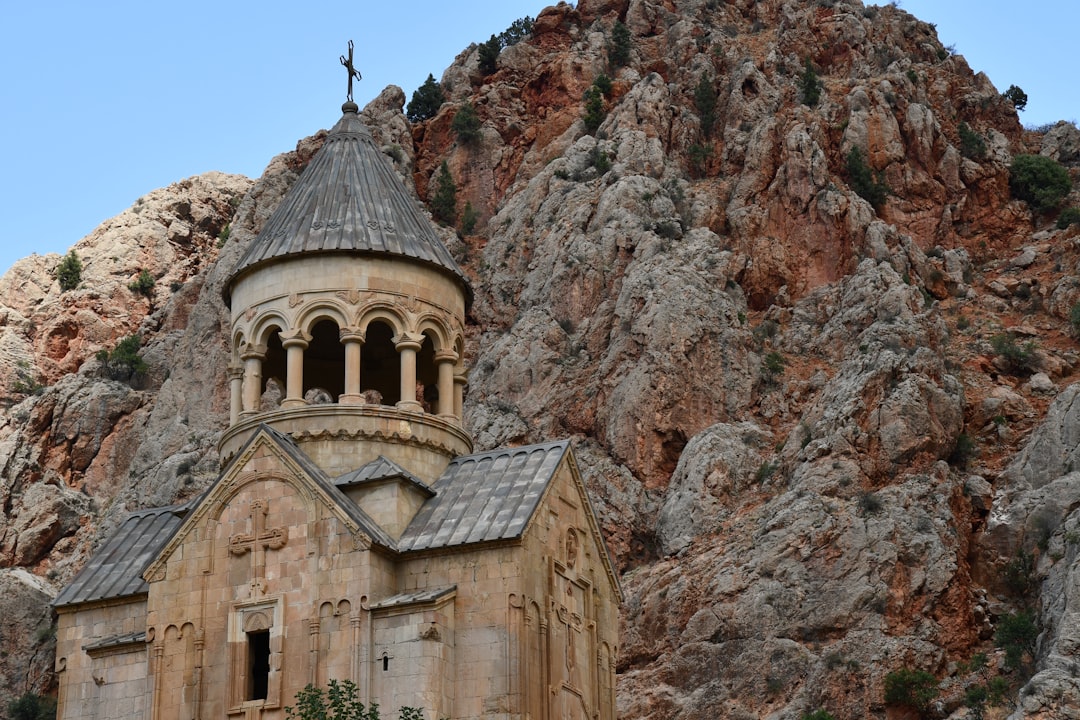

The vertical walls of blood-colored sandstone wrap around the Noravank monastery like the hands of a giant holding something sacred with care. Built starting from the 13th century in the gorge of the Amaghu River, near the village of Areni in the Vayots Dzor province, this Armenian monastic complex is one of those places where architecture and nature seem to have agreed to create something extraordinary. The ochre and brick-red rocks that surround it change shades with the passing hours, transforming each visit into a visually different experience.
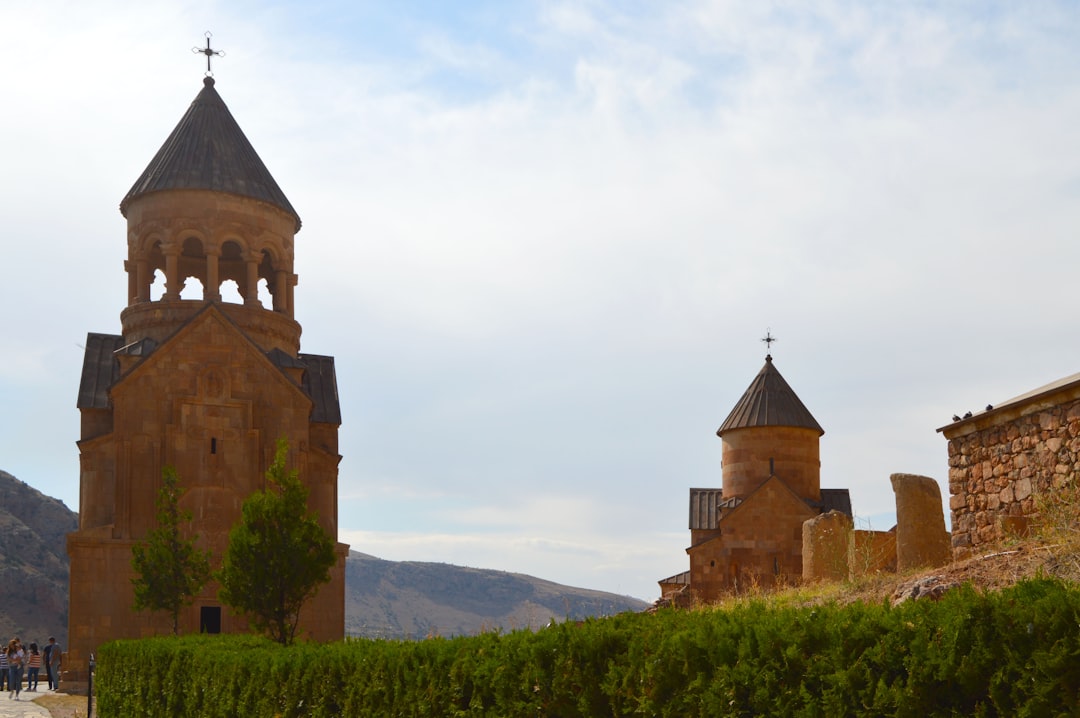
The monastery is not an isolated building, but a collection of structures that tell centuries of devotion and craftsmanship. Hundreds of khachkars — the typical carved stone crosses of Armenian tradition — dot the ground and the surrounding rocky walls, each with unique geometric and floral patterns, carved with a precision that still leaves one speechless today. Walking among these monuments means traversing a forest of stone where each cross is an individual work of art.
The history: from Bishop Hovhannes to Master Momik

The origins of Noravank date back to 1205, when Bishop Hovhannes Orbelian founded the complex on a rocky promontory within the gorge. During the 13th and 14th centuries, the site was expanded and embellished thanks to the patronage of the powerful Orbelian family, who ruled the region. It was during this period that Noravank became not only a religious center but also an important cultural and artistic hub of medieval Armenia.
The name most closely associated with the architectural greatness of Noravank is Momik, the famous Armenian architect and miniaturist active between the late 13th and early 14th centuries. He is credited with designing the church of Surb Astvatsatsin (Holy Mother of God), completed in 1339, shortly before Momik's own death, who according to tradition is buried right within the complex. The church is known for its richly decorated façade and for the steep and narrow external double-flight staircase that leads to the entrance of the upper floor, a rare and immediately recognizable architectural detail.

What to Observe Up Close
Entering the courtyard of the monastery, the gaze is immediately captured by the gavit of the church of Surb Karapet (Saint John the Baptist), a colonnaded hall that serves as a narthex. The internal columns support a perforated covering that allows natural light to filter through in a suggestive way, creating plays of shadow on the stone walls. Observe the capitals: each column is decorated with different motifs, a testament to the expressive freedom of the medieval Armenian stone carvers.

The church of Surb Astvatsatsin deserves special attention for its main portal, framed by reliefs depicting Christ blessing flanked by angels, and for the frieze with intertwined animals that runs along the facade. Climbing the external staircase — if physical conditions allow — offers a unique perspective of the canyon and the rocky towers that rise all around. It is one of those moments when one realizes how carefully the site was chosen, almost as if to place the sacred at the center of a natural amphitheater.
How to get there and when to visit

Noravank is located about 122 kilometers southeast of Yerevan, the Armenian capital. The road leading to the monastery passes through the village of Areni, famous for its local wine production — a stop at the village winery is almost mandatory. The final stretch of the road, which winds into the gorge, is a spectacle in itself: the rocky walls gradually close in, and the landscape becomes increasingly dramatic.
The most convenient way to reach the site is to rent a car or book a private taxi from Yerevan, as public transport connections are limited. The afternoon is the best time for photography: the slanting light of late afternoon ignites the red colors of the rock and casts long shadows on the khachkars. Allow at least an hour and a half to visit the complex at a leisurely pace. Entrance to the site is generally free, although a symbolic contribution for parking nearby may be requested.
Practical tips for the visit
Wear shoes with a non-slip sole: the ground around the churches is uneven and some areas are sloped. If you intend to climb the external stairs of the Surb Astvatsatsin church, be aware that the steps are narrow and steep, lacking a handrail in the central part — it is advisable to exercise maximum caution, especially with small children or in case of rain.
Bring enough water with you, as there are no guaranteed refreshment points inside the gorge. In summer, temperatures in the gorge can be high, while in spring and autumn the climate is milder and the colors of the surrounding landscape are particularly vivid. Avoid high season weekends if you want to enjoy the site in relative tranquility: on weekdays, especially early in the morning, Noravank reveals all its silent grandeur.


