


The smell of grilled fish spreads through the warm air of Friday night even before seeing the lights. In Oistins, a small fishing village on the southern coast of Barbados, every Friday night the parking lot near the harbor transforms into something difficult to describe to those who have never been there: dozens of illuminated stalls, smoke rising from the grills, plastic tables occupied by Barbadian families and tourists sitting side by side, and a sound system blasting soca at high volume until well past midnight.

The Oistins Fish Fry did not start as a tourist attraction. It was — and largely remains — the way local fishermen sold the fresh catch of the week, cooking it right on the spot. Over time, this tradition has solidified into a regular event that today attracts thousands of people every Friday night, with attendance further intensifying in the months between December and April during the high tourist season.
What to eat: the menu that doesn't change

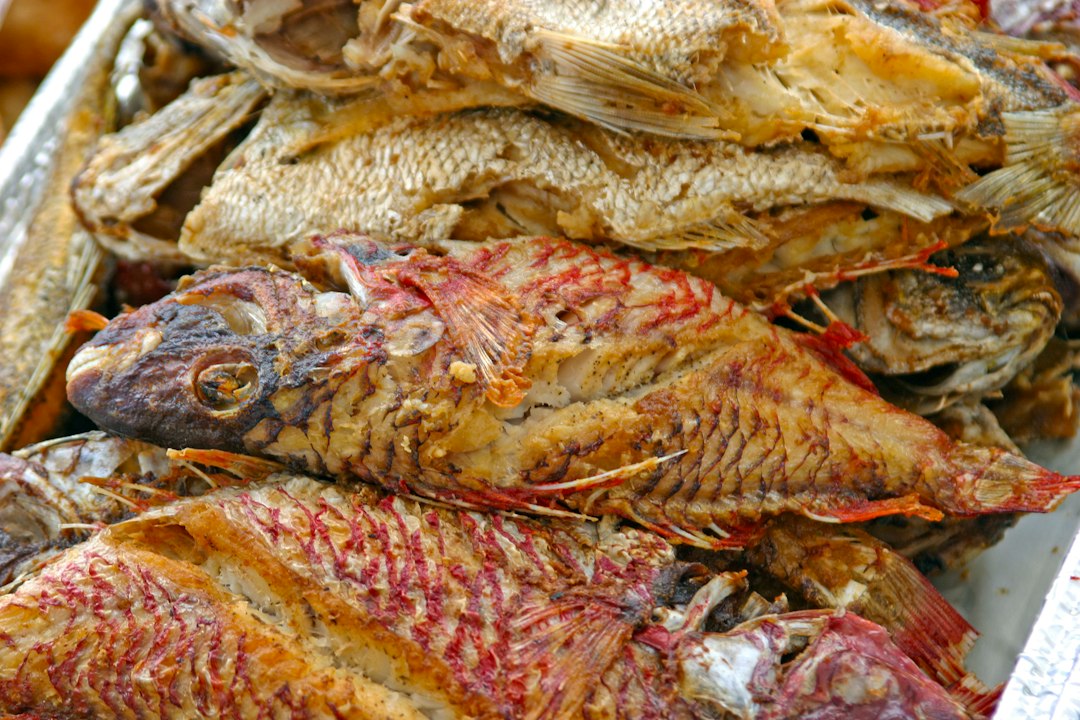
The absolute protagonist is the flying fish, the flying fish, which is also the national symbol of Barbados. It is cleaned, marinated with local spices — thyme, onion, cayenne pepper — and then grilled over large wood coals. The meat is firm, slightly smoky, with an outer crust that gives way under the teeth, leaving the inside soft and juicy. Next to the flying fish, you will find mahi-mahi, locally called dolphin fish, and medium-sized shrimp cooked with butter and garlic.
But the Fish Fry would be incomplete without the side dishes that Barbadians consider essential. The macaroni pie is a kind of baked pasta pie with cheddar cheese, eggs, and spices: it has a compact, almost solid texture that is cut into slices like a savory pie. Next to this, you will find cou-cou, a polenta made from cornmeal and okra that is the official national dish of Barbados, and coleslaw dressed with mayonnaise and vinegar. A complete meal — fish, two sides, and a drink — costs approximately between 20 and 35 Barbadian dollars, equivalent to about 10-17 euros at the current exchange rate.

The atmosphere: sounds, lights, and movement
Each stall has its own style, its name painted on a wooden sign, and often its specialty. Some have been run by the same families for decades. The cooks work standing behind grills that are up to two meters long, turning the fish with metal tongs while talking to customers and taking orders from memory. There are no uniformly written menus: you look at what is on the fire and ask.

The music is a structural element of the experience, not just background noise. The soca — a genre that originated in the Caribbean from the fusion of soul and calypso — comes out of the speakers at a volume that makes conversation possible only by getting close to the person you are speaking with. During peak times, between 9 PM and 11 PM, the area becomes almost an improvised dance floor: it is not uncommon to see groups of people moving between the tables following the rhythm. All of this happens just a few meters from the beach, with the ocean visible beyond the fishing boats moored in the small harbor.
How to get there and practical advice
Oistins is located on the south coast of Barbados, about 11 kilometers from the capital Bridgetown. From the center of Bridgetown, it can be reached by public bus — the lines serving the south area cost less than 2 Barbadian dollars — or by taxi, with a fare from the capital ranging between 25 and 40 Barbadian dollars depending on negotiation. Many hotels on the south coast, such as those along St. Lawrence Gap, are reachable on foot or by a short taxi ride.
The best time to arrive is around 7:00-7:30 PM: the stalls are already operational, but the crowd has not yet peaked. After 9:00 PM, finding a seat becomes difficult and the lines at the most popular stands get longer. If you are in a large group, it is advisable to arrive early, occupy a table, and then split up to place orders. Bring cash in Barbadian dollars: not all stalls accept credit cards. Avoid going on days other than Friday expecting the same atmosphere: on other days of the week, the area is much quieter and the food offerings are reduced.
Why it is worth the visit
The Oistins Fish Fry offers something that many tourist-oriented dining experiences fail to replicate: the feeling of being in a place that would exist exactly the same even without you. Barbadians come here to eat well while spending little, to be with family, to dance. Tourists are drawn to this same authenticity and end up becoming part of it, at least for an evening.
The grilled flying fish eaten at a plastic table with a view of the harbor, accompanied by a Banks beer — the local lager produced by Banks Breweries of Barbados — and the music coming from the speakers: it is a precise sensory experience, hard to confuse with anything else in the Caribbean.


