
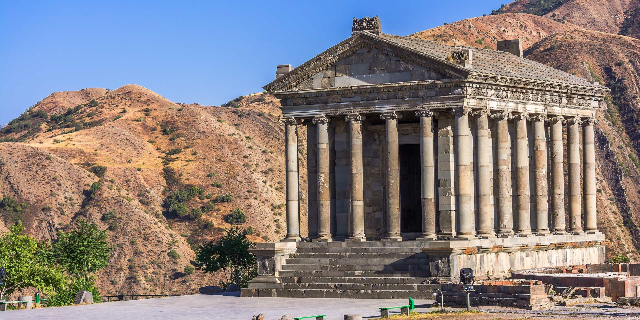

The Temple of Garni is the only standing Greco-Roman colonnaded building in Armenia and the former Soviet Union. Built in the Ionic order, it is located in the village of Garni, in central Armenia. It is the best-known structure and symbol of pre-Christian Armenia. According to the research of some historians, the temple was created by the Armenian king Trdat I, who ruled in the second half of the 1st century. According to the cuneiform found in the village of Garni, the temple was later conquered by King Argishti in the first half of the 8th century, after which he built the fortress of Erebuni, which began to develop and later became the capital of Armenia, modern Yerevan.
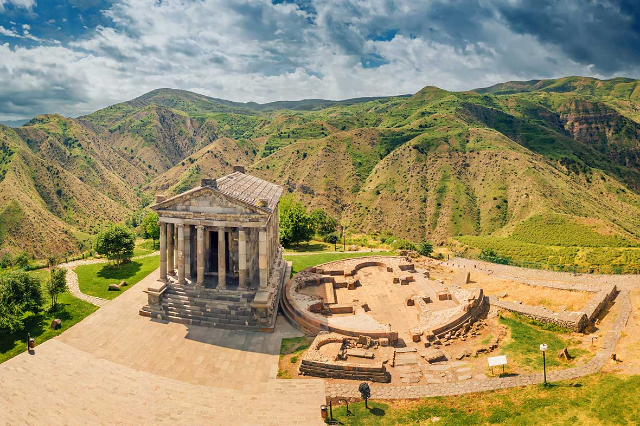
Beginning from the 3rd BC up to the 4th century, the Garni temple was the summer residence of the Armenian kings, because it was liked by both the kings and the population for its inaccessibility.
The temple was created in honour of the ancient Armenian god Mihr – the god of the Sun, light and purity. In 301, Armenia adopted Christianity as its state religion, and everything that was somehow connected with paganism was destroyed, and the Garni temple is the only surviving pagan temple in Armenia today.
The army of Trdat III, the new ruler, in order to strengthen and protect the new religion, burnt all the pagan temples, statues, relics. However, thanks to the graciousness of the king’s sister, Khosrovandukht, who asked her brother not to destroy this temple, so only the images and statues of the pagan gods were destroyed.
However, the temple of Garni was not out of danger. The destructive campaigns of the Roman legions against Armenia in the 1st century caused devastating damage to the temple, and the 1679 earthquake near the village of Garni scattered columns and stones of the temple in all directions, into the Azat River and into the gorge around the triangular cape. The temple was rebuilt in Soviet times by the efforts of the local population.The temple was entirely rebuilt using original stones. The missing pieces were replaced by blank stones to make them easily recognizable.


