


Three overlapping loggias overlook a rooftop garden that abruptly ends at the edge of the Val d'Orcia: this is the first image that captures anyone entering the inner courtyard of the Palazzo Piccolomini di Pienza. It is not a random effect. The architect Bernardo Rossellino, a student of Leon Battista Alberti, designed every element to amplify the perception of space and frame the Tuscan landscape as if it were a living painting. The result, completed around 1462, is one of the most coherent examples of Renaissance architecture of the Italian Quattrocento.

The palace was commissioned by Pope Pius II, born Enea Silvio Piccolomini, who wanted to transform his hometown of Corsignano — renamed Pienza in his honor — into an ideal Renaissance city. The urban planning project involved not only the palace but the entire central square, the cathedral, and the bishop's palace, all completed in an extraordinarily short period, between 1459 and 1462. This concentrated effort is recognized by UNESCO, which in 1996 included the historic center of Pienza in the list of World Heritage Sites.
The architecture: three facades for three functions

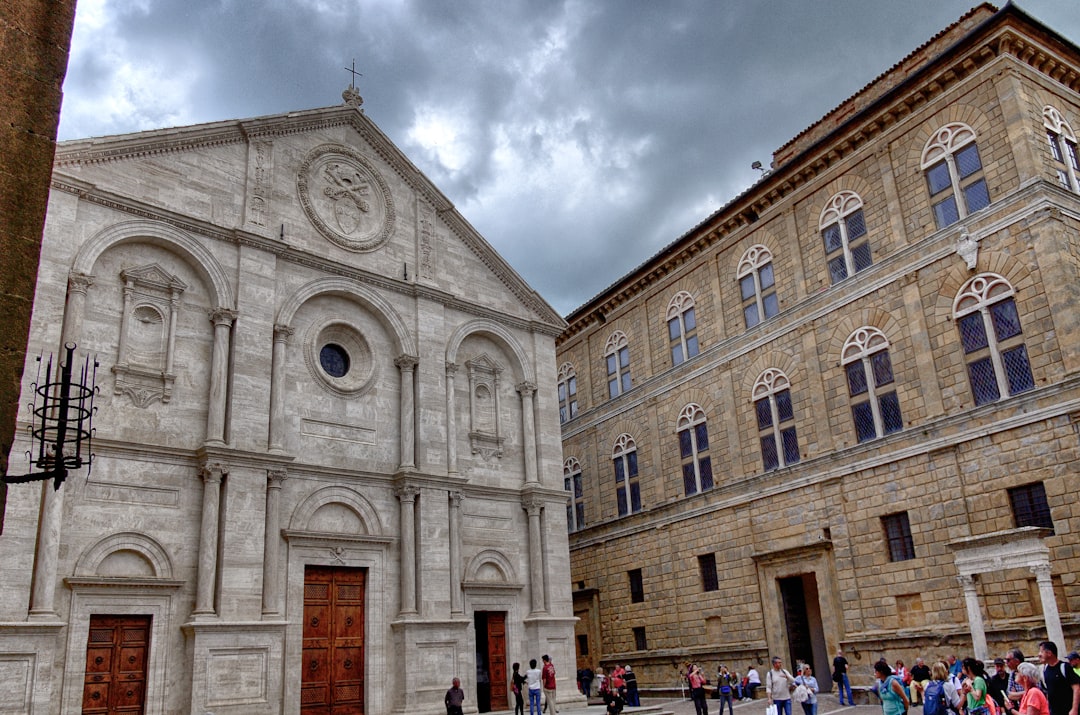
The palace has three distinct facades, each with a different character. The main facade on Piazza Pio II is austere and symmetrical, with rustic ashlar on the ground floor and bifore windows on the upper floors that recall the Florentine models of the time. Rossellino was explicitly inspired by Palazzo Rucellai in Florence, a work by the same Alberti, reinterpreting it in a more compact way suitable for the hilly context.
At the back, however, the palace opens up to the landscape through the famous loggia with three superimposed orders — Doric, Ionic, and Corinthian — that delineates the hanging garden. This choice to orient the residence towards the panorama rather than towards the city was unusual for the time and reveals Pio II's almost modern sensitivity towards nature as an aesthetic element. Visitors who reach the garden can directly observe how the columns of the loggias frame the Sienese hills and Mount Amiata in the background.

The interiors: papal furnishings still in place
The rarest aspect of the palace is the preservation of the interiors. Unlike many Renaissance residences that have been emptied over the centuries, the rooms of Palazzo Piccolomini still retain much of the original furnishings from the 15th century, including canopy beds, armor, tapestries, and furnishings that belonged to the Piccolomini family. The palace remained the property of the family until 1968, when it was transferred to a foundation that manages its operation and public opening.
Among the visitable rooms, the library stands out, with its original carved wooden shelves, and the papal bedroom, where the canopy and tapestries recreate a period atmosphere that is hard to find elsewhere. The collection of weapons and armor displayed in some rooms is an additional element that surprises visitors, often not mentioned in generic tourist guides. The guided tour typically covers about ten rooms and takes approximately 45-60 minutes.
The Hanging Garden and the View of the Val d'Orcia

The garden at the back of the palace is divided into four geometric sections bordered by boxwood hedges, following the classic scheme of the Italian garden. It is not a particularly large space, but its position at the edge of the cliff on which Pienza stands makes it visually extraordinary. Looking beyond the balustrade, the land drops sharply towards the Sienese countryside, with cypress trees, gullies, and white roads that characterize the landscape of the Val d'Orcia.
The afternoon light, when the sun illuminates the hills from the west, is the best time to enjoy this view. Those visiting the palace in the morning hours will instead find the interior rooms better lit by natural light filtering through the windows. In any case, it is advisable to arrive in Pienza on weekdays, as on weekends during the high season — especially between May and October — the lines for entry can become considerably longer.
Practical Information for the Visit
The palace is located directly on Piazza Pio II, in the heart of the historic center of Pienza, reachable on foot from the only main parking area of the town in about five minutes. The entrance ticket costs around 7 euros for adults, with discounts for students and groups. The visits generally take place with a guide included in the price, in Italian or English depending on availability.
The palace is closed on Mondays and during certain winter holidays; it is always advisable to check the updated hours on the foundation's website before departing. Those intending to visit the cathedral and the nearby Diocesan Museum should allow at least half a day for the entire monumental area of Pienza. Combining the visit with a walk along the panoramic walls of the town, which offer views similar to those of the hanging garden but are accessible for free, is a choice that many visitors do not consider but is worth making.


