



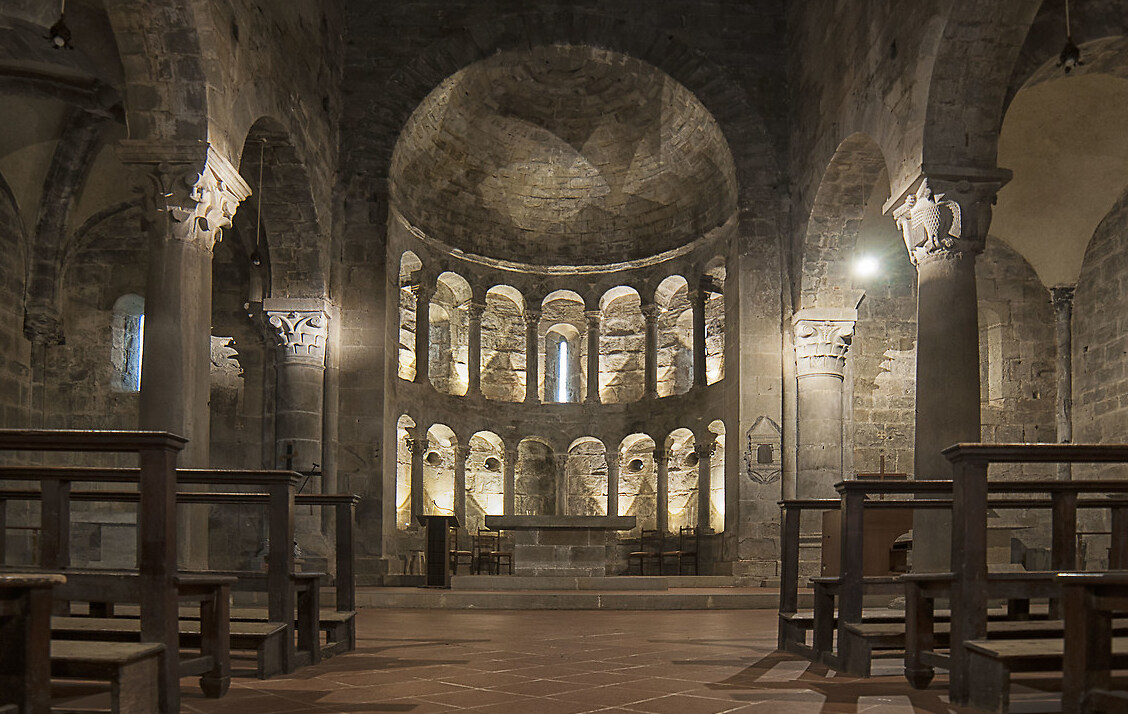
The parish church of San Pietro a Gropina is certainly a masterpiece of Romanesque architecture and one of the most important medieval parish churches in all of Tuscany. Near Loro Ciuffenna, on a ridge at an altitude of 380 metres, just above the present-day route of the Setteponti road, is the large Romanesque parish church of Gropina, and around the church some private dwellings, a small chapel of the Compagnia and the rectory. The position is truly dominant and panoramic, the mountain to the north counteracts the flow of cold north winds thus defending the village, while to the south and west the view of our valley and the Arezzo area is truly spacious. The church, 45 m. long and 17 m. wide, was built on the route of the ancient Roman road between Arezzo and Fiesole, which was moved further up the hill than the present Via dei Sette Ponti. According to a popular legend that has survived to this day, on the hill where the church is located, in pre-Christian times there was built a pagan temple dedicated to the goddess Diana, daughter of Jupiter and Latona and sister of Apollo. The name "Gropina" is probably of Etruscan origin and the present temple, built in the Romanesque period in the twelfth century is known throughout Italy by lovers of art, history and religious architecture. There is a document from the year 780 in which it is said that the Pieve di San Pietro a Gropina was assigned as an endowment to the Abbey of Nonantola (Modena), so we can deduce that already in the Lombard/Carolingian period there was another church older than the present one. However, for some historians this important document is apocryphal, that is "false", while for other historians it is authentic. The capitals of the naves, twelve in reference to the apostles, depict monsters and fantastic animals: "The sow suckling piglets", four like the seasons as a propitious sign of abundance, "The Knights Templar" intent on fighting against demons and again "The fight between lion and tiger", "The eagles" with the prey in their claws and the "Green Man", demonic masks covered in roots and vegetation, a metaphor for the evil forces that cling to the human being without escape (this interpretation originates from an ancient Anglo-Saxon pagan cult that later spread throughout the world: It can be found in India, Germany, France, Indonesia and Israel, in the Templar churches in Jerusalem).Particular mention should be made of the beautiful (and bizarre) pulpit of the church, an extremely interesting artefact due to the large number of enigmatic symbols depicted on it, making it one of the most mysterious and magical in Italy. The balustrade is supported by two columns intertwined with each other with at the base the "Praying Men" (twelve anthropomorphic figures side by side and with raised hands, probably the twelve apostles). Above the symbolic representation of "Three Evangelists" (John the eagle, Matthew the angel-man and Mark the lion) and on the left side a "Mermaid with two tails" (the "Melusina" mythical figure of the Middle Ages) and a "Man clinging to two snakes" that seem to bite him. The pulpit is an absolute testimony to the coexistence of paganism and Christianity, with some images of dubious explanation, curious and at the same time disturbing, such as the praying men who recall the features of the "Greys" (extraterrestrials).
