


The roots of a spung tree wrap around a sandstone lintel like the fingers of a giant hand, slowly cracking the masonry that has stood for over eight hundred years. This is the first image that greets those who enter the complex of Preah Khan, one of the largest temples in the entire Angkor area, built in 1191 by the Khmer king Jayavarman VII as a sacred city dedicated to his father. It is not just a simple temple: it was a religious, educational, and administrative center that housed, according to inscriptions found on site, nearly 100,000 people including priests, dancers, teachers, and servants.

Unlike Angkor Wat, which attracts thousands of visitors every day lined up in an orderly fashion in front of the reflecting moat, Preah Khan maintains an atmosphere of controlled abandonment that makes it unique in its kind. The corridors stretch for hundreds of meters between dimly lit columns, some galleries have partially collapsed, and it is common to walk entire stretches without encountering other tourists. This is not a flaw: it is exactly what makes the visit memorable.
The architecture: a labyrinth of stone and light
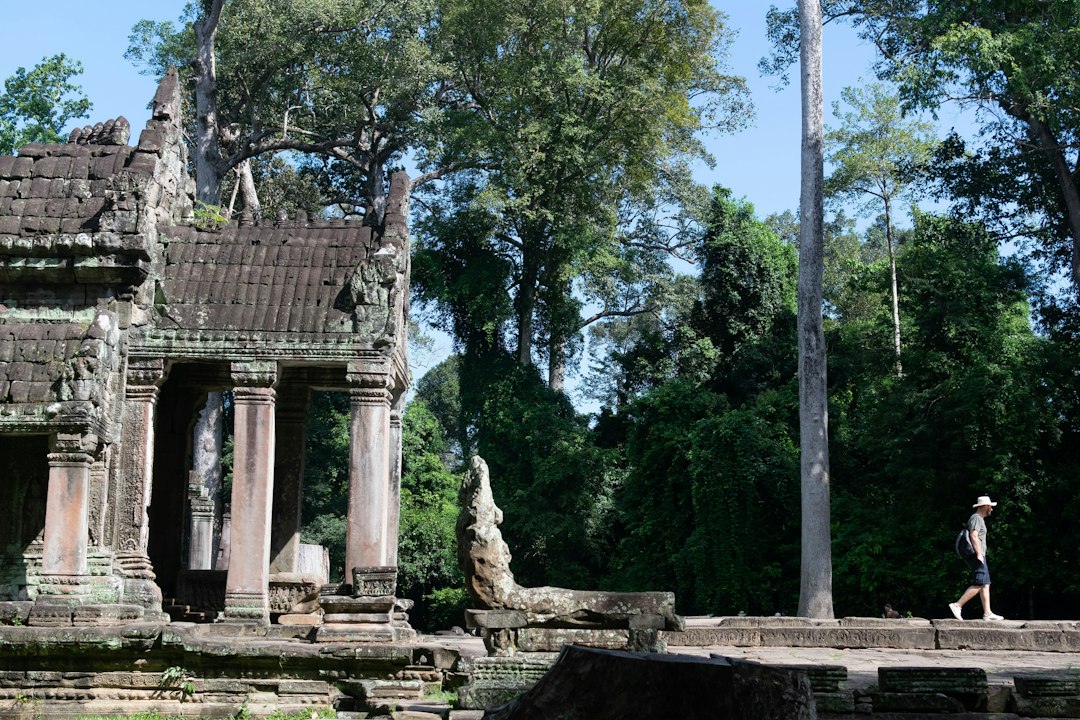
The complex develops around an east-west axis of about 800 meters, with four cardinal entrances preceded by avenues lined with mythological figures holding the body of a naga, the sacred serpent of Khmer cosmology. The structure follows the model of the mountain-temple typical of classical Khmer architecture, with concentric galleries that narrow towards the central sanctuary, originally dedicated to the bodhisattva Lokesvara, a deity of Mahayana Buddhism.
What immediately strikes is the variety of materials: red laterite for the outer perimeter walls, gray sandstone for the internal decorative structures, with bas-reliefs depicting apsara — the celestial dancers — in slightly different poses from one another. In the better-preserved galleries, traces of white stucco can still be seen on the walls, remnants of the original decoration that covered almost the entire internal surface of the temple.
The artistic details not to be missed
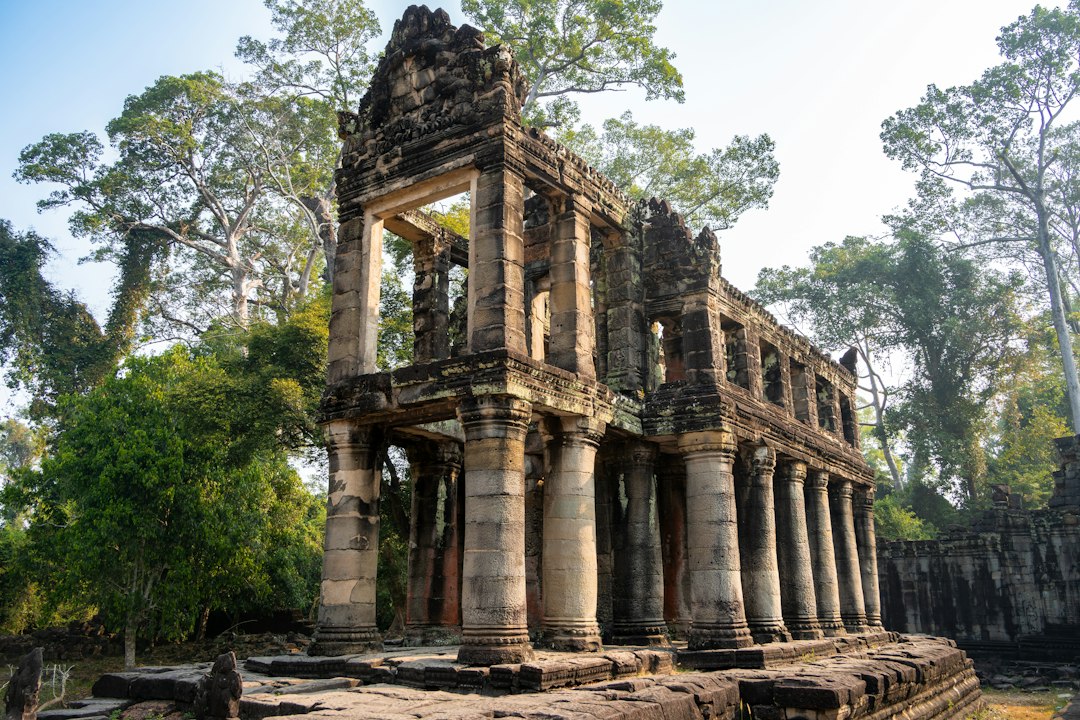
Inside the second enclosure is one of the most discussed architectural elements by scholars: a two-story building with circular columns, a very rare structure in Khmer architecture that normally favors square pillars. The function of this building remains uncertain — some hypotheses suggest a library, others a storage for ritual objects — but its visually anomalous presence makes it immediately recognizable on the tour path.
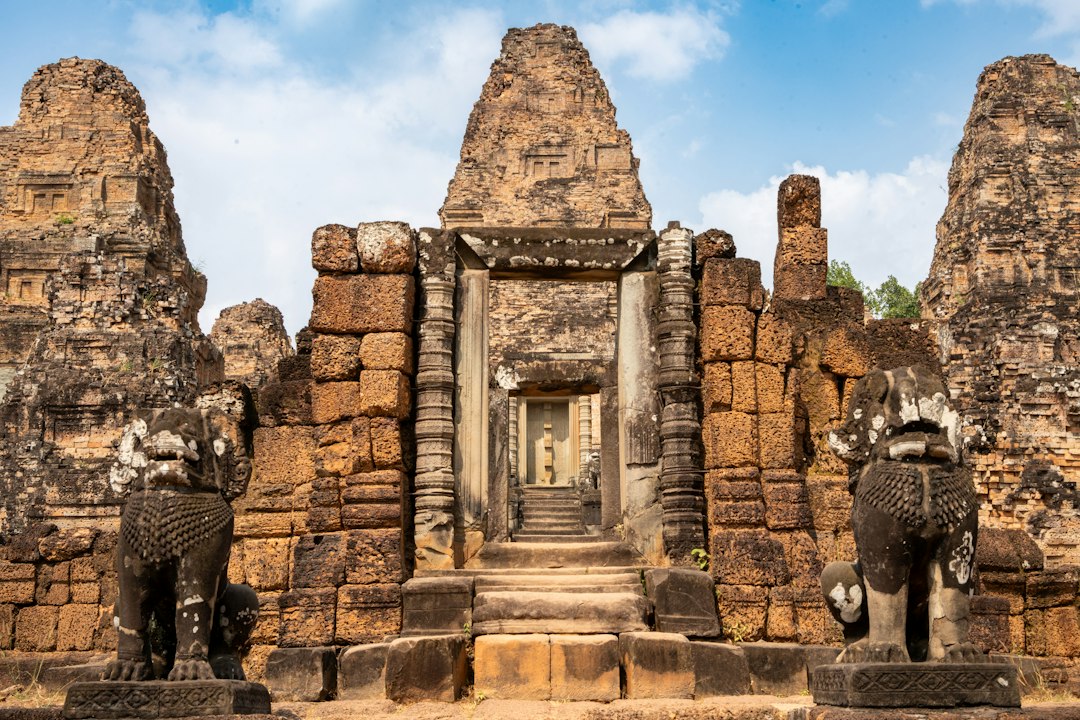
Near the eastern entrance, considered the original main entrance, are some of the best-preserved sculptures of the site: figures of dvarapala, the armed guardians who protect the sacred passages, with details in the headdresses and armor still legible despite centuries of exposure to the elements. It is worth slowing down at this point and observing the narrative panels on the side walls, which depict scenes of battle and court life in a typically Angkorian style.
The relationship with vegetation: restoration or abandonment?
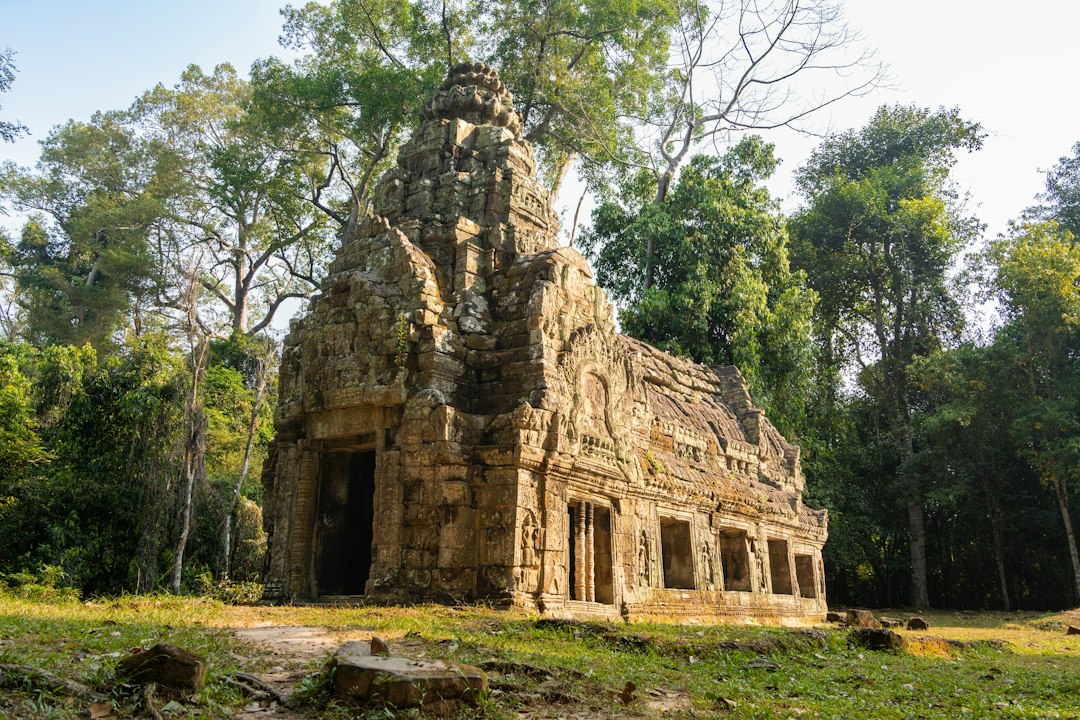
One of the most visible issues at Preah Khan concerns the conservative choice made by the École française d'Extrême-Orient, the French institution that oversaw restoration work during the twentieth century. Unlike other temples in Angkor where vegetation has been systematically removed, here some structures have been deliberately left with trees enveloping them, creating a visual tension between the geometry constructed by man and the organic growth of the forest.
The result is that some sections of the temple appear to be on the verge of collapse, with leaning walls held up only by the roots that pass through them. In reality, many of these points have been consolidated with discreet interventions. Walking under these vegetative arches is one of the most physically intense experiences that Angkor offers: the human scale is brutally and concretely resized.
Practical Information for the Visit
Preah Khan is included in the Angkor Pass, the single ticket for the archaeological area managed by the APSARA Authority of Cambodia, which in 2024 costs about 37 dollars for a single day. The site opens at 7:30 and closes at 17:30. The best time to visit is early in the morning, when the side light enters the eastern galleries and the temperature is still bearable: after ten, the heat inside the stone corridors becomes significant.
To reach Preah Khan from the center of Siem Reap, you can rent a tuk-tuk for the day, a common and convenient solution that allows you to combine the visit with other sites in the northern circuit such as Neak Pean and Ta Som. Bringing plenty of water is essential: the refreshment points within the complex are limited and far apart. Allow at least two hours for a thorough visit, three if you intend to walk the entire outer perimeter.


