

A stone staircase carved into the living rock, squeezed between walls that plunge into the void: this is how one arrives at the Rousanos Monastery, clinging to one of the most vertical sandstone pillars in the entire plain of Thessaly. Built in the 16th century — the first documented evidence dates back to 1545 — this female convent stands in Kalampaka, in the heart of central Greece, where the rock formations of Meteora defy all architectural logic and every law of gravity. Today it is managed by a community of Orthodox nuns who keep alive a centuries-old tradition among prayers, silence, and frescoes that burn with colors.
Rousanos is often overlooked by the more popular tourist circuits, which tend to focus on the Great Meteoron or the Varlaam Monastery. Yet it is precisely this relative solitude that makes it one of the most authentic places in the entire UNESCO complex. Here, there is no queue to enter, one does not hear the buzz of organized groups, and time seems to flow with the same slowness as the clouds that wedge between the rock pinnacles.
The architecture: building on the impossible
Observing Rousanos from the outside is already an exercise in wonder. The main building is literally embedded at the top of an isolated pillar, with the perimeter walls following the irregular profile of the rock without attempting to correct it. The builders of the 16th century did not level the ground: they adapted every architectural element — foundations, arches, loggias — to the natural morphology of the boulder. The result is a building organism that seems to have grown from the stone rather than being built on top of it.
Access is through a stone bridge that connects the monastery to the adjacent rock wall, replacing the ancient nets and baskets used for centuries to hoist people and materials. The main church, dedicated to the Transfiguration of Christ, is a compact single-nave volume with a semicircular apse, typical of the late Macedonian Byzantine style. The external walls show the characteristic alternation of local stone and fired bricks, a construction technique widespread in medieval Greek religious architecture that gives the surfaces a precise and recognizable visual rhythm.
The frescoes: martyrdom as a visual language
The interior of the church is entirely covered with frescoes that cover every available centimeter, from the vaults to the side walls and even the lunettes above the doors. The most powerful scenes are those dedicated to the martyrdom of the saints: stylized yet intensely depicted figures, with dark complexions and wide-open eyes, represented at the precise moment of physical suffering. The colors — deep reds, cobalt blues, burnt ochre — have maintained a surprising vibrancy despite the centuries of humidity and thermal variations typical of these rocky environments.
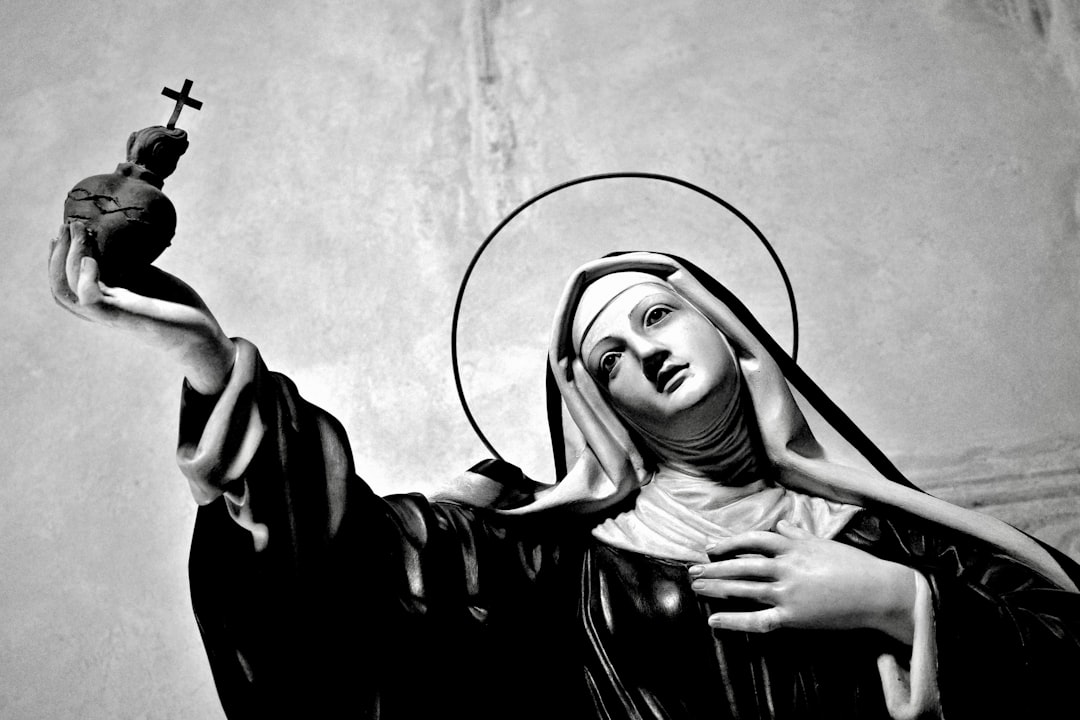
Particularly worthy of attention is the depiction of Saint Barbara, to whom the monastery is co-dedicated, recognizable by her traditional iconographic attributes. The frescoes of Rousanos are attributed to workshops of Cretan painters active in the region during the 16th and 17th centuries, the same tradition that has left traces in many monasteries of Athos and mainland Greece. Bringing a small torch or discreetly using the light from a phone can help to better read the details in the less illuminated areas of the nave.
The terrace and the landscape
After the visit to the church, a side door leads to the external terrace of the monastery. From here, the panorama suddenly opens up to a breathtaking scene: the pillars of Meteora stand around like a petrified forest, with the Varlaam monastery visible to the northwest and the plain of Kalampaka stretching southward to the horizon. The terrace is narrow, protected by a low railing, and the sense of vertical exposure is immediate and physical. It is not a place for those who suffer from vertigo, but for everyone else, it is probably the most dramatic observation point of the entire Meteora complex.
The nuns cultivate small pots of flowers along the perimeter of the terrace, a domestic detail that almost poignantly contrasts with the vastness of the surrounding landscape. In spring, when the plain is green and the sky is still heavy with clouds, the light changes every few minutes, and each variation completely transforms the perception of space.
Practical tips for the visit
Rousanos is generally open to visitors in the morning and early afternoon, with a closure during the central hours typical of all the monasteries in Meteora. The best time to arrive is between 9:00 and 10:30, when the morning light optimally illuminates the frescoes and the number of visitors is still manageable. The entrance ticket, as for the other monasteries in the complex, is around 3 euros. Women are required to wear a long skirt, available for loan at the entrance; men need to wear long pants. The visit takes on average 45-60 minutes, but those who want to spend time on the frescoes can easily exceed an hour. From Kalampaka, it takes about 10 minutes by car following the scenic road that connects the monasteries.


