
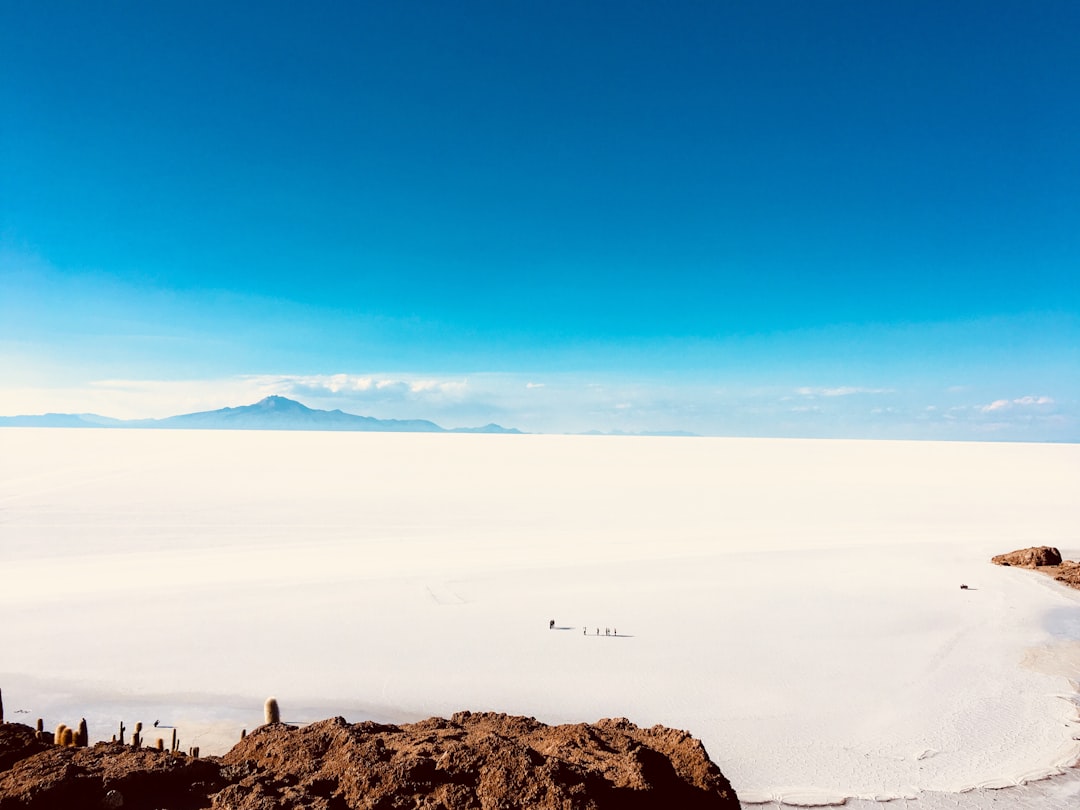

At 3,656 meters above sea level, the blinding white never ends. The Salar de Uyuni extends over 10,000 square kilometers in the Bolivian highlands, making it the largest salt desert in the world. Walking on it during the dry season is like moving on a perfect geometric surface: the salt crust cracks into regular polygons, each separated by a thin edge that looks hand-drawn. There is no shadow, no noise, no reference for scale. Just white and sky.

In the months between November and March, the rains completely transform this landscape. A thin layer of water settles on the surface, and the salt becomes a perfect horizontal mirror, reflecting the clouds and distant volcanoes with a precision that confuses the mind. The volcano Tunupa, overlooking the northern edge of the salt flat, appears inverted in the water like in a symmetrical painting. This season, although less convenient for transfers, is the one that produces the most famous photographs in the world of this place.
The geology of salt: an ancient sea beneath our feet

The Salar de Uyuni was formed from the evaporation of ancient prehistoric lakes that covered much of the Andean plateau. Beneath the crust of salt, which reaches several meters in thickness in some places, lies one of the largest lithium deposits on the planet. Bolivia possesses about 50-70% of the known global lithium reserves, most of which are concentrated right beneath this white expanse, making the salt flat geopolitically significant in recent years.
On the surface, tourists can observe the hexagonal structure of the salt with their own eyes: each polygon measures between one and three meters in diameter and is the direct result of the thermal expansion and contraction cycles of the salt crust. At the center of the salt flat lies Isla Incahuasi, a rocky island covered with giant columnar cacti that can exceed ten meters in height. The presence of these cacti on what seems like an alien planet is one of the most surprising physical details that can be observed during the visit.

The silence and the night: the sensory experience of the salt flat
During the day, the glare of the sun on the salt is so intense that it requires sunglasses with high UV protection, even on cloudy days. But it is at night that the Salar de Uyuni transforms into something difficult to describe. Far from any source of light pollution, the sky of the Bolivian highlands reveals a density of stars that is impossible to imagine in cities. The Milky Way appears as a concrete, almost material, luminous band.

Some local agencies organize night excursions to sleep directly on the surface of the salt flat, in temporary structures or in one of the few hotels built with salt blocks. The Luna Salada Salt Hotel, located on the edge of the salt flat near Colchani, is one of the most well-known examples of accommodation that uses salt as the main building material, from the walls to the tables. The silence on these nights is total and physically perceivable, almost overwhelming for those not used to the complete absence of sound.
How to get there and when to visit

The city of Uyuni is the mandatory starting point for all excursions to the salt flats. It can be reached by train from Oruro or by bus from various Bolivian cities, including La Paz with a journey of about ten hours. There is also a small airport with domestic connections. From the city, local agencies organize jeep tours lasting one to three days, with prices starting at around 50-70 US dollars for the basic one-day tour, excluding the entrance to Isla Incahuasi which incurs an additional cost.
The most important practical advice concerns sun protection and hydration: the altitude above 3,600 meters, combined with the sun's reflection on the salt, significantly increases the risk of sunburn and dehydration. Bringing at least two liters of water per person, high SPF sunscreen, and polarized sunglasses is not optional. Those with cardiovascular issues or who are not accustomed to high altitudes should acclimatize for at least one day in Uyuni before undertaking longer excursions to the colorful lagoons of the Eduardo Avaroa National Park, which many tours combine with a visit to the salt flats.
What to observe on site: details that leave a mark
In addition to the salt polygons and Isla Incahuasi, the salt flat holds a cemetery of rusty trains a few kilometers from Uyuni, known as Train Cemetery. These are abandoned locomotives and cars dating mainly from the late 19th and early 20th centuries, when the Bolivian railway served the mines in the region. The contrast between the oxidized metal and the surrounding white salt creates a visually powerful and historically significant landscape.
Finally, the sunset light over the salt flat deserves special attention. As the sun descends toward the horizon and colors the salt orange and pink, the polygons cast thin shadows that make the three-dimensionality of the surface visible, normally flattened by direct light. It is the moment when the salt desert stops looking like an abstraction and becomes a landscape with depth and warmth.


