
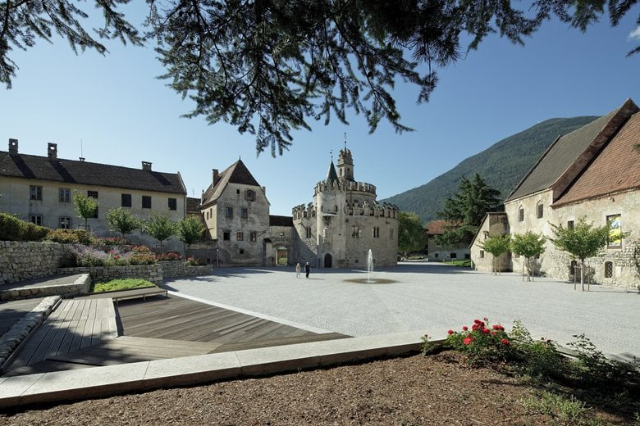

The Santa Maria ad Gratias Shrine is located in the Novacella Abbey complex, currently supported by Augustinian Canons. In the Middle Ages the Abbey of Novacella reached an early cultural flowering under the leadership of Abbot Konrad II of Rodank (1178-1200). It suffered a serious fire on April 17, 1190, but Konrad, particularly skilled in art and science, rebuilt the entire monastery complex in a very short time so that the new abbey church could be reconsecrated around 1198.
In 1221 Novacella obtained patronal rights over the parish of Olang. The incorporation of the parish of Fié allo Sciliar took place in 1257, while the parish of Assling was given to the abbey in 1261.The complex consists of the abbey, the chapel of St. Michael, and the sanctuary of Our Lady. The sanctuary is a building of Romanesque layout built in 1442. Around the 18th century the church underwent major renovations that reshaped the style according to the canons of the time and made it one of the most important Marian shrines in all of South Tyrol.
During the three wars against France between 1792 and 1805, the Abbey frequently had to endure extensive encampments by paying large tributes. With the Peace of Pressburg in 1805 finally the Princely County of Tyrol passed to Bavaria.
Inside the sanctuary is a large atrium located at the base of the tower. The interior consists of three naves, decorated with fine marble and stucco decoration. On the left is the Baroque-style chapel dedicated to Santa Maria ad Gratias, completed in 1695. The painting by Giovanni Battista Delai is embellished with a dome decorated with stucco.
Of great value on the high altar is the Gothic-style statue of the Madonna and Child.
Inside the sanctuary, not to be missed, passing over the right aisle leads to the 13th-century portico, decorated with frescoes referring to Gospel scenes, parables, biblical figures, saints and allegories.


