← Back

Shrine of Our Lady of the Lattans

81035 Roccamonfina CE, Italia ★★★★☆ 191 views
Adam Rise
Roccamonfina
🏆 AI Trip Planner 2026

Get the free app

Discover the best of Roccamonfina with Secret World — the AI trip planner with 1M+ destinations. Get personalized itineraries, hidden gems and local tips. Free on iOS & Android.

🧠 AI Itineraries 🎒 Trip Toolkit 🎮 KnowWhere Game 🎧 Audio Guides 📹 Videos
Scan to download iOS / Android
Scan for AppGallery Huawei users

About Shrine of Our Lady of the Lattans

Shrine of Our Lady of the Lattans - Roccamonfina | Secret World Trip Planner

The attribution "of the Lattans" to Our Lady and the Shrine as a whole is not uniquely motivated. There are, in fact, those who claim that it is to be referred to the namesake that indicates its location and/or the location of reference of the Holy Icon, but there are also those who refer to a legendary goat defined as "lattifera" that was the cause of the aforementioned "miraculous" finding. Still others refer to a place originally linked to the cult of the fountains and it is precisely S. Maria delle Fonti that Fr. Francesco Gonzaga calls it in the 16th century, in his work De Origine Seraphicae Religionis Franciscanae de Observatia (Rome 1587- 527) Pope Pius XII, in his Pontifical Brief Vitae Hujus Jactati of May 12, 1952, instead gives her the more ecumenical and majestic title of Regina Mundi.

Shrine of Our Lady of the Lattans - Roccamonfina | Secret World Trip Planner

he Sanctuary of Maria Santissima dei Lattani is beautifully situated on the wooded slopes of the Roccamonfina Volcano, and is the most representative monument of this town. The religious complex, founded in 1430 by St. Bernardino of Siena and St. Giacomo della Marca, includes the church, the Hermitage of St. Bernardino, the cloister, the convent, and the courtyard. Tradition has it that around the years 1429-1430 a shepherd boy, while intent on guarding his herd of goats, discovered a Holy Image of Our Lady in a cave. The news spread quickly outside the village as well, and it began to attract so many crowds of pilgrims that St. Bernadine and St. James made a stop on Mount Lattani. The two friars, understanding the situation, worked to build a temple in which to place the statue worthily. Thanks to donations that arrived conspicuously, they began the construction of a first chapel, later enlarged and transformed into a Romanesque church (1430), which, in turn, would become a final church in the Gothic style, completed between 1448 and 1507, and restored between 1962 and 1999.

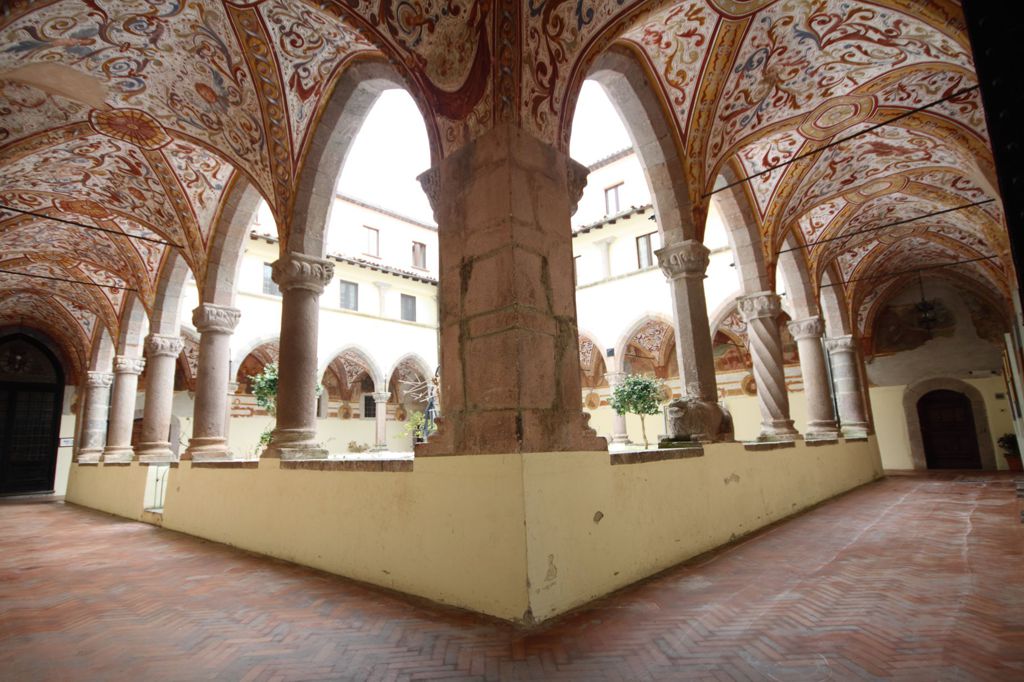
The church can be reached after climbing a majestic flight of steps made of local stone, ending in a Gothic-style pronaos over which the chestnut-wood entrance portal (1507) opens. The interior has a single nave with cross vaults supported by elegant pillars. In one of the side chapels is preserved the original statue of Our Lady found in the cave. On the left side of the church is access to the cave where the discovery occurred. On the right side, however, is the magnificent rectangular cloister surrounded by columns of different shapes that support part of the Franciscan friars' dormitory. Very interesting are the paintings adorning the vaults and walls, executed by Father Tommaso da Nola between 1630 and 1637.
Shrine of Our Lady of the Lattans - Roccamonfina | Secret World Trip Planner

In the main courtyard of the religious complex is the fountain of Our Lady, dating from the 1400s and artistically crafted. Popular tradition attributes the spring water with miraculous properties, guaranteeing those who drink it the birth of sons. On the left side of the courtyard, for those entering, is the famous Romitorio di San Bernardino, probably built before the chapel, later becoming a reception center for pilgrims. The building has remained virtually identical to its original layout, and is most notable for the beautiful window ornamented above with a "fretwork rose" in basalt stone .

Shrine of Our Lady of the Lattans - Roccamonfina | Secret World Trip Planner
🗺 AI Trip Planner 2026

Plan your visit to Roccamonfina

Suggested itinerary near Shrine of Our Lady of the Lattans

MAJ+
500.000+ travelers worldwide
  1. 🌅
    Morning
    Shrine of Our Lady of the Lattans
    📍 Roccamonfina
  2. ☀️
    Afternoon
    Campania: The beautiful Conca waterfalls
    📍 4.7 km · Roccamonfina
  3. 🌆
    Evening
    Archaeological Museum of Sessa Aurunca
    📍 7.5 km · Roccamonfina

Buy Unique Travel Experiences

Powered by Viator

See more on Viator.com

Explore nearby · Roccamonfina

Frequently Asked Questions

The Shrine was founded in 1430 by St. Bernardino of Siena and St. Giacomo della Marca, two friars who came to the site after learning of a miraculous discovery of a Holy Image of Our Lady by a shepherd boy. The original chapel was later expanded and transformed into a Romanesque church, eventually becoming a Gothic-style structure completed between 1448 and 1507.
The exact origin of 'Lattans' is debated among historians—some claim it refers to the location itself, others attribute it to a legendary goat called 'lattifera' that supposedly led to the discovery of the Holy Icon, and some believe it comes from the shrine's original association with fountain worship, as Fr. Francesco Gonzaga called it 'S. Maria delle Fonti' in the 16th century. Pope Pius XII later gave the sanctuary the more ecumenical title of 'Regina Mundi' (Queen of the World) in his 1952 Pontifical Brief.
The religious complex includes a stunning Gothic-style church, the Hermitage of St. Bernardino, a cloister, a convent, and a courtyard, all situated on the wooded slopes of Roccamonfina Volcano. Visitors access the shrine by climbing a majestic flight of steps made of local stone, which provides a memorable approach to this architecturally significant monument.
The Shrine underwent major restoration between 1962 and 1999, preserving its Gothic architectural style that was completed between 1448 and 1507. The structure evolved from an initial Romanesque chapel built in 1430 to the final impressive Gothic church that stands today.
According to tradition, around 1429-1430, a shepherd boy discovered a Holy Image of Our Lady hidden in a cave while tending his herd of goats on Mount Lattani. The discovery attracted so many pilgrims that St. Bernardino and St. Giacomo della Marca decided to build a proper temple to house the statue, which led to the construction of the first chapel that eventually became the sanctuary we see today.
