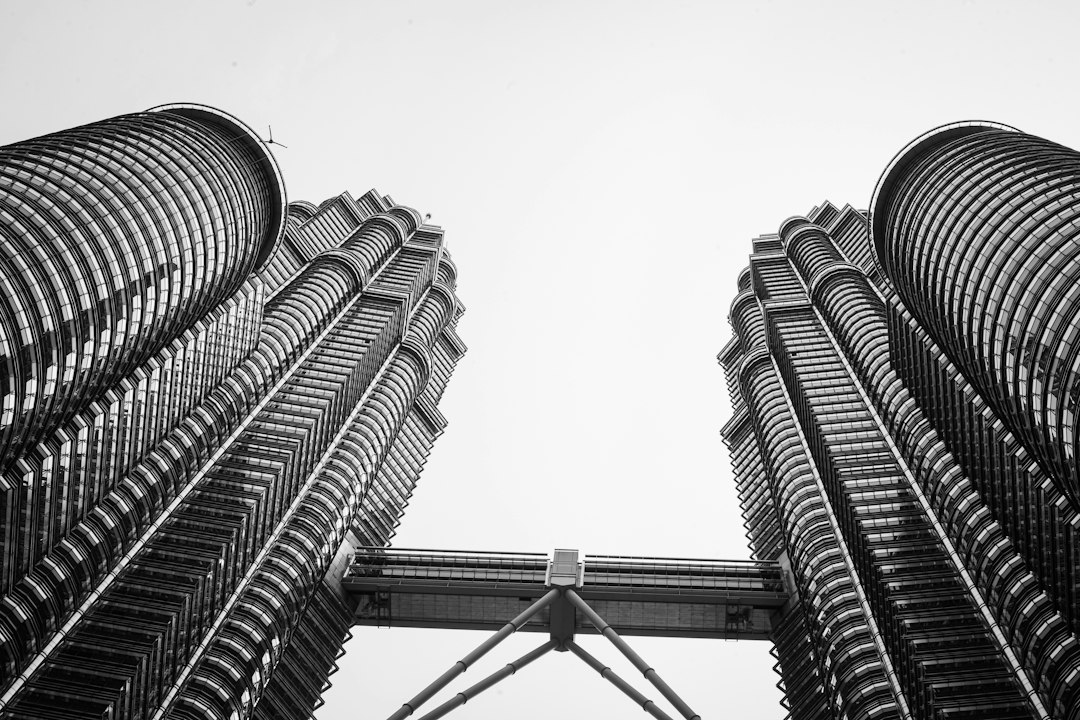

At a 170 meters high, the bridge connecting the two Petronas towers sways imperceptibly underfoot, and that slight but real sensation of movement is the first concrete data that the body registers even before the eyes. The Skybridge of the Petronas Twin Towers in Kuala Lumpur is not just a simple observation corridor: it is an autonomous engineering structure, anchored to the towers not in a rigid way but through a system of sliding arms that allow the buildings to move independently under the effect of the wind. A detail that the eye cannot see but that the mind, once known, cannot ignore.
The towers were designed by the Argentine-American architect César Pelli and completed in 1998, the year in which they held the title of the tallest buildings in the world with their 452 meters up to the top of the antennas. Their octagonal floor shape, inspired by geometric motifs of Malaysian Islamic tradition, is also visible from the inside: the corridors and sections of the common spaces evoke that symmetrical grid which from above appears as a mandala of steel and glass. Today they house the offices of Petronas, the Malaysian national oil company, but the floors dedicated to visitors offer an experience that goes well beyond just the simple view from above.
The Skybridge: architecture suspended between the two towers
The bridge is located on the 41st and 42nd floors and connects the two twin towers at a precise point in their geometry. It is not an open viewing platform: it is an enclosed space, with large windows on both sides, framing on one side the financial center of Kuala Lumpur and on the other the urban park KLCC with its reflecting pool. The steel structure of the bridge is also visible from the outside, and many visitors spot it from below even before ascending, looking for that thin horizontal line that connects the two dark glass giants.
During the visit, it is possible to observe closely the construction details: the expansion joints, the support beams, and the slightly convex curvature of the floor. The guides explain in English and Malay the construction phases of the towers, including the interesting fact that Tower 1 was built by a Japanese consortium and Tower 2 by a South Korean one, with an unofficial competition between the two teams that led to Tower 2 being completed first.
The Panoramic Deck on the 86th Floor
In addition to the Skybridge, the ticket includes access to the observation deck on the 86th floor, at about 370 meters high. From here, the view encompasses the entire urban expanse of Kuala Lumpur: you can recognize the KL Tower with its mushroom shape, the Bukit Bintang district, and on clearer days, the hills covered in rainforest that surround the capital. The jungle is also visible from the city center, and this contrast between the metropolitan skyline and tropical greenery is one of the most visually powerful elements of the experience.
The windows tilted outward amplify the feeling of exposure, allowing you to look directly down along the stainless steel and glass surfaces of the towers. The light changes significantly throughout the day: in the morning, the towers capture the eastern sun, and the surfaces reflect the sky differently compared to sunset, when the entire structure is tinged with orange and gold.
Practical Information for the Visit
The entrance ticket for Skybridge and Observation Deck costs approximately 80 Malaysian ringgit for adults, with discounts for children and residents. Tickets can be purchased online or at the ticket office on the ground floor of Tower 2, but the available spots each day are limited and sell out quickly, especially on weekends and during holidays. Booking at least a few days in advance is strongly recommended.
The opening hours are generally from 9:00 AM to 9:00 PM, with closure on Mondays. The best time to visit is early in the morning, when the light is clearer and the chances of reduced visibility due to fog or tropical rain are lower. To reach the towers, the KLCC LRT and MRT station is directly connected to the shopping mall on the lower level, making access by subway the most convenient and economical choice. Avoid showing up without a reservation on weekends: the risk of finding tickets sold out is real.
The urban context: KLCC and the park around the towers
The Petronas Twin Towers do not exist as isolated monoliths but as the focal point of an entire planned urban district. The KLCC Park at their feet is a green space with fountains, walking paths, and a public pool, frequented by neighborhood residents every morning for jogging and walks. Looking up at the towers from below, sitting on the edge of the reflecting pool at sunset, offers a completely different perspective than from above: the perfect symmetry of the two structures is reflected in the water and the scale of the building suddenly becomes understandable in comparison to the people walking at its feet.
The shopping mall Suria KLCC occupies the lower floors of the towers and also houses the Petronas Gallery, an exhibition space dedicated to contemporary Malaysian and regional art, with temporary exhibitions that change periodically. It is not a museum in the traditional sense, but represents a point of contact between Petronas's corporate identity and the country's cultural scene, with works that often engage with themes related to the territory, the environment, and Malaysian identity.