
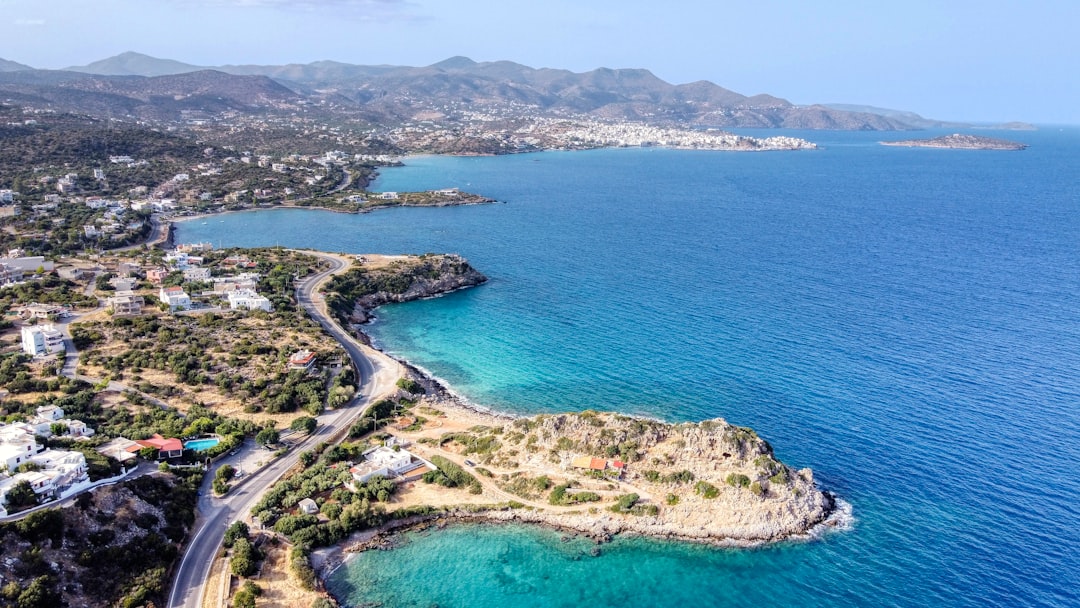

The last patient left Spinalonga in 1957, taking with him four centuries of forced isolation. Today, those who land on this small rock in the Gulf of Mirabello, in eastern Greece, walk among buildings still standing, ajar doors, walls that retain their original plaster. It is not a reconstructed site nor an open-air museum in the conventional sense: it is simply a place that time stopped touching the moment the last man left.
Spinalonga is located a few minutes by ferry from the coast of the Lasithi district in eastern Crete, accessible from the villages of Plaka and Elounda. The island measures about 850 meters in length and hosts a dense and readable historical stratification: Venetian walls from the 16th century, an Ottoman settlement, then the leper colony active from 1903 to 1957. Each layer is still physically distinguishable, superimposed on the previous one without anyone ever having an interest in erasing the former.
The Venetian fortifications: stone by stone since the Sixteenth Century
The Venetians built the walls of Spinalonga starting from 1579, when Crete was still a possession of the Serenissima and the Eastern Mediterranean was the scene of continuous clashes with the Ottoman Empire. The fortress resisted the Ottomans until 1715, making it one of the last Venetian strongholds to fall in all of Greece, well after the loss of Candia in 1669. Those who visit the island can still observe the main entrance gate, called Porta Dante, with the carved stone arch and the Venetian symbols partially eroded by sea salt.
The perimeter walls are largely walkable and offer a direct perspective of the Gulf of Mirabello: to the north, the coast of Elounda can be glimpsed, and to the east, the interior mountains of Lasithi. The construction is made of local stone, with angular bastions designed to withstand artillery — a technique common in Venetian fortresses of the Eastern Mediterranean. The quality of the masonry is still evident: few collapses, no visible modern reconstruction.
The leper colony: a silence that can be touched
Since 1903, the Greek authorities transformed Spinalonga into a colony for patients with leprosy, isolating lepers from all over Greece and Crete here. In the following decades, the island developed its own internal life: shops, a church, a café, even an informal autonomous government system. The patients were not detained in the legal sense, but they could not leave the island until they were cured or died.
The buildings of the colony are what strikes the contemporary visitor the most. The hospital structures, the homes, the warehouses are in a state of abandonment but not collapse: the window frames, the tiled floors, the corridors of the health buildings can still be seen. The Byzantine church of Agios Panteleimonas, patron saint of doctors, is one of the best-preserved buildings and still recognizable in its original structure. The total absence of ornamental vegetation or modern explanatory panels makes the visit particularly direct: there is no mediation between the observer and what remains.
The island's ecosystem and its atmosphere
Spinalonga is also a small isolated ecosystem. The Mediterranean scrub has reclaimed the undeveloped spaces: euphorbias, mastic trees, and capers grow among the stones and along the edges of the internal roads. Some seabirds nest in the crevices of the Venetian walls. The contrast between the spontaneous vegetation and the abandoned human structures is one of the visually strongest elements of the island.
The geographical isolation — although relative, given the short ferry crossing — is felt especially during the central hours of the day, when groups of tourists thin out. The silence is real, not constructed: no shops, no bars, no commercial establishments on the island. The only constant sound is the wind flowing between the walls and the noise of the sea on the exposed side.
Practical information for the visit
The ferries to Spinalonga depart regularly from Elounda and Plaka, with crossings of about 15 minutes from Elounda and 5 minutes from Plaka. The entrance ticket to the island is separate from the cost of the ferry. The opening season typically runs from April to October, with extended hours in the summer months. A complete visit takes about two hours for those who want to walk the entire perimeter and visit the internal buildings.
The most useful advice is to arrive with the first ferry in the morning, before ten: organized groups reach the island during the central part of the day and the simultaneous presence of many people significantly alters the experience. Bringing water is essential — there are no refreshment points on the island — and comfortable shoes with sturdy soles, as many internal paths are on uneven stone or gravel. The early morning light is also the best for photographing the Venetian walls on the north side.


