


A dull roar rises from the underground, the surface of the water curves into a blue and translucent dome, then everything explodes into the sky: Strokkur hurls a column of boiling water up to 40 meters high, and it does this every six to ten minutes, without pause, all year round. There is no countdown, there is no announcement. You simply have to wait, eyes fixed on that circle of steaming water, knowing that the explosion will come — but not exactly when.
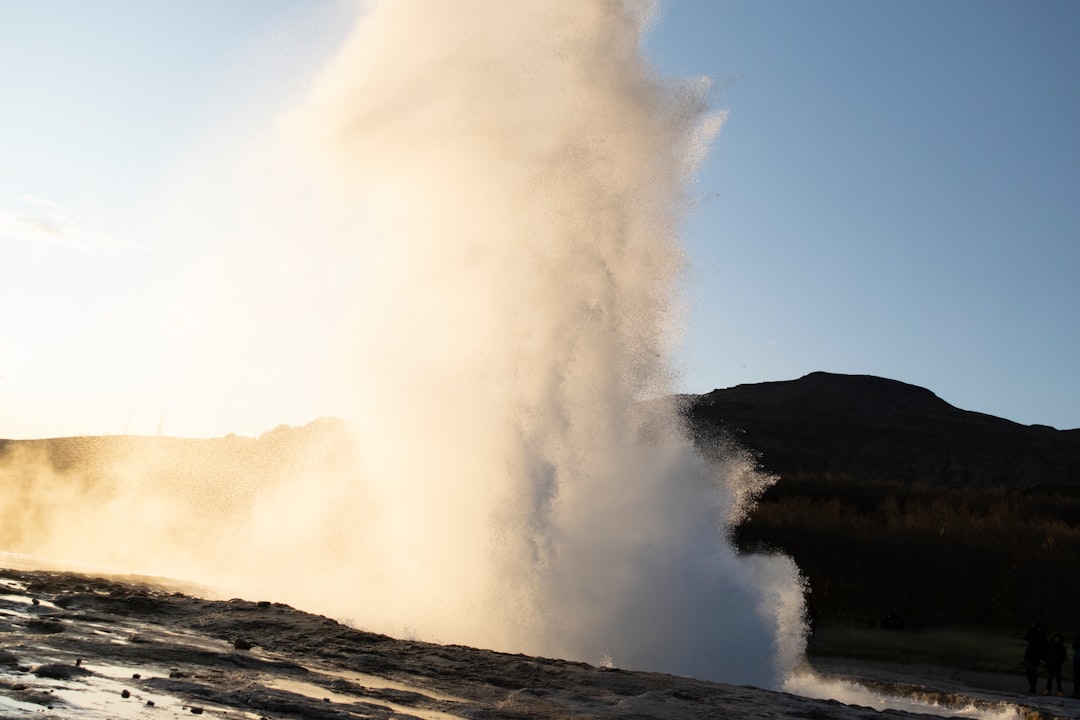
Strokkur is located in the geothermal valley of Haukadalur, about 80 kilometers northeast of Reykjavík, along the famous tourist route known as the Golden Circle. The area is part of the Geysir natural park, named after the historic geyser of the same name — the Great Geysir — from which the English and Italian word geyser derives. While the Great Geysir is now almost inactive, Strokkur has become the true star of the site, capable of erupting with a frequency and regularity that few natural phenomena in the world can imitate.
The geology beneath our feet: why Strokkur erupts so often

Iceland is one of the most geologically active regions on the planet, positioned directly on the Mid-Atlantic Ridge, the boundary between the North American and Eurasian plates. This tectonic context fuels a system of shallow magma chambers that heat underground aquifers to temperatures exceeding 100°C. Water trapped in narrow rock channels cannot boil normally due to pressure: when the pressure drops, the liquid instantly transforms into steam and is explosively expelled upwards.
Strokkur operates exactly according to this principle. The channel that feeds the geyser is relatively narrow and refills in a few minutes, which explains its almost metronomic eruption. By observing closely before the explosion, one can notice how the water at the center of the basin begins to swell upwards, forming a semi-spherical bubble of green-blue color, almost gelatinous, before everything erupts in a white jet of steam and water. That moment — the bubble forming — is one of the most unique visual spectacles that Icelandic nature has to offer.

The Geysir site: history and context of the park
The Great Geysir, from which the entire area takes its name, is documented in Icelandic written sources as early as the 14th century, making it one of the oldest geysers described in human history. Over the centuries, it has experienced periods of great activity alternating with long phases of dormancy. Today it erupts rarely and irregularly, often only after earthquakes or artificial interventions. Strokkur, on the other hand, has gained its current fame precisely for its reliability.

The area around the geysers is dotted with other geothermal features visible to the naked eye: boiling mud pools colored gray-ochre, fumaroles emitting continuous steam, ground colored orange and yellow due to deposits of silica and sulfur. The soil in some places is warm to the touch and the landscape takes on an almost alien quality, with vegetation thinning out as one approaches the more active areas. Entrance to the site is free, while the adjacent parking is paid.
How to get there and when to visit Strokkur
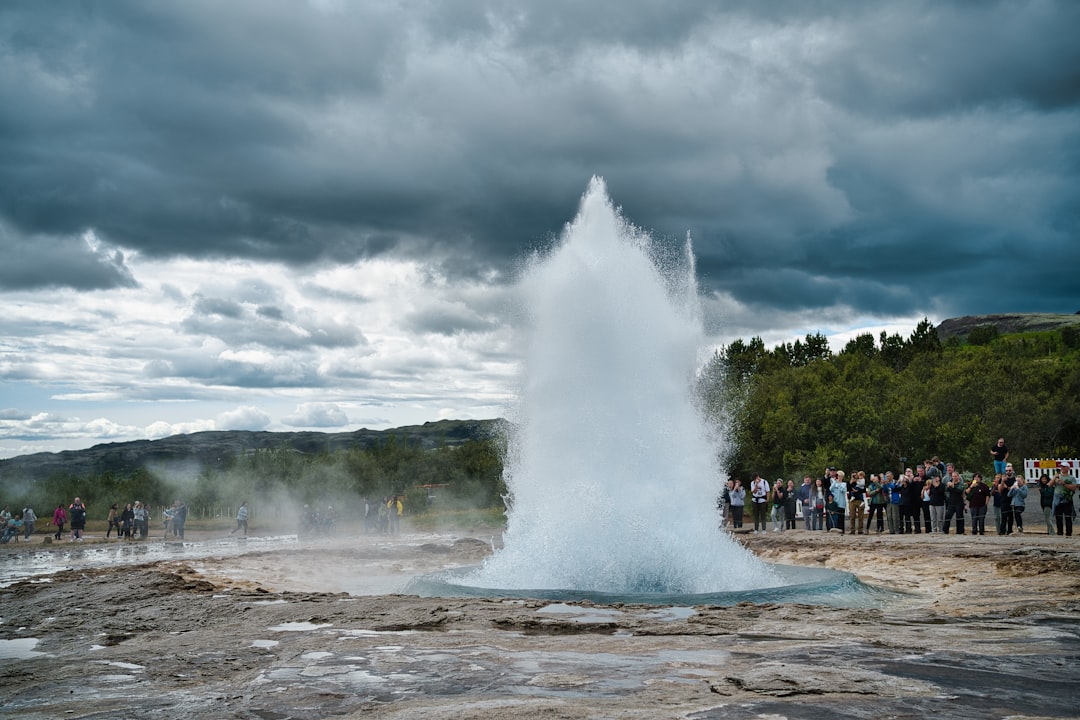
The most common way to reach Strokkur is by car from Reykjavík, taking Route 35 north through Selfoss. The journey takes about an hour and a half. The site is accessible year-round, even in winter, when the eruptions of white steam stand out against skies often filled with gray clouds or, with a bit of luck, illuminated by the northern lights during the nighttime hours.
The most important practical advice: arrive early in the morning, preferably by 9:00 AM, to avoid organized groups that gather between 10:00 AM and 2:00 PM. Strokkur is one of the must-see stops on the Golden Circle, which means that during the central hours of the day, the edges of the pool quickly become crowded. Bringing a lightweight raincoat is useful not only for the typically frequent rain but also because depending on the wind direction, the steam from the eruption can soak spectators. Positioning oneself upwind of the pool allows for enjoying the show without getting drenched.
The on-site experience: what to really expect
Standing in front of Strokkur for the first eruption is an experience that pleasantly disorients the senses. The heat of the steam can be felt on the face even from several meters away, the smell of sulfur is present but not overwhelming, and the sound of the explosion is more physical than auditory — it is felt in the chest even before it reaches the ears. Many visitors stay on site to witness three or four consecutive eruptions: it is almost impossible to leave after the first one.
The adjacent visitor center offers a small exhibition on Icelandic geology and a restaurant with a view of the site. It is worth dedicating at least an hour and a half to the entire Geysir area, enough time to walk along the marked paths that traverse the various geothermal zones and to observe Strokkur from different angles. Those with a camera should know that the morning light, coming from the east, illuminates the water jet from the front in the early hours — an ideal condition for sharp and contrasted images.


