


The sun begins to set towards the west and the floor of the crater, nearly 600 meters below your feet, is tinged with orange and gold. From the edge of Ngorongoro, one of the most extraordinary viewpoints in East Africa, the landscape opens up into a volcanic caldera about 19 kilometers wide and up to 610 meters deep — the largest intact volcanic caldera on the planet. Down there, tiny dark shapes move slowly: they are buffalo, elephants, perhaps a herd of wildebeest following routes as ancient as the savanna itself.
The Ngorongoro Crater is located in northern Tanzania, within the Ngorongoro Conservation Area, established in 1959 as a shared management zone between wildlife and the Maasai community. This area was declared a UNESCO World Heritage Site in 1979, a recognition that reflects not only the exceptional biodiversity of the place but also its geological and anthropological value. The volcano that created this caldera became extinct about two or three million years ago, leaving a natural basin that today hosts one of the highest densities of large African predators in the world.
What can be seen from the edge at sunset
Positioning oneself at the viewpoint on the crater rim — accessible from the road that connects the entrance gate of the conservation area to the lodge on the rim — the view encompasses the entire caldera in a single glance. With binoculars or a good telephoto lens, it is possible to distinguish the waters of Lake Magadi, a soda lake at the center of the crater where colonies of pink flamingos live. At sunset, the slanting light transforms the surface of the lake into a copper-colored mirror, while the flamingos form pink stripes along the shores.
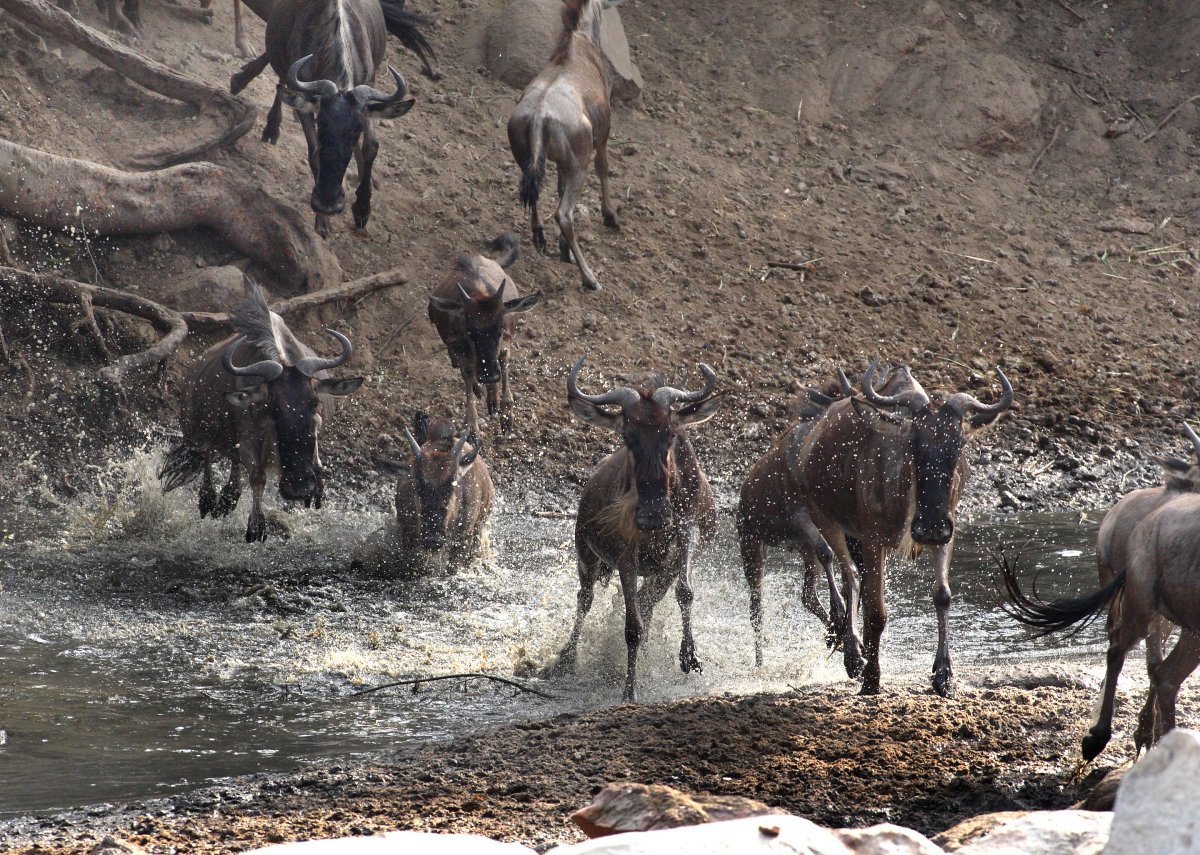
Lower down, in the grassy plains that cover most of the crater floor, groups of zebras and wildebeests are often spotted, and it is not uncommon to see lions lounging in the shade of the acacias. The crater permanently hosts about 25,000 large animals, including one of the few remaining populations of black rhinos still present in Tanzania. Looking towards the opposite rim, the crater wall stands out against the sky that shifts from blue to purple, creating an almost unreal perspective.
The sunset light and why it's worth the wait
The sunset at Ngorongoro is not simply an aesthetic fact: it is a matter of atmospheric physics and geography. The edge of the crater is located at an altitude between 2,200 and 2,400 meters above sea level, which means that the air is thinner and clearer compared to the underlying plains. This results in a particularly sharp quality of light during the golden hours, with more saturated colors and more pronounced shadows than what is observed at lower altitudes.
The morning fog that often envelops the bottom of the crater dissolves throughout the day, and at sunset the air is generally stable and clear. Photographers who visit the viewpoint in the late afternoon find ideal lighting conditions for about forty minutes before the sun disappears beyond the western edge of the caldera. The best time to position yourself is about an hour before the actual sunset, which in Tanzania varies between 6:30 PM and 7:00 PM depending on the season.
Practical Information for the Visit
Access to the Ngorongoro Conservation Area is subject to a fee: the entrance ticket cost for foreign visitors is around 70-80 US dollars per person per day, with rates updated periodically by the Tanzania National Parks Authority. To reach the viewpoint on the crater's edge, it is necessary to have a 4x4 vehicle with a driver-guide, as the dirt roads that traverse the rim require all-wheel drive, especially during the rainy season from March to May.
The most useful advice for those visiting at sunset is to book a lodge or camp on the crater's edge — there are several in the high-end market — to avoid having to descend into the valley after sunset, when visibility on the road decreases drastically. Those staying on the rim can simply walk to the nearest viewpoint from their accommodation. Alternatively, those staying in Arusha or other areas can arrange an afternoon visit with a return before sunset, following the guidelines of the local authorities that regulate traffic in the protected area.
The broader context: Ngorongoro in the Tanzanian park system
Ngorongoro is not a national park in the strict sense, but a conservation area with a particular management regime that allows the Maasai communities to continue grazing livestock on the edge of the crater, even if not inside the caldera itself. This coexistence between traditional human use and wildlife conservation is one of the elements that makes the place unique in its kind in Africa.
The viewpoint at sunset thus becomes something more than just a lookout: it is an observation point on an ecosystem that has endured for millennia, where the sunlight disappearing beyond the caldera closes each day a cycle that has been repeating since the volcano became dormant, long before any human being looked down from this edge.


