
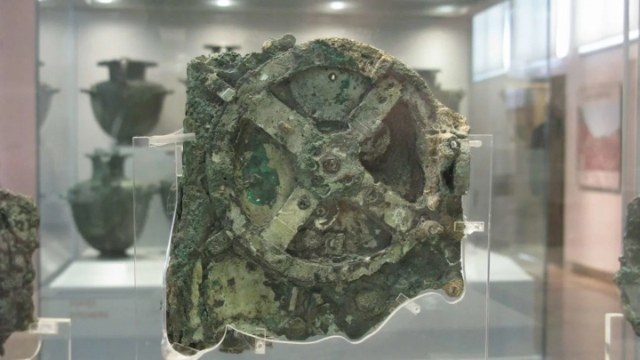

For over two millennia, a remarkable treasure lay hidden beneath the depths of the Mediterranean, off the coast of the Greek island of Antikythera. This treasure, a shipwreck laden with secrets, remained silent until the turn of the 20th century when sponge divers stumbled upon it. Among the sunken riches, they unearthed an astonishing device, an engineering marvel shrouded in mystery. Little did they know just how remarkable this find was.
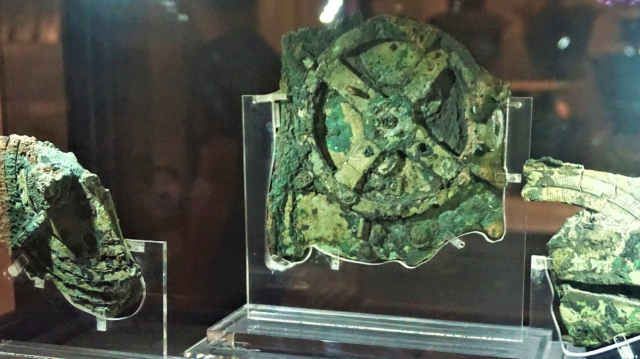
This enigmatic device, known as the Antikythera mechanism and often referred to as a "clockwork computer," is a small bronze instrument with an intriguing backstory. Crafted around 200 B.C., it boasts over 30 intricately designed gears concealed behind its intricate dials. Remarkably, it stands as the most technologically advanced artifact of its kind from the pre-Christian era. As the first-known analog computer, it can perform precise calculations based on the astronomical and mathematical principles established by the ancient Greeks.
For half a century, the Antikythera mechanism languished in a museum, a seemingly insignificant historical curiosity. However, it was only a matter of time before historians recognized its profound significance. The identity of its creator remains a mystery, as does its purpose aboard the ill-fated shipwreck. Nevertheless, over the course of a century, scientists and researchers have diligently worked to unravel the mechanism's history.
Interestingly, many experts doubt that the Antikythera mechanism served as a navigational tool. The hostile maritime environment would have jeopardized the delicate gears, and features such as eclipse predictions appear unnecessary for navigation. Instead, its compact size suggests that it was designed with portability in mind. According to some scholars, a more plausible theory is that the mechanism was employed for teaching astronomy to individuals with limited knowledge of the subject.
Operating the device was straightforward. You would input a date using a crank, and as the gears whirred to a halt, a wealth of information would emerge at your fingertips: the positions of the Sun, Moon, planets, and stars, the lunar phase, the dates of forthcoming solar eclipses, the Moon's speed across the sky, and even the dates of the Olympic games. Most impressively, the mechanism's calendar dial could adjust for the additional quarter-day in the astronomical year, shifting the scale back by one day every four years. It's worth noting that the Julian calendar, which introduced leap years to the region, came into effect decades after the device's construction.
While the Antikythera mechanism remains the sole known artifact of its kind, its precision engineering and references to similar instruments in contemporary texts suggest that it was not a one-of-a-kind creation. It's widely believed that the renowned inventor Archimedes of Syracuse may have constructed similar devices. Some theorists even link the instrument to the school of the esteemed astronomer Hipparchus. Whatever its origin, the attached written instructions on the instrument's face suggest a Greek influence.
Today, the Antikythera mechanism resides in the Bronze Collection of the National Archaeological Museum of Athens. A replica of the mechanism is on display at the American Computer Museum in Bozeman, Montana. Despite Jacques-Yves Cousteau's last visit to the shipwreck in 1978 revealing no additional pieces, the device continues to yield its secrets to the researchers of the Antikythera Mechanism Research Project—an international endeavor backed by various universities and technology companies. As time passes, the Antikythera mechanism's allure only grows, reminding us of the incredible ingenuity of those who came before us.


